


Fireballs and lightning, very, very frightening – or not!
Millions of lightning flashes occur worldwide every day. To help track active storms, EUMETSAT’s Meteosat Third Generation (MTG) satellite has been monitoring Europe, Africa and the Atlantic regions with its Lightning Imager (LI) since late 2024.
But not all that flashes in the sky is lightning.
From flicker to fireball
Seen from space, lightning events typically appear as dots of light around 10 km in diameter. They consist of rapid, chaotic bursts that vary strongly in position and intensity and are grouped together as a single flash.
But not all flashes in the sky are alike.
Niels Rubbrecht, an ESA Graduate Trainee who joined the Space Safety Programme’s Planetary Defence team in September 2025, has been studying the differences between lightning flashes and those produced by fireballs (bright meteors that burn up in the atmosphere). In collaboration with EUMETSAT’s Remote Sensing and Products (RSP) Division, he is developing a processing pipeline to systematically distinguish meteor-induced flashes from lightning using data from the MTG’s Lightning Imager (LI).
“EUMETSAT provided the images, data and infrastructure, while the Space Safety Programme provided the manpower. The plan is to openly release the fireball data in the near future,” adds ESA’s Planetary Defence Information Provision Coordinator, Juan Luis Cano.
After extensive data analysis, Niels saw that fireball flashes behave very differently. Rather than flickering in place, they carve a clear, linear path through the atmosphere. Their brightness evolves smoothly—gradually intensifying as they descend, before fading as they fragment or burn up. They also linger longer on the same detector pixels than lightning, leaving behind a distinct temporal signature.
These characteristics are clearly visible in an event detected on 22 January 2026 over the Gulf of Aden near the Arabian Sea, where MTG-LI captured a fireball brightening steadily before fading rapidly. This case provides a valuable reference pattern for identifying meteor events.
“It turned out that we were detecting very clear fireballs almost every day—sometimes even multiple per day!” Niels adds.
Not all fireballs appear equal

On 8 March of this year, many witnessed a bright fireball flash across the skies of central Europe.
Niels remembers that day well.
“I was travelling by train from my hometown in Belgium back to Frankfurt when I started receiving messages from friends and colleagues saying they had seen a massive fireball over Darmstadt and Frankfurt. Naturally, I was a bit disappointed to have missed it in person,” he recalls.
Yet the event was not missed entirely, for MTG-LI had been watching.
“My immediate reaction was to check whether we had detected it with LI,” Niels admits.
“To my surprise, we only saw a very faint signal — far weaker than I had expected,” he says. The event produced a very small signal in a single pixel of the instrument. “This highlighted an important point: observing fireballs from the ground in visible light and detecting them from space with a narrow‑band instrument designed for lightning are fundamentally different.”
The striking difference between the January and March fireballs highlights how much more we have yet to learn about geostationary fireball observations. “We are still uncovering the more subtle ways in which different types of fireballs appear in our data,” Niels says.
From lightning to insight


Access the video
With MTG‑LI collecting lightning data every millisecond — much of it containing false events — separating fireballs from lightning is no easy task. Niels likens the process to finding a needle in a haystack. But he also points out that “this is what makes the process so engaging.”
And global coverage is just the start.
“We are building a global inventory of fireballs, which helps us better understand the influx of material impacting Earth and, potentially, their origin,” says Niels. “This is crucial for planetary defence and for improving our knowledge of the small‑object population in near‑Earth space, including potentially hazardous asteroids.”
Beyond detection, the pipeline also allows scientists to reconstruct how a fireball’s brightness evolves during atmospheric entry. “This information can help constrain atmospheric entry models and may also support the recovery of meteorites,” Niels adds.
Together, these advances are turning fleeting flashes in the sky into valuable scientific insights—bringing us closer to understanding both the origins of these objects and their journey to Earth.
Towards near-global coverage
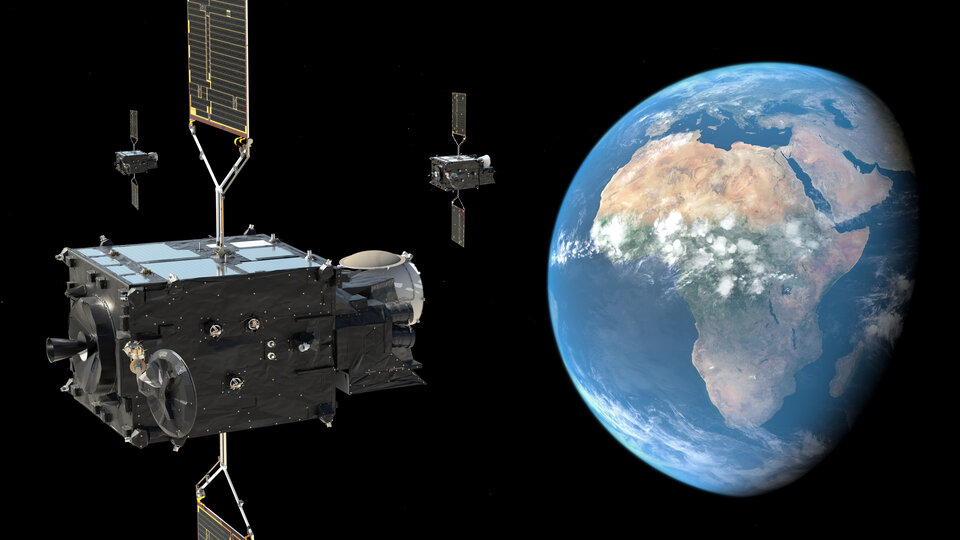
MTG‑LI’s ability to detect fireballs marks an important step towards near‑global coverage. Combined with NASA’s Geostationary Lightning Mapper (GOES‑GLM), MTG‑LI extends observations into the Eastern Hemisphere, enabling near‑global geostationary monitoring of fireball activity.
Niels expands on this by noting that ground‑based observations exist but are limited in coverage and cannot operate over remote regions such as oceans. “This is where space‑based detection adds clear value,” he adds.
This advantage is particularly evident over remote areas, like the one registered in January over the Gulf of Aden.
As MTG‑LI scans the millions of flashes lighting up our skies every day, it is uncovering much more than electric meteorological patterns alone. Because not every flash—however frightening—comes from lightning.