French meteorite challenges asteroid hazard models
An international research team including members of the European Space Agency's Near-Earth Object Coordination Centre have published a comprehensive study of an asteroid from discovery in space to the analysis of a recovered meteorite on Earth. The results highlight the importance of understanding how even small asteroids behave in our planet’s atmosphere.

Asteroid 2023 CX1 became the seventh asteroid ever observed prior to hitting Earth when it was detected on 12 February 2023, seven hours before impact.
It entered the atmosphere over Normandy, France, at 02:59 UTC on 13 February, within just a few tens of metres of the location predicted by ESA’s Near-Earth Object Coordination Centre (NEOCC).
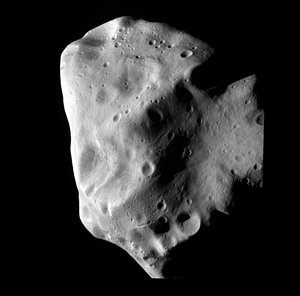
Roughly 72 cm wide and 650 kg in mass, it exploded at 28 km altitude, releasing nearly all of its energy in an instant.
Thanks to information on the asteroid’s trajectory shared by the NEOCC and others prior to impact, scientists and members of the public were able to witness and record the fireball.
A few days later, members of the Vigie-Ciel project, part of the Fireball Recovery and InterPlanetary Observation Network (FRIPON), recovered a fragment of the object near the city of Rouen and named the meteorite Saint-Pierre-Le-Viger.
☄️@esaoperations reported a 1 m meteoroid before it entered Earth's atmosphere over northern France early this morning: only the 7th time an #asteroidimpact has been predicted - but a sign of the rapid advances in global detection capabilities! #Fireball #Sar2667 https://t.co/MzYoIkRaF2
— European Space Agency (@esa) February 13, 2023
Now, an international team of researchers has published an analysis of the object in Nature Astronomy, making it the first meteorite of its type (L-type chondrite) to be studied from discovery in space to the laboratory on Earth. Led by Auriane Egal (Montreal Planetarium, FRIPON/Vigie-Ciel), the study highlights the importance of understanding how asteroids behave in Earth’s atmosphere.
Unlike most small asteroids, which break up higher in the atmosphere, 2023 CX1 fragmented lower, more suddenly, and generated a spherical shock wave that delivered more energy to the ground than is typical for an object of its size. The study suggests that certain types of asteroid, even when small, can survive deep into the atmosphere and prove potentially hazardous if they break up over urban areas.

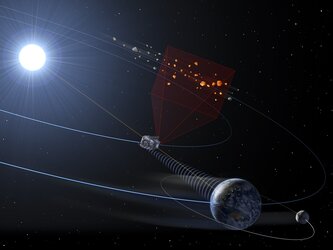
Astronomers at ESA’s NEOCC are co-authors on the study: “We coordinated observations of asteroid 2023 CX1 during the seven hours between discovery and impact and used them to accurately predict its impact location, which enabled people to witness the fireball and recover the meteorite,” says ESA astronomer Marco Micheli.
“Later, we used these and other observations to precisely calculate the object’s pre-impact trajectory and help researchers trace it back to a likely parent body in the main asteroid belt.”
“We have confirmed the existence of a new population of asteroids linked to L-type chondrites, capable of fragmenting abruptly in the atmosphere and releasing almost all their energy at once. Such asteroids must be accounted for in planetary defence strategies,” explains Auriane Egal.
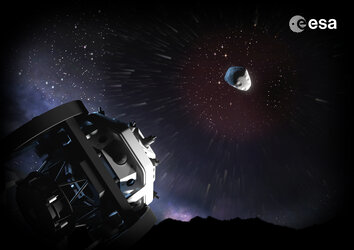
ESA’s upcoming Flyeye asteroid survey telescopes will scan the sky every night in an effort to spot incoming space rocks like 2023 CX1 earlier and more often. The first Flyeye is expected to enter operation next year.
Read the study in Nature Astronomy: Catastrophic disruption of asteroid 2023 CX1 and implications for planetary defence
Relive ESA’s social media coverage of asteroid 2023 CX1: Asteroid discovery | Fireball | Meteorite recovery