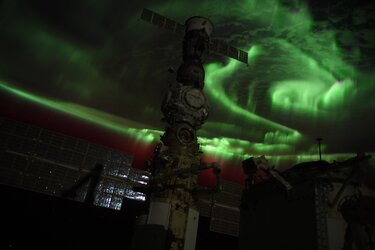
Space weather mission Sawa reveals Polish roots
The European Space Agency’s (ESA) Sawa mission is its second space weather nanosatellite mission. Sawa will primarily watch the thermosphere in situ from Earth orbit, observing how space weather causes the atmospheric layer to warm up and expand, pushing satellites off course.

Sawa is to be built by Polish prime contractor Creotech and is expected to launch in 2029.
ESA and Creotech celebrated the contract between prime contractor Creotech and ESA for the Sawa mission at the Warsaw Security Forum, underlining the strong connection of the mission with Poland. The certificate was signed by Creotech CEO Grzegorz Brona, Minister of Finance and Economy of Republic of Poland Andrzej Domański, ESA Director General Josef Aschbacher and ESA Director of Operations Rolf Densing.
Sawa’s mission patch

Sawa’s name is derived from an origin myth about the founding and etymology of the city of Warsaw, the capital of Poland. According to legend, Sawa was a mermaid living in the Vistula River, falling in love with a fisherman named Wars, together making Warsaw. She became the city’s guardian, and for generations, the mermaid Sawa has symbolised protection, vigilance and resilience. The name Sawa is therefore very fitting for this mission that will contribute to protecting our planet and critical infrastructure from space weather events.
The mission now has the Polish company Creotech as its prime contractor, inspiring the local nature of its name. On 12 October 2026, Sawa’s brand new mission patch was therefore revealed in the most fitting of places: Warsaw.
Watching the Sun’s effects around Earth


Access the video
“The Sawa mission will improve our understanding of the effects of the Sun’s activity on our magnetosphere, the thermosphere and the ionosphere system, a layer of Earth’s atmosphere,” says Stefan Kraft, Sawa project manager at ESA.
“The in situ data it collects will help improve the understanding of the interactions and dynamic, which are driven by the space weather conditions. The modelling of the current flow and resulting particle densities is also important to understand how much the orbit of active spacecraft and space debris degrade as a result, leading to their eventual reentry and burning up into the atmosphere. In the longer term, a constellation based on Sawa’s demonstration mission can also support space traffic management solutions.”
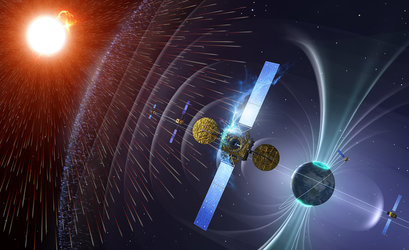
Sawa will measure properties of the thermosphere directly in orbit, with a much higher accuracy than currently possible, as well as measure Earth’s magnetic field. The data collected by Sawa will be fed into models and services that provide space weather alerts, forecasting tools and other data products. Its measurements will be complementary to two other ESA space weather missions targeting Earth’s ionosphere: Swing and Aurora-D, the latter being a remote sensing satellite that looks at auroral emissions to determine the impact of space weather on the ionosphere.
After Sawa and Swing are successful, they can be expanded into constellations of satellites, creating a distribution of measuring points around Earth at any time, improving coverage and adding depth to the space weather services and space debris modelling.
Building a network of sensors

“Individually, nanosatellites provide an innovative opportunity to implement cost-effective, targeted space missions. As a constellation, they have the potential to form an effective part of the European space weather monitoring system,” says Juha-Pekka Luntama, Head of Space Weather at ESA.
“Solar storms can’t be stopped, but if we combine the data from different satellites, including nanosats like Sawa, each monitoring different aspects of our atmosphere, we can deliver comprehensive space weather services that can help us mitigate the effects of such storms.”
ESA’s space weather missions Aurora, Swing and Sawa – all part of ESA’s Space Safety programme – along with sensors onboard other satellites and on Earth’s surface, will feed data into space weather forecasts, alerts and other tools. Together, these services will help Europe protect its industries such as aviation, satellite navigation and power grids from disruption.
Sawa’s timeline
Development of Sawa has now been kicked off in earnest, with launch being prepared for 2029. Data provision is expected to begin a few months later via the ESA Space Weather Portal.