


When the Sun disrupts aviation
Earlier this month, Airbus reported that one of its aircraft experienced disruptions linked to ‘intense solar radiation’. Space weather impacts aviation in many ways, posing risks to flight operations.
Solar activity, whether from our Sun or other stars, shapes the environmental conditions in space and around our planet. This phenomenon, known as space weather, can create impressive auroras in the night sky but also poses serious threats to our technology-dependent society. Aircraft are vulnerable to these disturbances, as they fly at high altitudes beyond the full protection of Earth’s atmosphere.
One phenomenon has recently drawn attention for its impact on aircraft electronics: energetic charged particles.

When these particles originate from the Sun, they are known as Solar Energetic Particles (SEP). Released at nearly the speed of light, they form a cloud of protons, electrons, and alpha particles, which, upon reaching Earth, can trigger cascades of secondary particles in the atmosphere. Our Sun is not the only source of such particles, others, called Galactic Cosmic Rays (GCR), arrive from outside our solar system as the result of distant supernova explosions.
“Such energetic particle events with the energies needed to reach aircraft altitude are quite rare in recent solar cycles. The event we had in November 2025 was the most significant in almost 20 years according to some experts and, so far, no major impacts on the aviation sector have been reported,” says Alexi Glover, ESA Space Weather Service Coordinator.
Rare effects on aviation
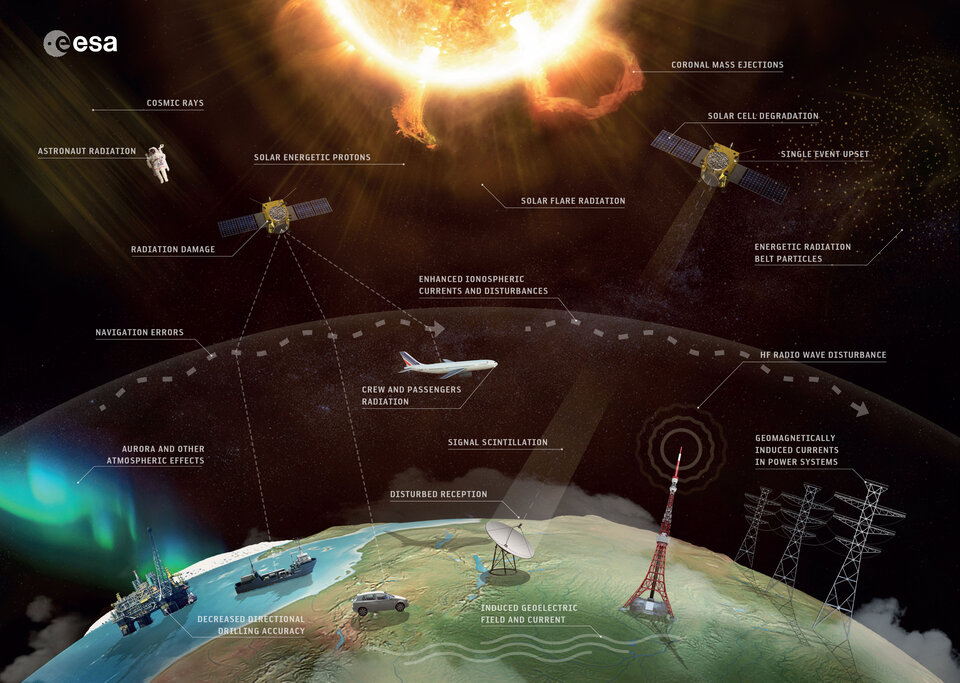
The consequences of these particles on electronic components can range from minor to severe. Minor effects can be as simple as a ‘bit flip’ in an onboard computer - a 0 turning into a 1 or vice versa - causing a malfunction that requires a software reset.
In the worst case, the radiation strike is so intense that the components of the electronics fail completely and must be replaced. Cases of the latter have been reported on satellite hardware, yet none in aviation.
No communication, no navigation
In the case of an extreme, once-in-a-century solar storm, individual aircraft would not be the only ones affected, but the entire aviation sector, from traffic control to airports. Because of multiple backup systems, aviation safety would not be compromised, but the efficiency of the operation would suffer causing substantial economic losses and personal discomfort to passengers due to delayed and cancelled flights.
Radio bursts from the Sun and changes in the upper atmosphere can provoke large-scale radio blackouts, severely affecting the ability of aircraft and flight control to communicate. Such disturbances would be particularly severe for flights through the polar regions and over the oceans, where alternative communication options might not be available.
A solar storm would also impact the ionosphere, the upper layer of the atmosphere which, when disturbed, can seriously degrade radio communications and satellite navigation signals. Intermittent GNSS failures and positioning errors would take place, forcing aircraft to rely on backup navigation systems, such as gyroscopes and accelerometers, ground-based radio beacons, and paper charts.
New tools at the service of aviation
Space weather cannot be prevented, but its effects can be mitigated. While certain impacts, such as radio blackouts or GNSS outages, cannot be fully avoided, advanced forecasting enables airlines and air traffic control to adjust flight plans and manage airspace proactively. Accurate forecasts can also help flight crews to prepare for potential disturbances and take efficient action, when needed.

The European Space Agency (ESA) plays a key role in this effort, monitoring solar activity and collecting data from a network of sensors and forecasting models operated by partner agencies and institutes. This information is available via ESA’s Space Weather Service Portal, which provides tailored tools and models for sectors affected by space weather.
The portal features a dedicated aviation service that offers tools designed to help airlines, pilots, and dispatchers anticipate disruptions. The service includes a special tool, AVIDOS, to calculate the expected radiation dose for any flight. It also indicates whether there is an energetic particle event ongoing thanks to measurements from ground-based neutron monitors.
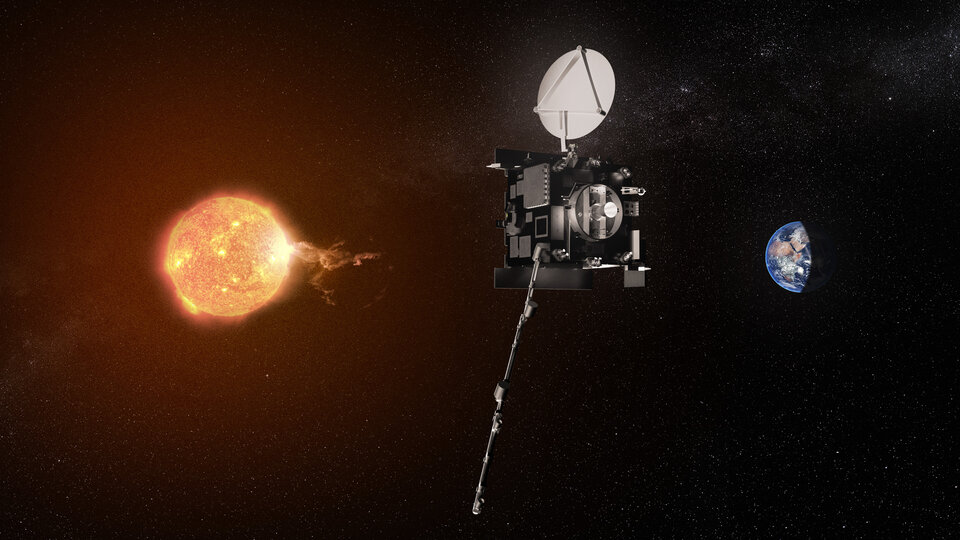
To strengthen these capabilities, ESA is developing the Vigil mission, which will provide timely warning of extreme solar events by introducing a new way of watching the Sun. Observing the Sun’s ‘side’ from Lagrange Point 5, ESA’s Vigil will provide continuous insight into solar activity and monitor space weather conditions close to the Sun–Earth line. Scheduled for launch in 2031, Vigil will detect potentially hazardous solar events before they rotate into Earth view, giving us early knowledge of their characteristics and valuable time to protect spacecraft and critical ground infrastructure.
Other upcoming ESA missions will offer accurate and timely information about ongoing and expected impacts of solar storms and facilitate the provision of actionable data for the protection of sensitive, critical infrastructure.

Access the video