Mercury Magnetospheric Orbiter
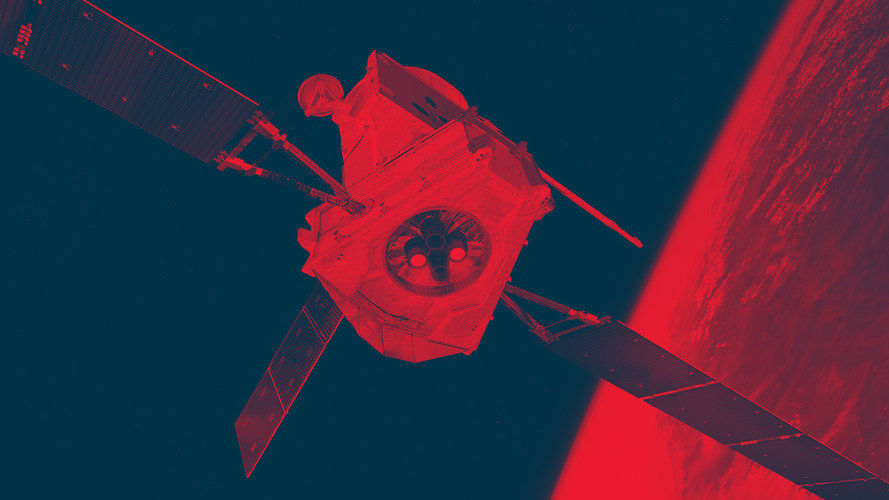
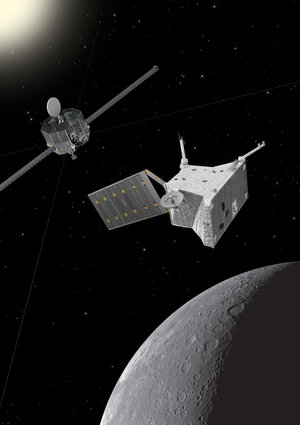
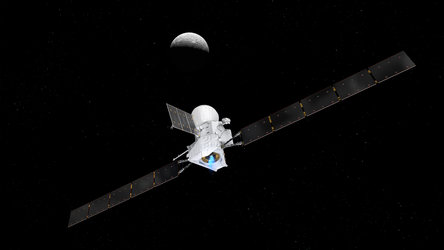
JAXA’s Mercury Magnetospheric Orbiter (also known as Mio) is one of two spacecraft making up the BepiColombo mission to Mercury, the other being ESA's Mercury Planetary Orbiter (MPO).
Mio will operate from a 9.3-hour elliptical polar orbit that will take it between 590 and 11 640 km above the planet’s surface.
The spacecraft's main body is an octagonal prism measuring 1.1 m in height and 1.8 m in diameter. Two 5-metre-long masts stick out its sides, as well as four 15-metre antennas.
Mio stabilises itself by spinning, making 15 rotations per minute with its spin axis 90° to the Sun. This also distributes the Sun's heat over its solar cells.
Throughout the journey to Mercury, Mio is mounted on top of MPO and unable to spin. Instead, it is protected by the 1.8 x 3 m Magnetospheric Orbiter Sunshield and Interface Structure (MOSIF). This ESA-built component provides thermal protection as well as mechanical and electrical interfaces for Mio. MOSIF will be discarded after the two orbiters arrive at Mercury and separate from one another.

MMO has five science instruments:
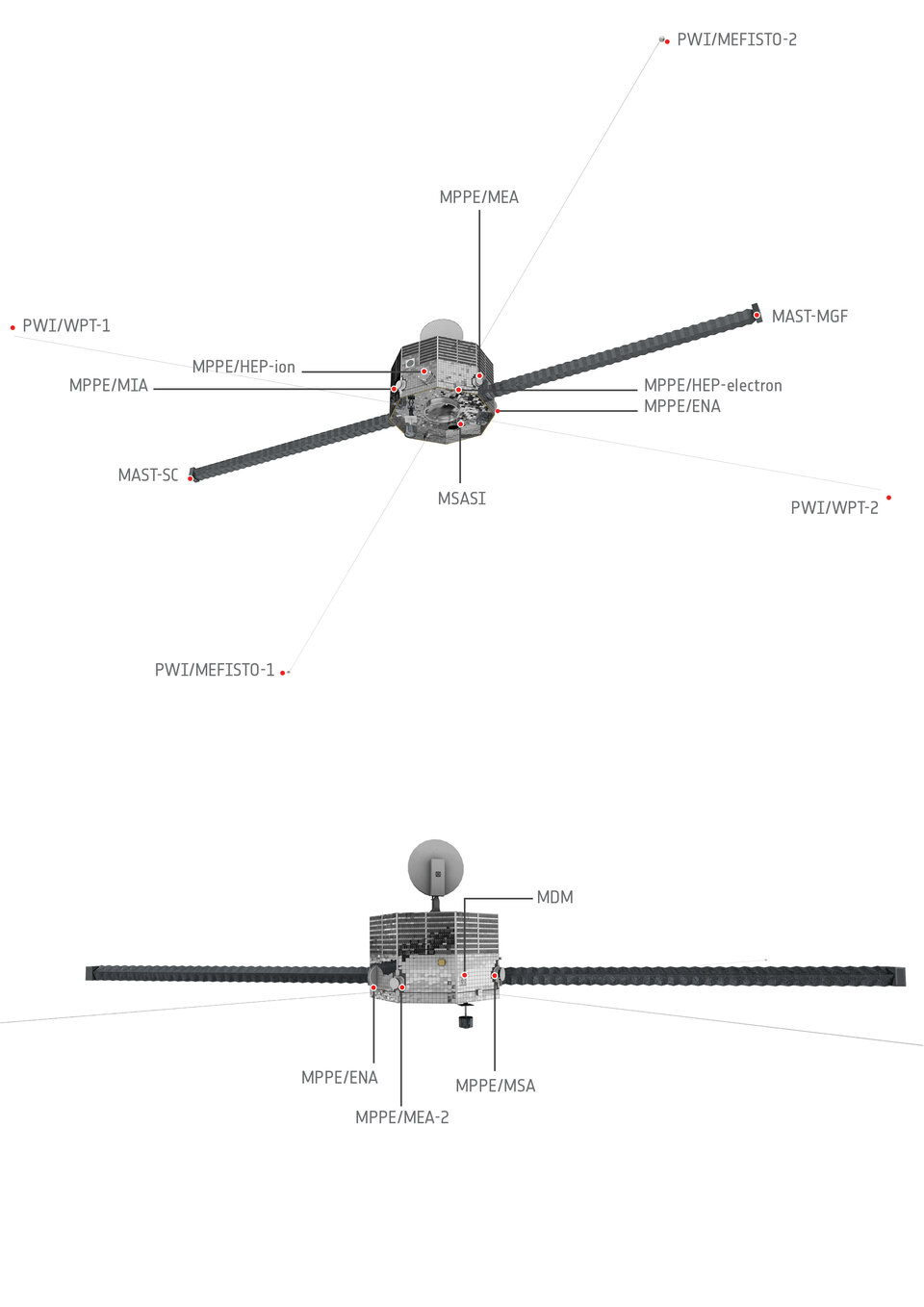
Magnetic Field Investigation (MMO-MGF): Providing a detailed description of Mercury’s magnetosphere and of its interaction with the planetary magnetic field and the solar wind. Principal Investigator: Daniel Schmid, Austrian Space Science, Graz, Austria.
Mercury Plasma Particle Experiment (MPPE): Seven sensors studying plasma and energetic particles in the magnetosphere and the interaction between the solar wind and Mercury’s magnetosphere. Principal Investigator: Yoshifumi Saito, Institute of Space and Astronautical Science, Kanagawa, Japan.
Plasma Wave Instrument (PWI): In situ and remote-sensing analysis of electric fields, plasma waves and radio waves in Mercury’s plasma environment. Principal Investigator: Yasumasa Kasaba, Tohoku University, Sendai, Japan.
Mercury Sodium Atmosphere Spectral Imager (MSASI): Measuring the abundance, distribution and dynamics of sodium in Mercury’s exosphere to investigate its sources and related processes. Principal Investigator: Ichiro Yoshikawa, University of Tokyo, Japan.
Mercury Dust Monitor (MDM): Studying the distribution of interplanetary dust in the orbit of Mercury. Principal Investigator: Masanori Kobayashi, Chiba Institute of Technology, Japan.