• → European Space Agency

      • Space for Europe
      • Space News
      • Space in Images
      • Space in Videos
    • About Us

      • Welcome to ESA
      • DG's News and Views
      • For Member State Delegations
      • Business with ESA
      • ESA Exhibitions
      • ESA Publications
      • Careers at ESA
    • Our Activities

      • Space News
      • Observing the Earth
      • Human Spaceflight
      • Launchers
      • Navigation
      • Space Science
      • Space Engineering
      • Operations
      • Technology
      • Telecommunications & Integrated Applications
    • For Public

    • For Media

    • For Educators

    • For Kids

    • ESA

    • Education

    • Teachers' Corner

    • ESA Kids

    • About ESA Education
    • Education programme
    • International collaboration
    • Projects for Teachers
    • European Space Education Resource Office
    • CanSats
    • Hands-on Projects
    • CubeSats
    • Drop Your Thesis!
    • European Student Earth Orbiter
    • European Student Moon Orbiter
    • Fly Your Thesis!
    • Global Educational Network for Satellite Operations
    • Spin Your Thesis!
    • Previous projects
    • Hands-on Collaboration
    • REXUS/BEXUS rocket & balloon experiments
    • GENSO Experimental Orbital Initial Demonstration
    • Previous projects
    • Opportunities
    • Conferences
    • Courses
    • Gaining experience
    • Affiliation programme
    • Subscribe for news

    ESA > Education

    Microgravity and drop towers

    Everything on Earth’s surface is subject to an average gravitational acceleration (g) of 9.81 m/s2. Gravity determines nearly all physical, chemical and biological phenomena occurring on our planet. It is fundamental to all natural processes around and within us, from the distribution of water and vegetation on our planet to the way that living organisms look and function. Furthermore, gravity is also a primary influence on all human technological developments.

    Zero gravity (0 g) is a theoretical concept that cannot exist. This is because gravity is a fundamental force with infinite reach between bodies. As a consequence, gravitational accelerations, however small, always exist. Objects in free fall (only exposed to gravitational forces) experience weightlessness. However, in practice, it is not easy to completely remove other non-gravitational forces, such as air drag or solar pressure. Therefore, the term “microgravity” is used. Microgravity is expressed as a fraction of g (from 10-2 to 10-6 g).

    Scientific research in microgravity allows us to ask some important questions. What happens to basic physical, chemical and biological processes in the absence of this directional force? What does this teach us about the processes in the universe, on our Earth and even inside bodies? Can these insights lead to greater awareness and technological improvements?

    There are many different platforms for performing scientific or technological experiments in microgravity. The most obvious examples are manned or unmanned platforms in orbit above the Earth. While this offers microgravity conditions of unlimited duration, the cost and time associated with developing and sending payloads into space make this option difficult.

    Terrestrial-based options include sounding rockets, parabolic flights and drop towers. The first two of these offer microgravity of several seconds to minutes, but preparation times and costs are still relatively high.

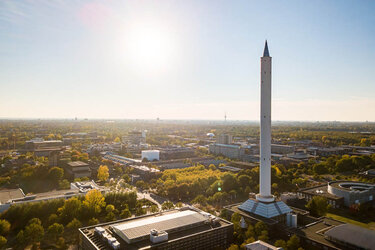
    Drop towers offer the best microgravity levels - as low as 10-6 g - and are the most flexible and adaptable platforms for many scientific experiments. Not only are they available for 300 working days every year, but they allow the experiment hardware to be changed at short notice and the experiment set-up to be adjusted or improved between drops. Drop towers also offer reliable and accurate monitoring of experiments, allowing both data upload and download during the experiment.
    Rate this

    Views

    Share

    • Currently 0 out of 5 Stars.
    • 1
    • 2
    • 3
    • 4
    • 5
    Rating: 0/5 (0 votes cast)

    Thank you for rating!

    You have already rated this page, you can only rate it once!

    Your rating has been changed, thanks for rating!

    16
    facebook
    twitter
    reddit
    google plus
    digg
    tumbler
    digg
    blogger
    myspace
    • More information
    • Drop Your Thesis!
      • Microgravity and drop towers
        • ZARM drop tower
        • Research opportunities
        • Past experiments
          • Eligibility criteria
          • 2013 schedule
            • List of documents
              • How to apply
              • Documents
              • Experiment proposal
              • Experiment report
              • European user Guide to Low-Gravity Platforms
              • ZARM users manual
              • Terms and conditions
              • Erasmus Experiment Archive
              • Meet the teams
              • GAGa DropT (2012)
              • Falling Roots (2011)
              • BubJet (2010)
              • Physics Addicted (2009)
              • Related news
              • 2013 call for proposals
              • 2012 campaign
              • 2012 team selected
              • 2011 campaign
              • 2011 team selected
              • 2010 campaign
              • 2010 team selected
              • Related Links
              • ELGRA
              • ZARM - Center of Applied Space Technology and Microgravity
              • Register for ESA Education projects

    Connect with us

    • RSS
    • Youtube
    • Twitter
    • Flickr
    • Google Buzz
    • Subscribe
    • App Store
    • LATEST ARTICLES
    • · CryoSat hits land
    • · Ariane 5 completes seven launches …
    • · Measuring skull pressure without t…
    • · Malargüe station inauguration
    • · The solar wind is swirly
    • FAQ

    • Jobs at ESA

    • Site Map

    • Contacts

    • Terms and conditions