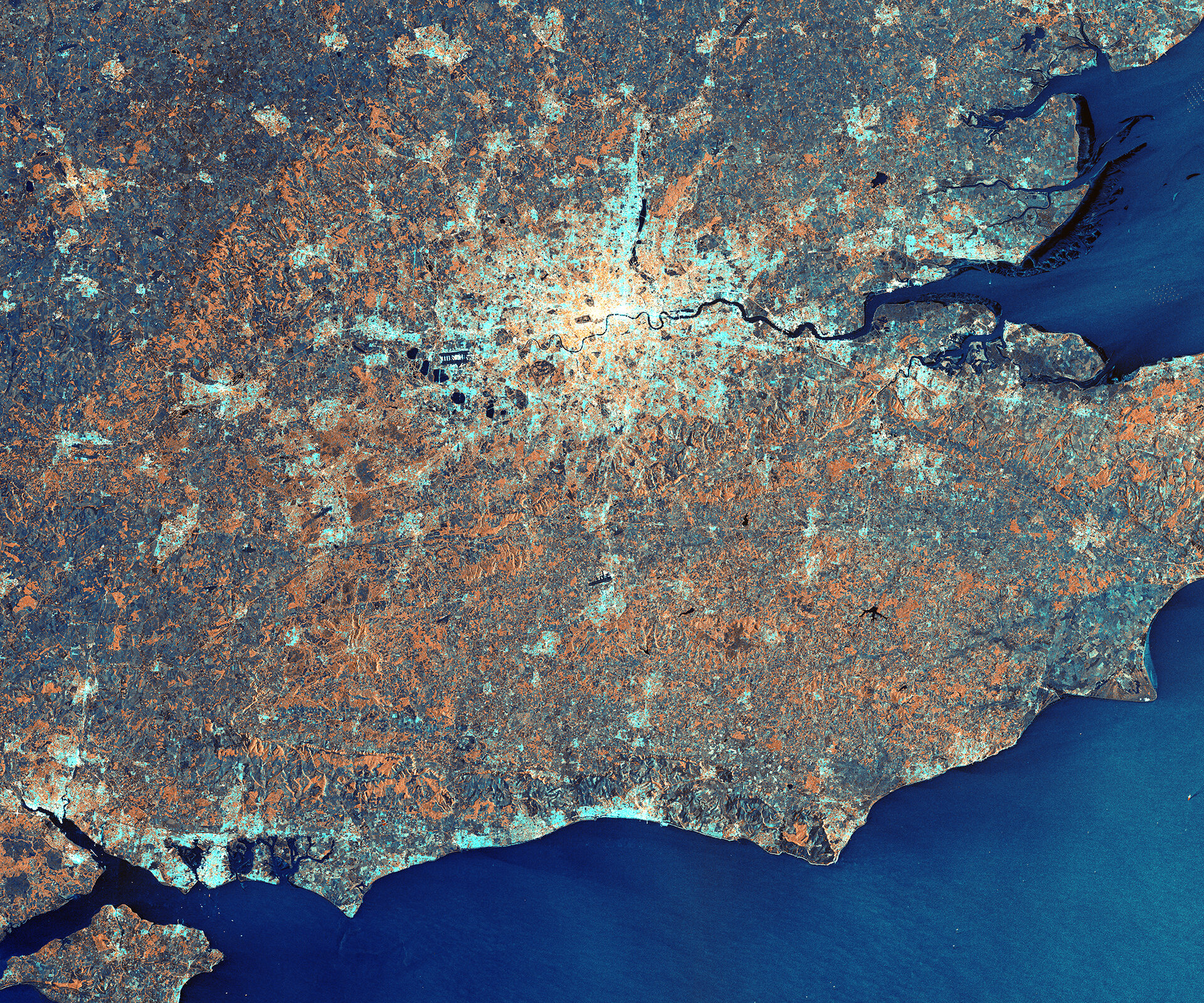
London appears as a cluster of bright radar reflections along the River Thames in this radar image from Sentinel-1A. The satellite captured this image on 4 March 2015 in its Interferometric Wide Swath mode and dual polarisation, from which the artificial colour composite was generated.
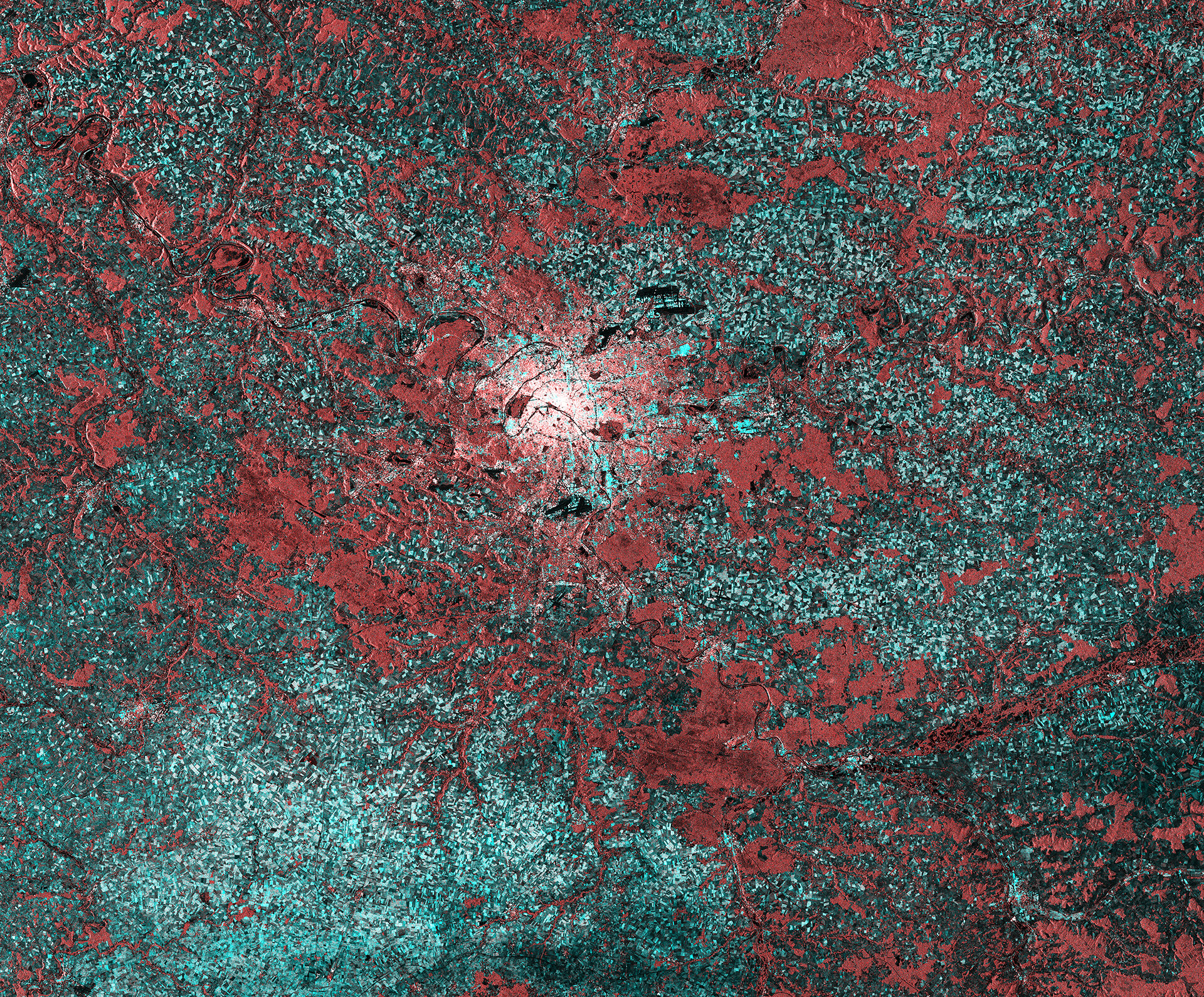
Paris appears as a cluster of bright radar reflections along the Seine River in this radar image from Sentinel-1A. The satellite captured this image on 2 March 2015 in its Interferometric Wide Swath mode and dual polarisation, from which the artificial colour composite was generated.
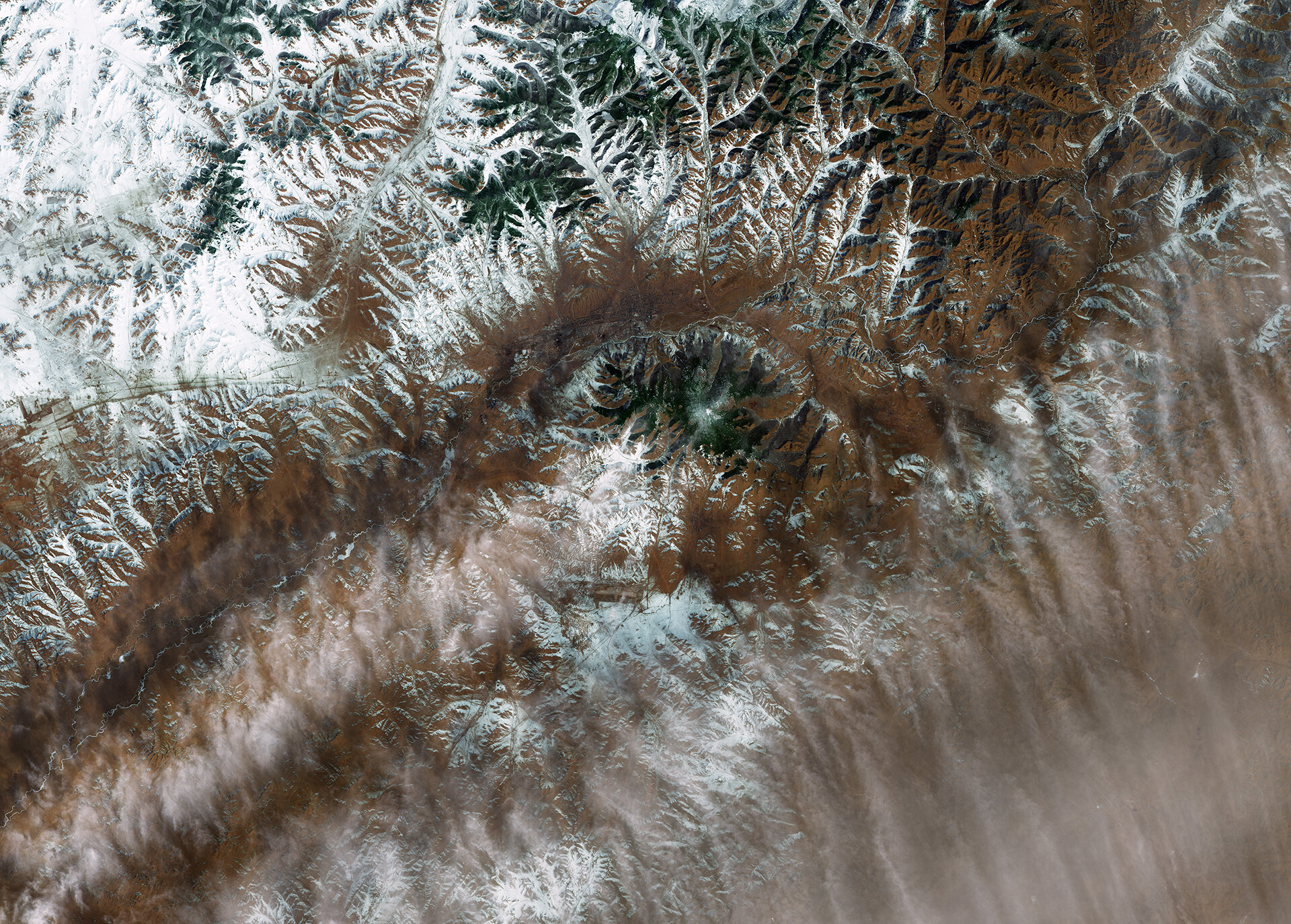
The Mongolian capital of Ulan Bator is captured in this image from the Landsat-8 satellite.
Sitting in the valley of the Tuul River – running northeast to southwest across the image – the city is flanked by the Bogd Khan Mountain to its south (centre of image). This forested mountain is the site of one of the oldest national parks in the world, home to wildlife such as foxes and wolves and endangered species of hare and deer.
South of the mountain, a light covering of clouds blanket the steppe ecoregion. This is part of the greater Eurasian Steppe, stretching from Moldova through Siberia, characterised by grasslands, savannahs and shrublands.
The area pictured is also part of the discontinuous permafrost zone, meaning that in some areas the ground is frozen year round, while other areas thaw for weeks or months at a time.
This poses a challenge for building, so many suburban residents of Ulan Bator live in traditional dwellings that are built on top of the soil. These circular houses – called yurts – are traditionally made from steam-bent wood and covered in layers of fabric for insulation.
This image, also featured on the Earth from Space video programme, was acquired on 19 February by the Landsat-8 satellite.
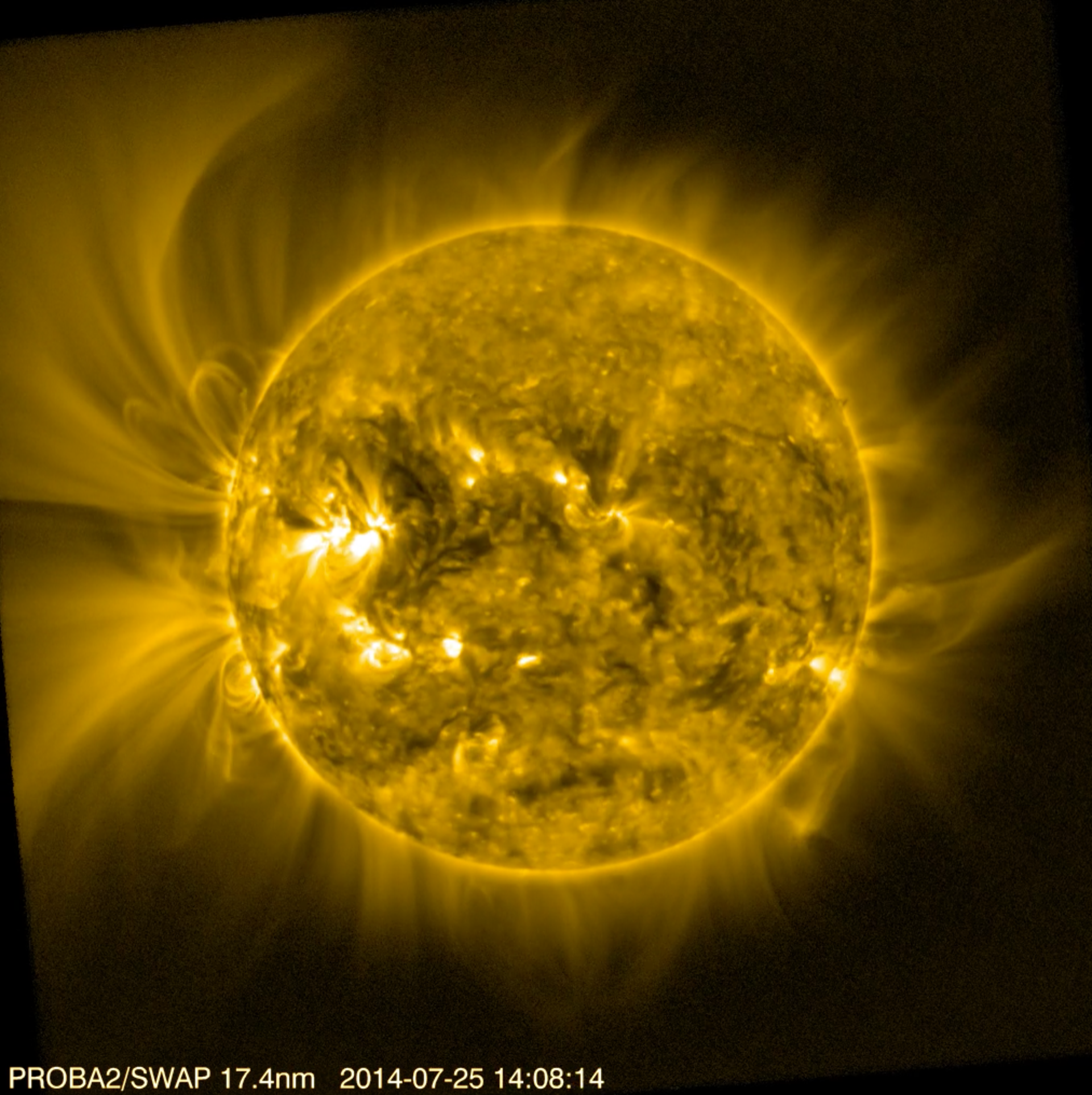
This snapshot of our constantly changing Sun catches looping filaments and energetic eruptions on their outward journey from our star’s turbulent surface.
The disc of our star is a rippling mass of bright, hot active areas, interspersed with dark, cool snaking filaments that wrap around the star. Surrounding the tumultuous solar surface is the chaotic corona, a rarified atmosphere of super-heated plasma that blankets the Sun and extends out into space for millions of kilometres.
This coronal plasma reaches temperatures of several million degrees in some regions – significantly hotter than the surface of the Sun, which reaches comparatively paltry temperatures of around 6000ºC – and glows in ultraviolet and extreme-ultraviolet light owing to its extremely high temperature. By picking one particular wavelength, ESA’s Proba-2 SWAP (Sun Watcher with APS detector and Image Processing) camera is able to single out structures with temperatures of around a million degrees.
As seen in this image, taken on 25 July 2014, the hot plasma forms large loops and fan-shaped structures, both of which are kept in check by the Sun’s intense magnetic field. While some of these loops stay close to the surface of the Sun, some can stretch far out into space, eventually being swept up into the solar wind – an outpouring of energetic particles that constantly streams out into the Solar System and flows past the planets, including Earth.
Even loops that initially appear to be quite docile can become tightly wrapped and tangled over time, storing energy until they eventually snap and throw off intense flares and eruptions known as coronal mass ejections. These eruptions, made up of massive amounts of gas embedded in magnetic field lines, can be dangerous to satellites, interfere with communication equipment and damage vital infrastructure on Earth.
Despite the Sun being the most important star in our sky, much is still unknown about its behaviour. Studying its corona in detail could help us to understand the internal workings of the Sun, the erratic motions of its outer layers, and the highly energetic bursts of material that it throws off into space.
Two new ESA missions will soon contribute to this field of study: Solar Orbiter is designed to study the solar wind and region of space dominated by the Sun and also to closely observe the star’s polar regions, and the Proba-3 mission will study the Sun’s faint corona closer to the solar rim than has ever before been achieved.
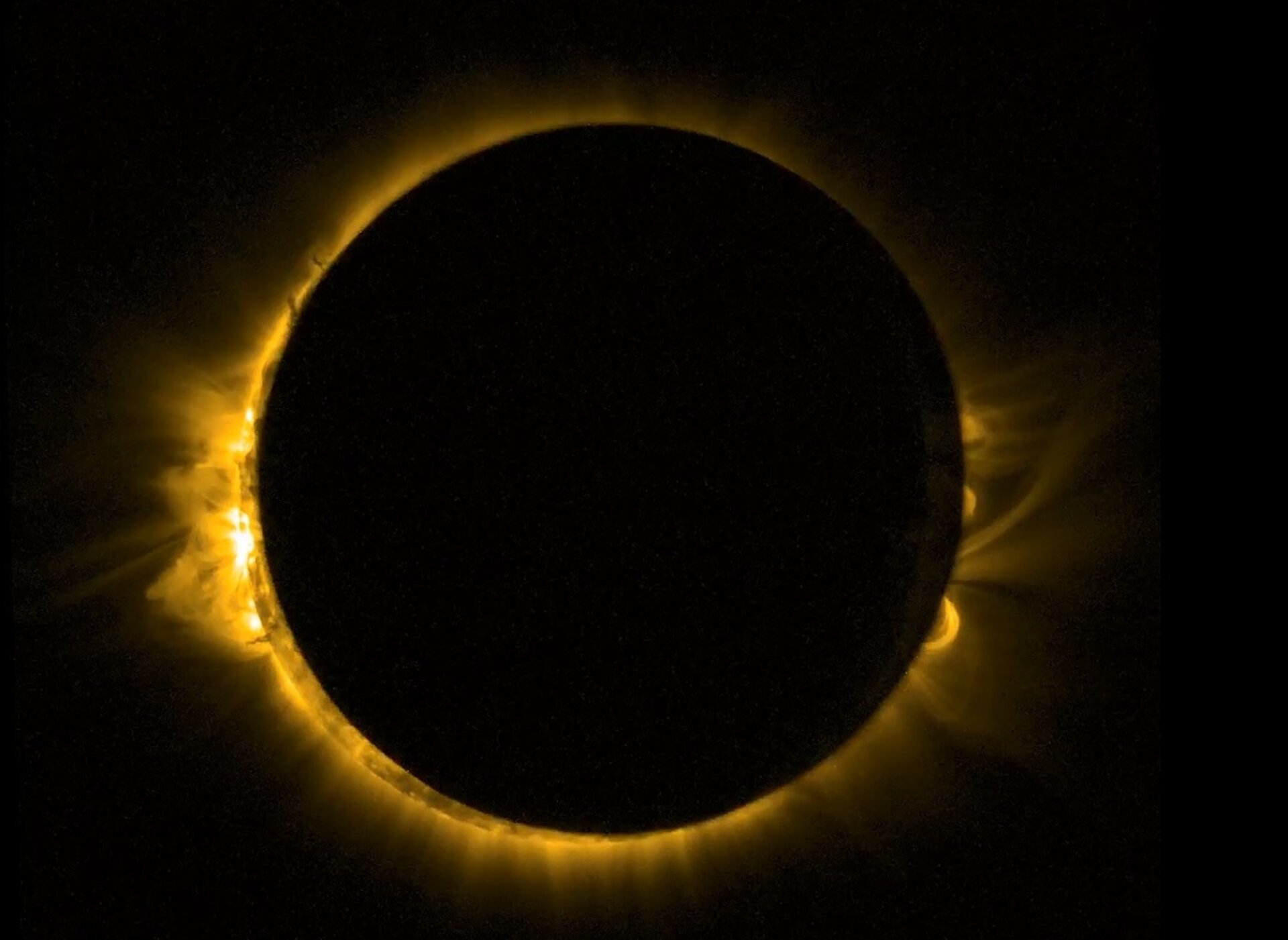
As Europe enjoyed a partial solar eclipse on the morning of Friday 20 March 2015, ESA’s Sun-watching Proba-2 minisatellite had a ringside seat from orbit. Proba-2 used its SWAP imager to capture the Moon passing in front of the Sun in a near-totality. SWAP views the solar disc at extreme ultraviolet wavelengths to capture the turbulent surface of the Sun and its swirling corona. Click here to see the footage.
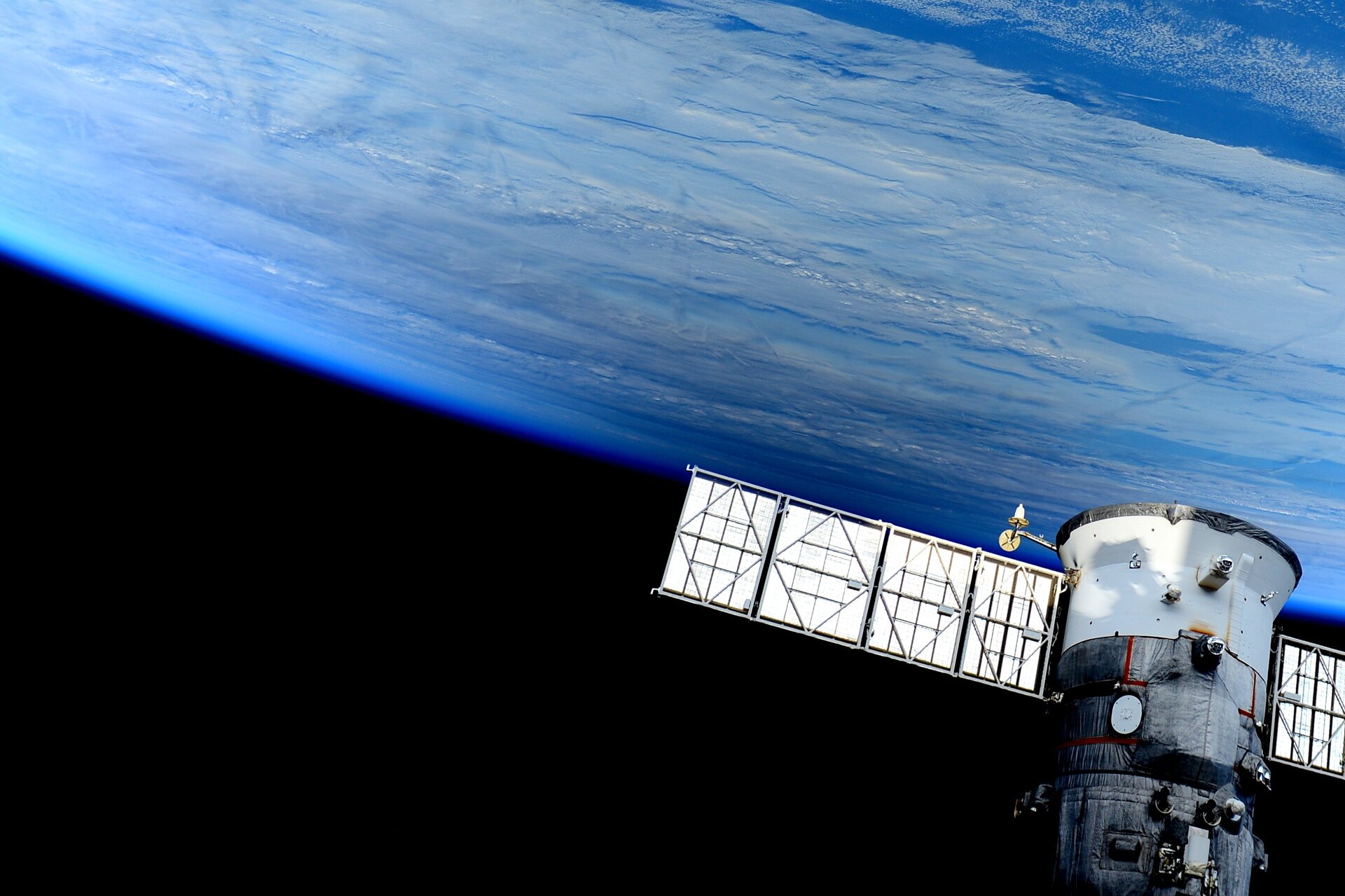
ESA astronaut Samantha Cristoforetti took this image of Earth from the International Space Station on 20 March 2015. As Europe enjoyed a partial solar eclipse parts of our planet were shrouded in the Moon's shadow which can be seen faintly in this image.
Samantha took this picture in between operations for an experiment with the Station's centrifuge.
See the complete set of solar eclipse pictures on Samantha's Flickr page.
Connect with Samantha and her Futura mission at: samanthacristoforetti.esa.int
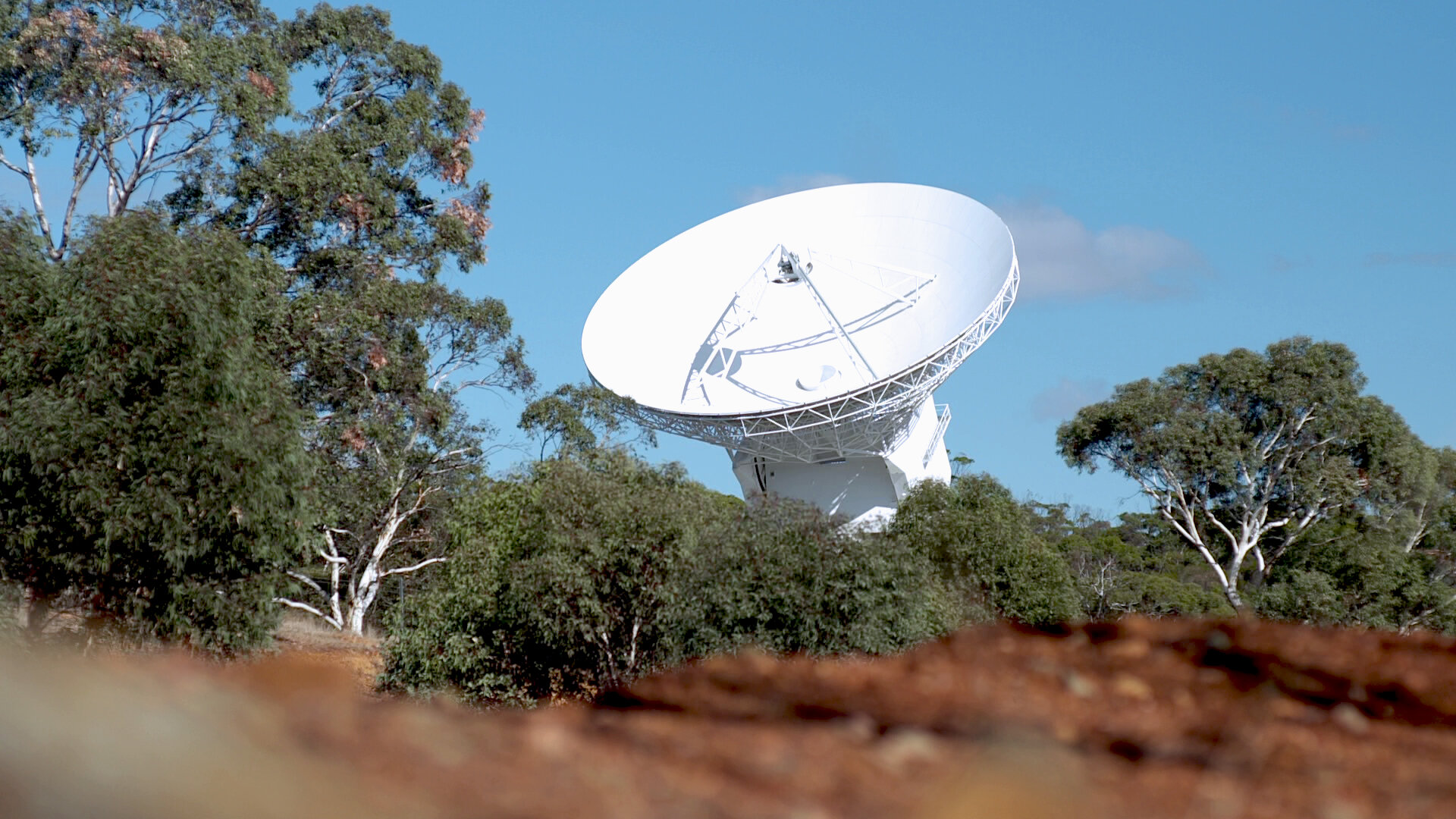
Twelve years ago this month, in March 2003, ESA inaugurated a new deep-space ground tracking station 8 km south of the town of New Norcia, which is about 150 km north of Perth, in Western Australia.
The large, 35 m-diameter antenna was completed in 2002, and engineers conducted pointing tests using NASA’s Stardust mission in the lead up to operational readiness. It entered service as the first of the Agency’s three deep-space ground tracking stations in March 2003, and has been used for communications with Mars Express, Rosetta, Venus Express and Gaia, among other ESA and partner agency missions.
The mechanical movable structure weighs 580 tonnes. Engineers can point it with a speed of 1 degree per second in both horizontal and vertical axes. Its control system provides extremely high pointing accuracy under the site’s difficult environmental, wind and temperature conditions.
In 2005 and 2012, ESA inaugurated two more deep-space stations, at Cebreros in Spain and Malargüe in Argentina, providing global, 360° coverage, 24 hours per day.
Like the other two, the New Norcia antenna is one of the largest in the world for spacecraft tracking and control. It is essential for high-performance communications with spacecraft deep in our Solar System and in highly elliptical orbits that take them far from Earth.
The three stations are part of the Agency’s Estrack tracking station network, a worldwide network linking satellites in orbit and ESA’s Space Operations Centre, ESOC, in Darmstadt, Germany.
The essential task of all ESA tracking stations is to communicate with our missions wherever they go, uplinking commands and downlinking scientific data and spacecraft status information. Estrack stations also gather ‘radiometric’ data to help mission controllers know the location, trajectory and velocity of their spacecraft.
In 2015, Estrack celebrates its 40th anniversary, marking four decades since the 1975 decision to start providing tracking services for ESA missions using an antenna at Villafranca, Spain.
More information
Estrack ground station network
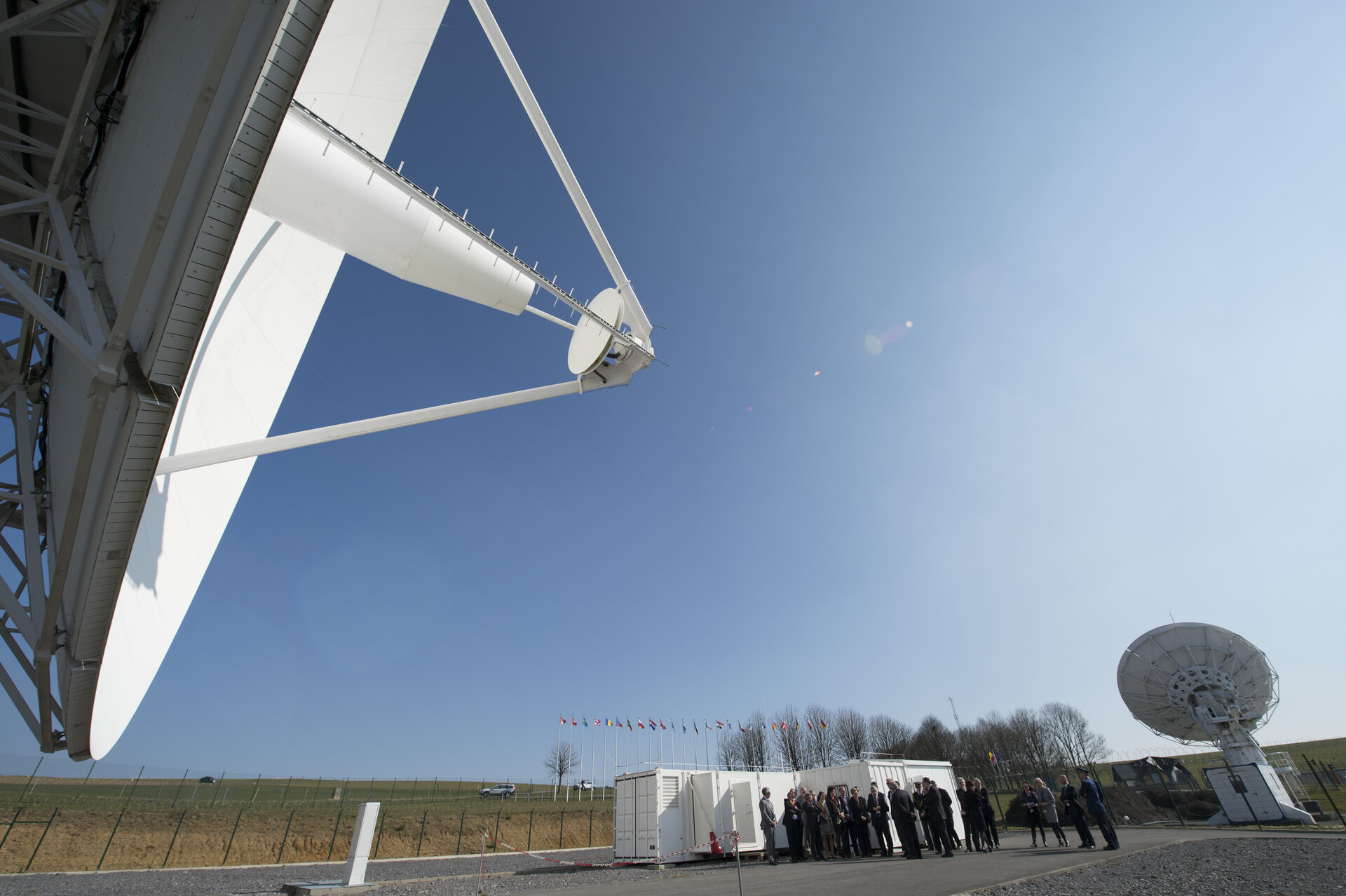
King Philippe of Belgium visited the ESA centre in Redu, Belgium, on 17 March 2015.
After a presentation by Jean-Jacques Dordain, ESA Director General, of Redu activities that have increased and diversified over recent years, the King took guided tour around the site, the only ESA site in Belgium, located amid the forests of the Belgian Ardennes.
The King viewed the 20-m Galileo antenna, the largest on the site. He also discovered the other antennas present on the site, today numbering around 50 against 15 antennas 10 years ago.
At the end of the visit, ESA Director General Jean-Jacques Dordain received official recognition from the King for his continuous efforts in promoting and supporting the Europe’s space interests and activities in his capacity as ESA Director General. He was awarded Grand Officer in the Order of the Crown by the King.
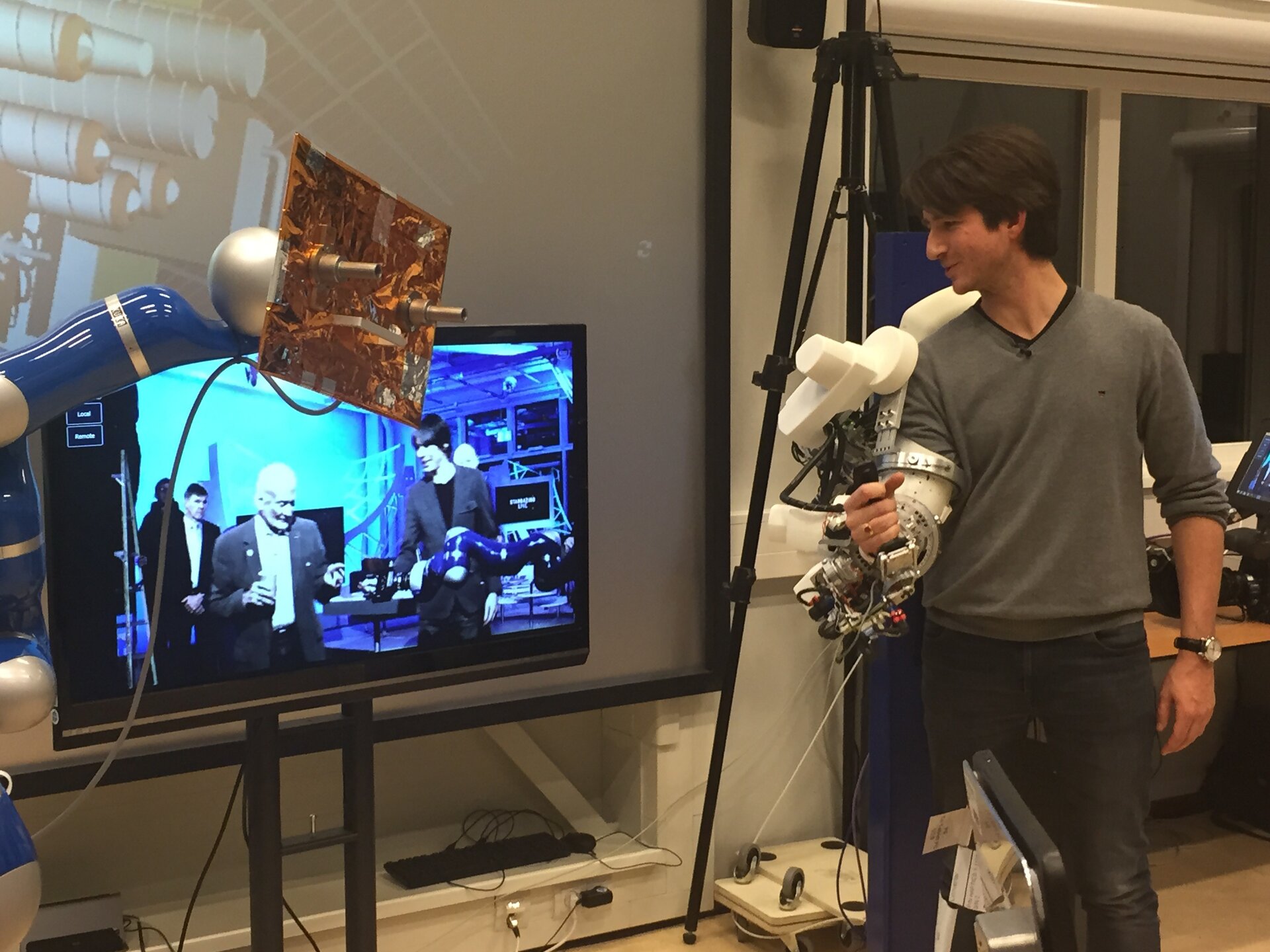
Pioneering Moonwalker Buzz Aldrin – seen on screen with Brian Cox – inspects the telerobotic arm later demonstrated on Wednesday evening’s BBC Stargazing Live.
Live on the show, host Dara O Briain at Jodrell Bank in the UK used the arm to shake hands remotely across more than 450 km with presenter Dallas Campbell at ESA’s technical heart in Noordwijk, the Netherlands.
Controlling the arm at the Dutch end is André Schiele, heading ESA’s Telerobotics and Haptics Laboratory, which works on extending the human sense of touch into space.
Using telerobotic force-feedback, the aim is to enable precision control of robots in space and also, one day, manipulation of rovers on planets by astronauts up in orbit – allowing direct human-guided exploration without the danger and expense of landing.
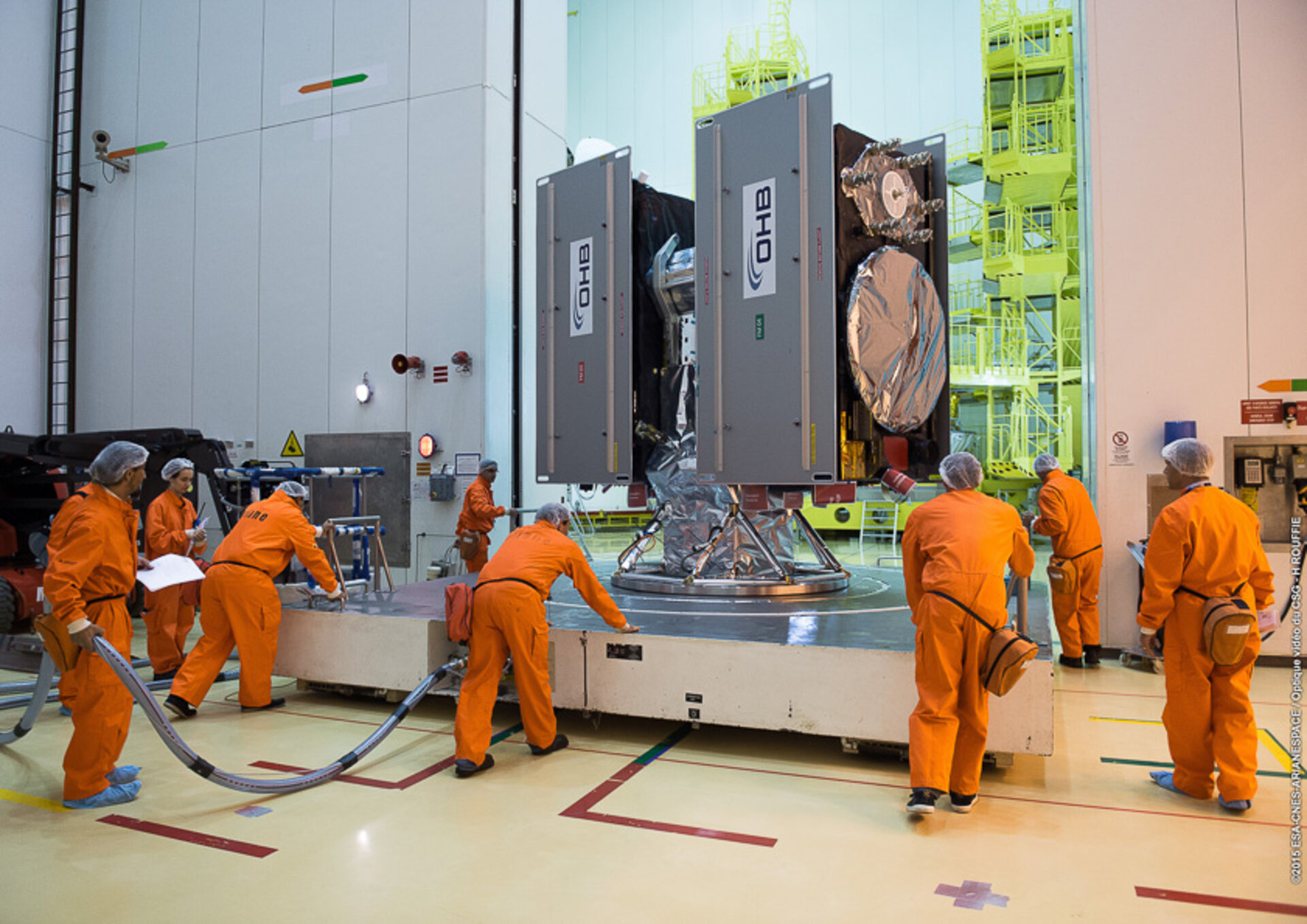
Europe's seventh and eighth Galileo satellites, fixed to their dispenser, being transported to the 3SB preparation building on Wedsnesday 18 March. It is here that they are mated to their Fregat upper stage and then encapsulated within their launch fairing. The pair of satellites will be launched by Soyuz ST-B on Friday 27 March 2015.
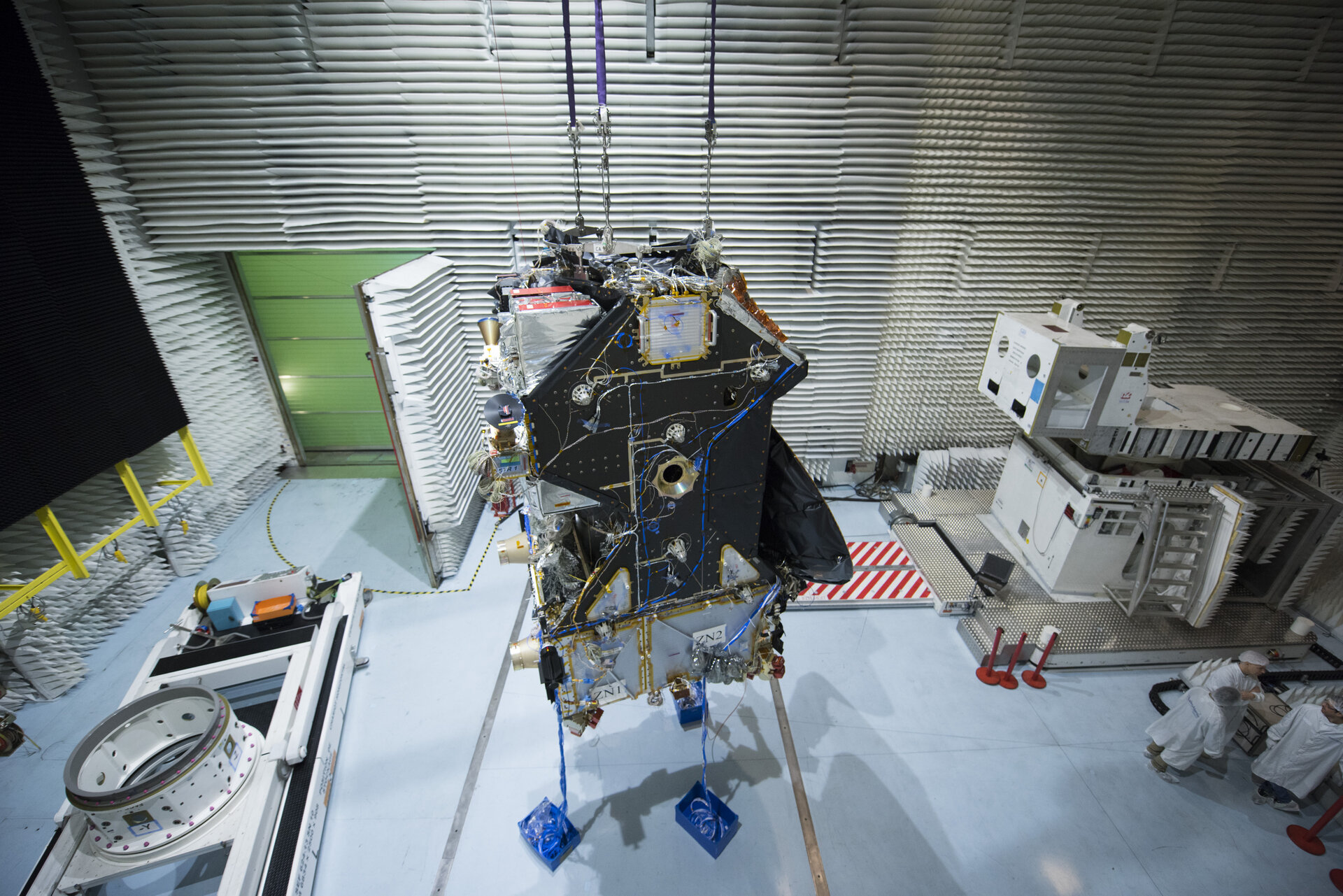
ESA’s ExoMars Trace Gas Orbiter module is seen here during tests in the anechoic test chamber of Thales Alenia Space, in Cannes, France, on 5 March 2015.
The Orbiter itself will remain in Mars orbit to image surface features and study the composition of the atmosphere.
The first mission of the ExoMars programme, scheduled to arrive at Mars in 2016, consists of a Trace Gas Orbiter plus an Entry, Descent and Landing Demonstrator Module (EDM). The main objectives of this mission are to search for evidence of methane and other trace atmospheric gases that could be signatures of active biological or geological processes and to test key technologies in preparation for ESA's contribution to subsequent missions to Mars.
Week In Images
16-20 March 2015
![[1/11] London, UK](/var/esa/storage/images/esa_multimedia/images/2015/03/london_uk/15317013-2-eng-GB/London_UK_latestnews.jpg)
![[2/11] Paris, France](/var/esa/storage/images/esa_multimedia/images/2015/03/paris_france/15316079-2-eng-GB/Paris_France_latestnews.jpg)
![[3/11] Ulan Bator, Mongolia](/var/esa/storage/images/esa_multimedia/images/2015/03/ulan_bator_mongolia/15316147-1-eng-GB/Ulan_Bator_Mongolia_latestnews.jpg)
![[4/11] Solar corona viewed by Proba-2](/var/esa/storage/images/esa_multimedia/images/2015/03/solar_corona_viewed_by_proba-2/15310256-1-eng-GB/Solar_corona_viewed_by_Proba-2_latestnews.jpg)
![[5/11] Proba-2 view of Europe's solar eclipse](/var/esa/storage/images/esa_multimedia/images/2015/03/proba-2_view_of_europe_s_solar_eclipse/15319278-1-eng-GB/Proba-2_view_of_Europe_s_solar_eclipse_latestnews.jpg)
![[6/11] Eclipse shadow](/var/esa/storage/images/esa_multimedia/images/2015/03/eclipse_shadow/15319658-1-eng-GB/Eclipse_shadow_latestnews.jpg)
![[7/11] New Norcia station](/var/esa/storage/images/esa_multimedia/images/2015/03/new_norcia_station/15310890-1-eng-GB/New_Norcia_station_latestnews.jpg)
![[8/11] King Philippe of Belgium views Redu's 20-m Galileo antenna](/var/esa/storage/images/esa_multimedia/images/2015/03/king_philippe_of_belgium_views_redu_s_20-m_galileo_antenna/15314982-2-eng-GB/King_Philippe_of_Belgium_views_Redu_s_20-m_Galileo_antenna_latestnews.jpg)
![[9/11] Buzz Aldrin inspecting telerobotic arm](/var/esa/storage/images/esa_multimedia/images/2015/03/buzz_aldrin_inspecting_telerobotic_arm/15317293-1-eng-GB/Buzz_Aldrin_inspecting_telerobotic_arm_latestnews.jpg)
![[10/11] Galileo satellites moved to S3B building](/var/esa/storage/images/esa_multimedia/images/2015/03/galileo_satellites_moved_to_s3b_building/15320341-1-eng-GB/Galileo_satellites_moved_to_S3B_building_latestnews.jpg)
![[11/11] ExoMars Trace Gas Orbiter during tests](/var/esa/storage/images/esa_multimedia/images/2015/03/exomars_trace_gas_orbiter_during_tests6/15312211-2-eng-GB/ExoMars_Trace_Gas_Orbiter_during_tests_latestnews.jpg)
Rate this
Views
Share
- Currently 5 out of 5 Stars.
- 1
- 2
- 3
- 4
- 5
Rating: 4.9/5 (35 votes cast)Thank you for rating!
You have already rated this page, you can only rate it once!
Your rating has been changed, thanks for rating!