• → European Space Agency

      • Space for Europe
      • Space News
      • Space in Images
      • Space in Videos
    • About Us

      • Welcome to ESA
      • DG's news and views
      • For Member State Delegations
      • Business with ESA
      • Law at ESA
      • ESA Exhibitions
      • ESA Publications
      • Careers at ESA
    • Our Activities

      • Space News
      • Observing the Earth
      • Human Spaceflight
      • Space Transportation
      • Navigation
      • Space Science
      • Space Engineering & Technology
      • Operations
      • Telecommunications & Integrated Applications
      • Preparing for the Future
    • Careers at ESA

    • For Media

      • Media
      • ESA TV
      • Videos for professionals
      • Photos
    • For Educators

    • For Kids

    • ESA

    • Human Spaceflight

    • Astronauts

    • International Space Station

    • Research

    • Education

    • About research in space
    • Research areas
    • Human health
    • Aging
    • Plants
    • Life support
    • Exobiology
    • Physics and materials
    • Radiation
    • Technology
    • Platforms and facilities
    • International Space Station
    • Sounding rockets
    • Parabolic flights
    • Drop towers
    • Bedrest and ground studies
    • Hypergravity
    • Research activities
    • Research Announcements
    • Experiment archive
    • Multimedia
    • Images
    • Videos
    • Web Streaming Network
    • Printed products
    • Brochures
    • European user guide to low gravity platforms
    • Space for life newsletter

    ESA > Our Activities > Human Spaceflight > Research

    Ecosystem Earth

    Life support

    Spaceship Earth offers all we need to live alongside the plants and animals of our planet. When exploring our Solar System, it would be ideal if we could take Earth’s ecosystem with us to survive and feel comfortable in the harsh vacuum of space. Obviously, this is impractical but can we scale down our ecosystem to provide our travel needs?

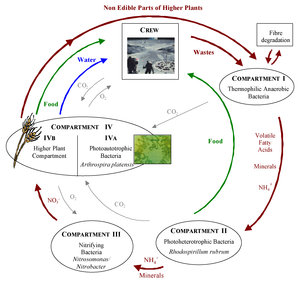
    ESA’s Micro-Ecological Life Support System Alternative team, or MELiSSA for short, is looking at doing just that. By finely tuning how microbiological cells, chemicals, catalysts, algae, bacteria and plants interact we could process waste to deliver never-ending fresh supplies of oxygen, water and food.

    Drinking in space

    Drinking water on the International Space Station is already processed from urine, condensation and other sources but the system still needs regular refills and fresh filters.

    A closed life-support system would need to recycle air, water and waste while producing drinking water and food. ESA is making huge steps in this area.

    Understanding and recreating an ecosystem in which humans can survive could benefit people who live in less affluent places where water or even clean air is sparse – regardless of whether these people are colonising a distant planet or living in a desert on Earth.

    Aquatic inspiration

    Cholesterol-eating bacteria

    To create this closed-loop system, ESA turned to an ecosystem based on lakes. Using resources from biology, microbiology and chemistry, researchers have already booked many successes, and some of the spin-offs are more down-to-Earth than you might think.

    Looking for organisms that could be harvested for food, the MELiSSA team came across a bacterium that cut levels of LDL cholesterol – the ‘bad’ cholesterol. The bacterium is now being further investigated as a possible medicine.

    As a food, it turned out to be less interesting than algae, but the nifty bacterium does has another trick up its sleeve: it has proven its worth as a major part of the MELiSSA loop for organic waste and water recycling.

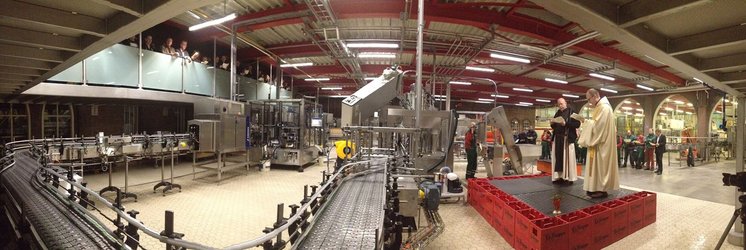
    Another spin-off is helping create sparkling wine. A sensor developed by MELiSSA controls the fermentation and monitors biological processes. The same technology is being used to control the growth of the yeast that produces alcohol and carbon dioxide bubbles in your glass.

    Next steps

    Closed ecosystem

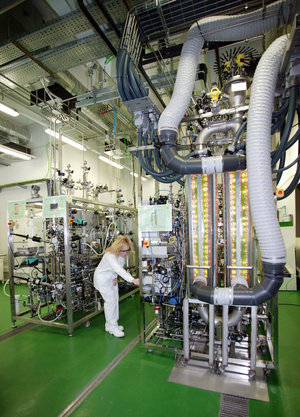
    ESA is testing closed-loop life-support systems on Earth and in space. A pilot plant in Barcelona, Spain, aims to support a number of rats indefinitely in a comfortable habitat – a complete ecosystem shut off from our environment created with one purpose: to keep the rats healthy and happy. This facility is the first step to a system that could support humans in space.

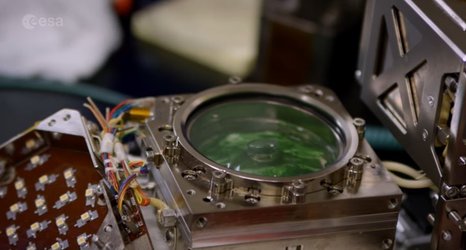
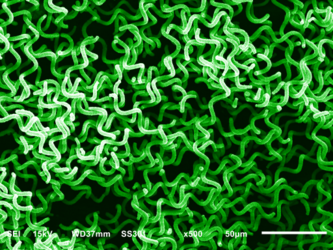
    Experiments are also planned on the International Space Station because nobody knows how some of the organisms in the MELiSSA system will grow in space. A series of experiments will fly Arthrospira bacteria and cultivate them in the Biolab facility in ESA’s Columbus laboratory to see how they adapt to weightlessness.

    From there, the system of bacteria could be enlarged to supply oxygen to a test subject while feeding on the exhaled carbon dioxide.

    In this way MELiSSA’s recycling loop will be progressively tested in space to increase the degree of closure in the ecosystem. The system will become more and more self-sustained so that astronauts on long-duration missions can reduce their dependency on costly supplies from Earth.

    Loading...
    Space Station life support
    Access the video

    Last update: 24 April 2015

    Rate this

    Views

    Share

    • Currently 4 out of 5 Stars.
    • 1
    • 2
    • 3
    • 4
    • 5
    Rating: 4.1/5 (10 votes cast)

    Thank you for rating!

    You have already rated this page, you can only rate it once!

    Your rating has been changed, thanks for rating!

    4781
    Tweet

    Related articles

    AstroPlant: citizen science for growing plants in space03 May 2017

    AstroPlant: citizen science for growing plants in space03 May 2017 ESA is teaming up with enthusiasts to build a desktop greenhouse for people to grow plants at home and in classrooms as potential crops in space.

    Full circle: space algae fighting malnutrition in Congo13 September 2016

    Full circle: space algae fighting malnutrition in Congo13 September 2016 Looking for food that could be harvested by astronauts far from Earth, researchers focused on spirulina, which has been harvested for food in South America and Africa for centuries. ESA astronaut Samantha Cristoforetti ate the first food containing sp...

    Cultivating microalgae using made-for-space formulas21 March 2016

    Cultivating microalgae using made-for-space formulas21 March 2016 A new facility is offering researchers and industry an opportunity to experiment with microalgae on larger scales than before. Based in Saint-Nazaire, France, the AlgoSolis site is a stepping stone to industrial production of algae-based products.

    Environment and ecosystems 26 June 2015

    Environment and ecosystems 26 June 2015 ESA is leading a consortium of research centres and companies aiming to create a closed ecosystem able to  provide everything an astronaut needs on a long mission exploring our Solar System, such as oxygen, water and food The Melissa project is u...

    An ecosystem in a box 19 January 2015

    An ecosystem in a box 19 January 2015 An unusual package was delivered to a hotel in Beijing, China, in 1987 containing a batch of blue–green algae that would spend five days in space in a capsule. The ESA-led MELiSSA project was on its way.

    Space brings fresh water to Morocco 06 May 2014

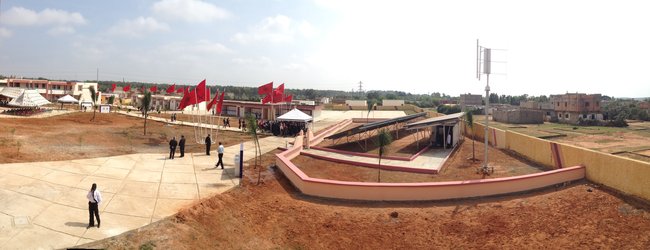
    Space brings fresh water to Morocco 06 May 2014 Recycling waste water and urine into drinking water is not only for astronauts – the same method is now treating groundwater for a school in Morocco.

    Closing the recycling circle27 June 2014

    Closing the recycling circle27 June 2014 The International Space Station welcomes up to eight supply vessels a year bringing oxygen, water and food for the six astronauts continuously circling our planet. Building, launching, docking and unloading these spacecraft is costly and time-consumin...

    Red bacteria fighting cholesterol for you 25 July 2013

    Red bacteria fighting cholesterol for you 25 July 2013 What started as a food that astronauts could grow themselves is showing potential for lowering cholesterol levels around the world: space research has found a bacterium that can reduce cholesterol by half.

    MELiSSA’s future in space09 July 2009

    MELiSSA’s future in space09 July 2009 Europe, through ESA, intends to play a major role in the 14-space-agency Global Exploration Strategy to explore the Moon and the rest of the solar system. Contributions are proposed in the areas of lunar landers, space transportation and habitation, a...

    • Experiment archive
    • International Space Station Benefits for Humanity
    • European space laboratory Columbus
    • App Store
    • Subscribe
    • mobile version
    • LATEST ARTICLES
    • · Counting calories in space
    • · How to rescue a Moonwalker in need
    • · See our seasons change from space
    • · Preparing for Mercury: BepiColombo…
    • · Giant iceberg in the making
    • FAQ

    • Site Map

    • Contacts

    • Terms and conditions