• → European Space Agency

      • Space for Europe
      • Space News
      • Space in Images
      • Space in Videos
    • About Us

      • Welcome to ESA
      • DG's News and Views
      • For Member State Delegations
      • Business with ESA
      • ESA Exhibitions
      • ESA Publications
      • Careers at ESA
    • Our Activities

      • Space News
      • Observing the Earth
      • Human Spaceflight
      • Launchers
      • Navigation
      • Space Science
      • Space Engineering
      • Operations
      • Technology
      • Telecommunications & Integrated Applications
    • For Public

    • For Media

      • Media
      • ESA TV
      • Videos for professionals
      • Photos
    • For Educators

    • For Kids

    • ESA

    • Home

    • Launch vehicles

    • Europe's Spaceport

    • New Technologies

    • Strategy for launchers
    • Launcher strategy
    • Future Launchers Preparatory Programme
    • International cooperation
    • Launchers and industry
    • Launcher history
    • A look at the past
    • Ariane 1, 2, 3
    • Ariane 4
    • Launches
    • Previous launches
    • Launch schedule
    • Multimedia
    • Image gallery
    • Video gallery
    • RSS feeds
    • Flyers
    • Vega - Europe's small launcher
    • Soyuz - Europe's launch site for Soyuz
    • IXV - Intermediate eXperimental Vehicle
    • Ariane 5
    • Launchers on your desktop
    • Screensavers and wallpaper
    • Services
    • Glossary
    • Frequently asked questions
    • Comments

    ESA > Our Activities > Launchers

    Control system tests begin for Vega’s main engine

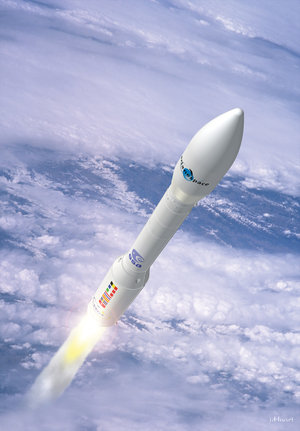
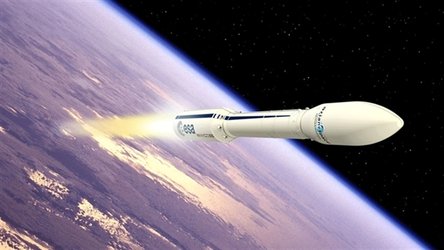
    Vega launcher (artist’s impression)
    15 June 2006

    Development of Vega, Europe’s new launcher for small payloads, continues at full speed. A dedicated test facility for the directional control system of the main engine has been completed and performance measurements are under way.

    The Vega development programme is performing a crucial series of tests during 2006, including engine firings, mechanical and electrical performance verifications, and system-level trials. Among the many test campaigns, measuring the performance of the control loop of Vega’s first stage was started in May.

    Vega's first stage, known as P80, is a solid-fuel rocket motor which includes a Thrust Vector Control (TVC) system consisting of two electromechanical actuators that operate a movable nozzle. The TVC system moves the nozzle to control the pitch and yaw of the launcher (the attitude of the vehicle in relation to the flight direction) during flight.

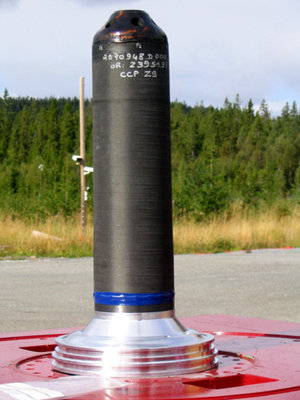
    P80 TVC Validation Model
    P80 TVC Validation Model

    In order to characterise the TVC behaviour under the various conditions that could occur during flight and to verify the functionality of the control loop, a dedicated validation facility has been constructed at ELV SpA, in Colleferro (Italy).

    The TVC Validation Model allows examination of all aspects of system performance using fully representative hardware, specifically:

    • the two electromechanical actuators, designed and manufactured by SABCA of Belgium
    • their associated electronics unit – known as the Integrated Power Distribution Unit – also designed and manufactured by SABCA of Belgium
    • a mechanically representative model of the rocket nozzle – designed and manufactured by Snecma Propulsion Solide of France
    • a battery set employing lithium-ion technology – to provide a more complete representation of operational conditions in some test scenarios – designed and manufactured by Saft of France.

    P80 TVC Validation Model - control room
    P80 TVC Validation Model - control room

    The design, manufacture and assembly of the components of the TVC Validation Model have been lead by Europropulsion SA, a jointly-owned subsidiary of Snecma Propulsion Solide (France) and Avio SpA (Italy), which is the Prime Contractor for the P80 main engine. The construction of the test plant, including mechanical parts and ground support equipment for electronic command and measurement acquisition, has been carried out under the responsibility of ELV SpA, the Prime Contractor for the Vega launch vehicle. The management of the P80 demonstrator programme is under the responsibility of the P80 Integrated Project Team (ASI , CNES and ESA), located at the CNES facility in Evry, France.

    The TVC subsystem tests are expected to last for several months. They will allow checking of the control sequence that will be used during the first P80 motor static firing test, scheduled to be conducted in Kourou during the last quarter of 2006.

    At a later stage, during the system test campaigns, the TVC Validation Model will also be used for overall system verification. It will be controlled by a test version of the Vega onboard computer and flight software, making use of the inertial measurement system simulator and the simulated flight dynamics environment.

    Rate this

    Views

    Share

    • Currently 0 out of 5 Stars.
    • 1
    • 2
    • 3
    • 4
    • 5
    Rating: 0/5 (0 votes cast)

    Thank you for rating!

    You have already rated this page, you can only rate it once!

    Your rating has been changed, thanks for rating!

    81
    Tweet
    • Related news
      • Vega's second stage motor roars to life
        • Control system tests begin for Vega’s main engine
          • Ariane Programme Board meets at Europe’s Spaceport
            • Successful first test for Vega's Zefiro 9 engine
              • Key tests for Vega igniters
                • Vega contract for SABCA
                  • Vega launcher
                  • Vega
                  • External links
                  • Avio
                  • SABCA
                  • Saft
                  • Snecma Propulsion Solide

    Connect with us

    • RSS
    • Youtube
    • Twitter
    • Flickr
    • G+
    • Facebook
    • Livestream
    • Subscribe
    • App Store
    • LATEST ARTICLES
    • · Earth Explorers take centre stage …
    • · The fast winds of Venus are gettin…
    • · ExoMars 2016 set to complete const…
    • · Herschel ends operations as orbiti…
    • · Europe’s largest spaceship reache…
    • FAQ

    • Jobs at ESA

    • Site Map

    • Contacts

    • Terms and conditions