• → European Space Agency

      • Space for Europe
      • Space News
      • Space in Images
      • Space in Videos
    • About Us

      • Welcome to ESA
      • DG's News and Views
      • For Member State Delegations
      • Business with ESA
      • ESA Exhibitions
      • ESA Publications
      • Careers at ESA
    • Our Activities

      • Space News
      • Observing the Earth
      • Human Spaceflight
      • Launchers
      • Navigation
      • Space Science
      • Space Engineering
      • Operations
      • Technology
      • Telecommunications & Integrated Applications
    • For Public

    • For Media

      • Media
      • ESA TV
      • Videos for professionals
      • Photos
    • For Educators

    • For Kids

    • ESA

    • Home

    • Launch vehicles

    • Europe's Spaceport

    • New Technologies

    • Strategy for launchers
    • Launcher strategy
    • Future Launchers Preparatory Programme
    • International cooperation
    • Launchers and industry
    • Launcher history
    • A look at the past
    • Ariane 1, 2, 3
    • Ariane 4
    • Launches
    • Previous launches
    • Launch schedule
    • Multimedia
    • Image gallery
    • Video gallery
    • RSS feeds
    • Flyers
    • Vega - Europe's small launcher
    • Soyuz - Europe's medium launcher
    • IXV - Intermediate Experimental Vehicle
    • NGL - Europe's Next-Generation Launcher
    • Launchers on your desktop
    • Screensavers and wallpaper
    • Services
    • Glossary
    • Frequently asked questions
    • Comments

    ESA > Our Activities > Launchers

    Successful first test for Vega’s Zefiro 9-A solid-fuel rocket motor

    24 October 2008

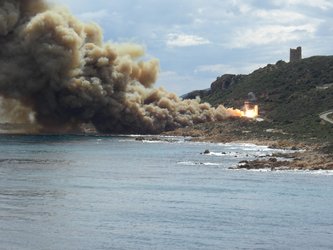
    Yesterday, the Zefiro 9-A motor successfully completed its first firing test at the Salto di Quirra Inter-force Test Range in Sardinia (Italy). This was the penultimate firing test for the engine prior to the Vega launcher’s qualification flight, scheduled to take place by the end of 2009.

    The Zefiro 9-A (Z9-A) solid-fuel rocket motor, which will power the Vega launch vehicle’s third stage, left the production facility of Avio, in Colleferro (Italy), at the end of September and was installed at the test site over the last three weeks.
     
    After a nominal 120-second burn time, during which a maximum combustion pressure of 75 bar was reached, the roar of the motor stopped as expected. The first results confirm the expected performance increase for this enhanced version of the motor, as well as the robustness of the modifications introduced in the nozzle design.

    Improved design

    This improved version of the Z9, with its new nozzle design and an optimised propellant loading, is fully flight-representative of the Vega third-stage motor – the only exception being the use of a truncated nozzle in order to partially adapt the motor to sea-level conditions.
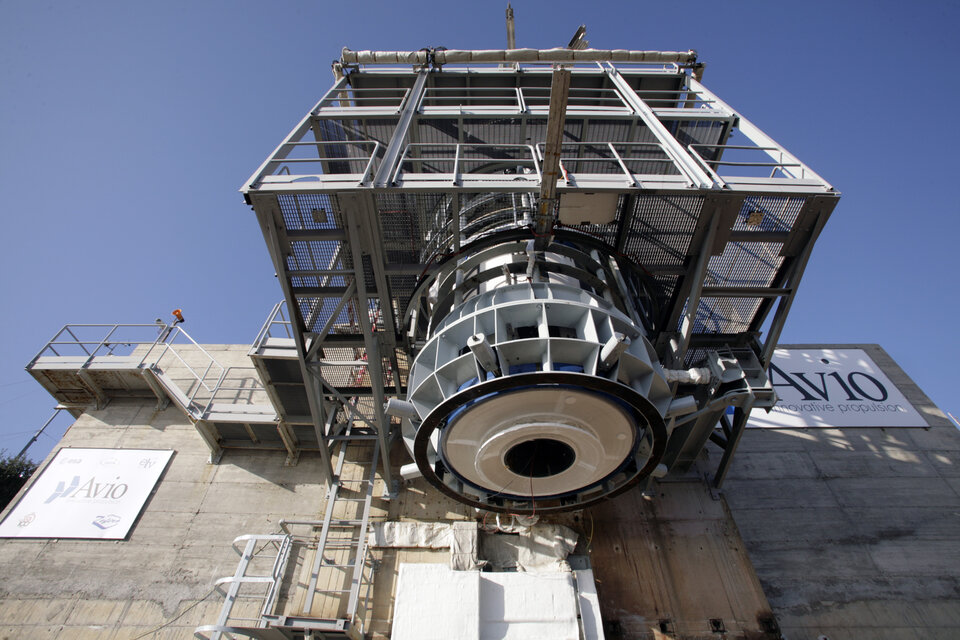

    Zefiro 9-A on test stand

    The Zefiro 9-A motor, with an overall height of 3.17 m and a diameter of 1.92 m, contains 10.5 tonnes of propellant and provides a maximum thrust of 320 kN (about 32.6 tonnes-force), in vacuum. The Z9-A has the highest propellant-mass to inert-mass ratio of any space-transportation solid-propellant rocket motor ever fired.
     
    Some 400 sensors fitted to the motor allowed monitoring of its behaviour during and after the firing test. The data collected will enable engineers from ELV SpA (Italy), the Vega launch vehicle prime contractor, and Avio SpA (Italy), in charge of the motor development and qualification, to check its performance, in particular:

    • ballistic performance (pressure and thrust curves)
    • internal thermal-protection efficiency
    • thrust-vector control performance
    • induced thermal and dynamic environment

    Following the test firing, the motor will be shipped back to Colleferro, for detailed inspection.

    Towards flight qualification

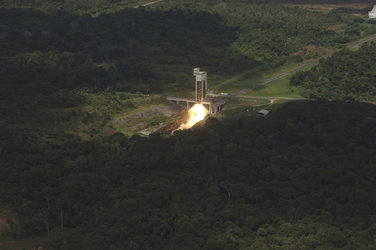
    A second qualification test for the Zefiro 9-A is planned for February 2009. This will complete the qualification process of the Vega solid rocket motors. The P80 first-stage motor and the Z23 second-stage motor, both of which also use solid propellant, have already completed successful qualification firing tests.
     
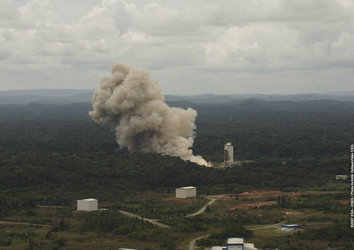
    The Vega launcher qualification flight is scheduled to take place before the end of 2009, from Europe’s spaceport at Kourou, in French Guiana.
     
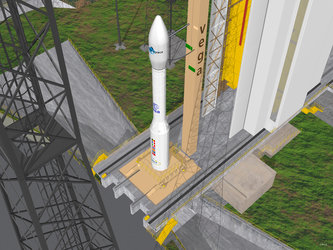
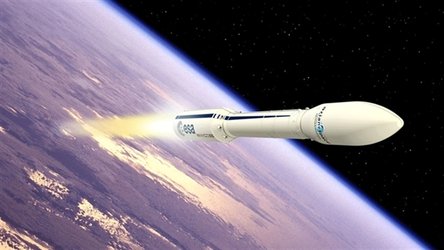
    Vega is a single-body launcher composed of three solid-propellant stages and a liquid-propellant upper module. It is approximately 30 m high, and weighs a total of 137 tonnes at lift-off. The reference mission for Vega’s launch capacity is to carry 1500 kg into a 700km-altitude polar orbit, but Vega will be able to launch a wide range of scientific and Earth-observation missions.
    Rate this

    Views

    Share

    • Currently 0 out of 5 Stars.
    • 1
    • 2
    • 3
    • 4
    • 5
    Rating: 0/5 (0 votes cast)

    Thank you for rating!

    You have already rated this page, you can only rate it once!

    Your rating has been changed, thanks for rating!

    116
    Tweet
    • Vega
    • Related news
      • Successful qualification firing test for Zefiro 23
        • Vega main engine test in Kourou
          • Qualification of Vega on-board computer completed
            • Anomalous behaviour affects firing test of Vega’s Zefiro 9 motor
              • Successful firing of Vega’s first-stage motor in Kourou

    Connect with us

    • RSS
    • Youtube
    • Twitter
    • Flickr
    • G+
    • Facebook
    • Livestream
    • Subscribe
    • App Store
    • LATEST ARTICLES
    • · Rare merger reveals secrets of gal…
    • · Watching for hazards: ESA opens as…
    • · ESA astronaut Timothy Peake set fo…
    • · Space drives e-mobility
    • · Proba-V opens its eyes
    • FAQ

    • Jobs at ESA

    • Site Map

    • Contacts

    • Terms and conditions