• → European Space Agency

      • Space for Europe
      • Space News
      • Space in Images
      • Space in Videos
    • About Us

      • Welcome to ESA
      • DG's News and Views
      • For Member State Delegations
      • Business with ESA
      • ESA Exhibitions
      • ESA Publications
      • Careers at ESA
    • Our Activities

      • Space News
      • Observing the Earth
      • Human Spaceflight
      • Launchers
      • Navigation
      • Space Science
      • Space Engineering
      • Operations
      • Technology
      • Telecommunications & Integrated Applications
    • For Public

    • For Media

    • For Educators

    • For Kids

    • ESA

    • Space Engineering

    • What we do
    • Directorate of Technical and Quality Management (TEC)
    • Electrical
    • Electrical engineering
    • Control Systems
    • Data Systems
    • Radio Frequency Payload Systems
    • Electromagnetics and Space Environment
    • Power and Energy Conversion
    • Mechanical
    • Mechanical engineering
    • Thermal Control
    • Structures and Mechanisms
    • Mechatronics and Optics, incl. robotics and life support
    • Propulsion and Aerothermodynamics
    • Systems
    • Systems and software engineering
    • Software Systems
    • Systems Engineering, incl. cost engineering
    • Technology programmes
    • Product Assurance
    • Product Assurance
    • Flight Safety
    • Dependability
    • Quality Management and Assurance
    • Materials and Processes
    • Electronic Components
    • Software Product Assurance
    • Standards
    • Requirements and standards
    • European Cooperation for Space Standardization (ECSS)
    • European Space Components Coordination (ESCC)
    • Services
    • ESA calendar of events
    • Subscribe

    ESA > Our Activities > Space Engineering

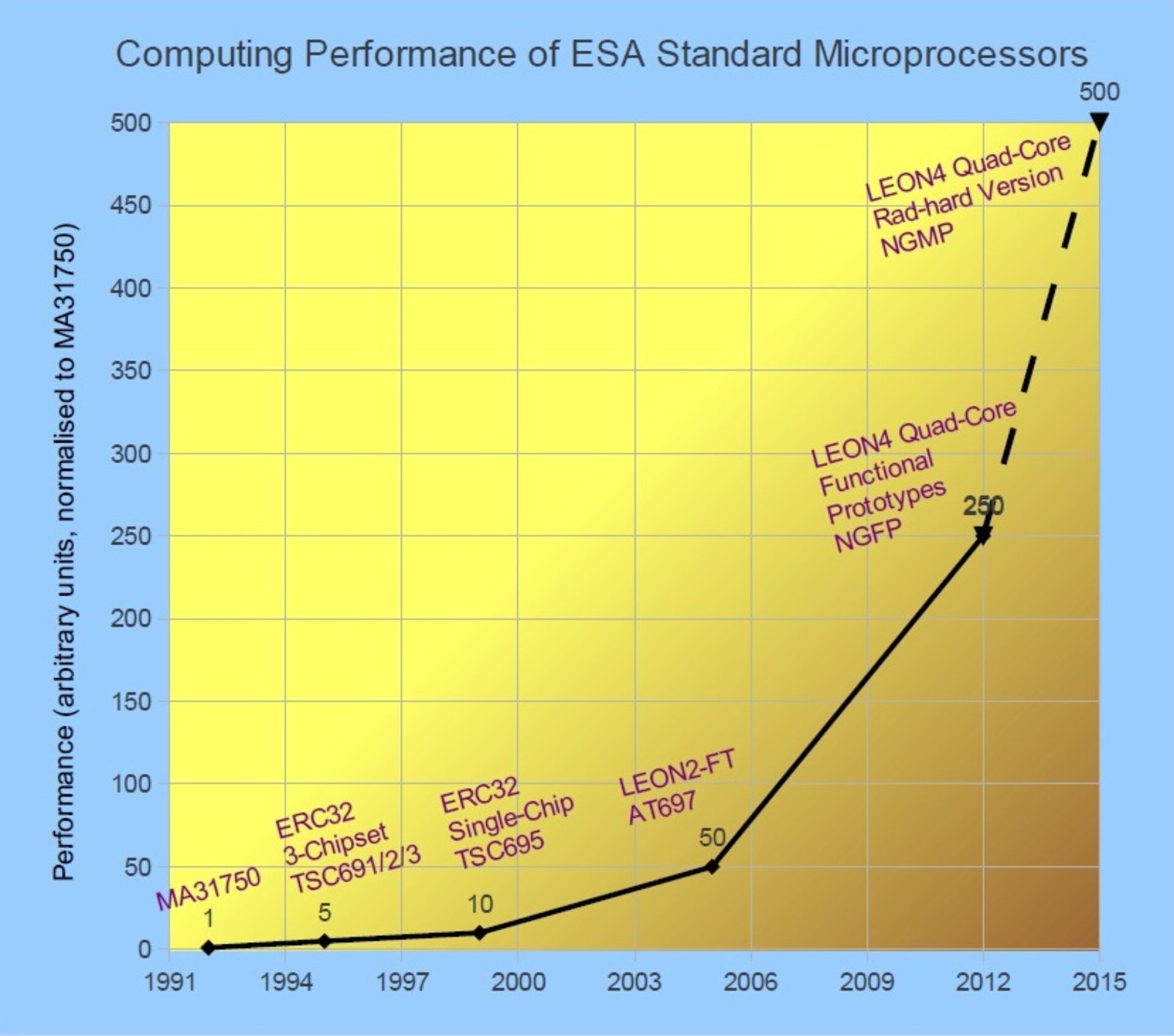
    Computing performance of ESA's standard microprocessors

    Leading up to LEON: ESA’s first microprocessors

    2 January 2013

    ESA engineers began by taking existing designs and adapting them for space use. This process began with the Agency’s MA31750 16-bit microprocessor, designed in the early 1990s.

    Manufactured in the UK, this microprocessor is sold internationally and still in widespread use in the satellite telecommunications sector, as well as serving ESA missions, including comet-chaser Rosetta.

    For its next attempt the Agency adopted the SPARC (Scalable Processor Architecture) open industry standard, resulting in the ERC32 design.

    An initial three-chip set (each chip containing part of the microprocessor) was developed in the mid-1990s. Commercialised by Atmel as the TSC691/692/693, it was employed by several computers of the International Space Station, by the Automated Transfer Vehicle supply truck and by ESA’s highly automated Proba-1 Earth observation microsatellite.

    Rosetta, running on ESA's MA31750 chip

    Its second generation, developed in the late 1990s, merged these three chips into one: the ERC32 ‘single chip’, subsequently commercialised by Atmel as the TSC695. This product has been at the heart of European space systems for more than a decade.

    Notable adopters include the inertial units guiding the flight of Ariane 5 launchers and the Herschel and Planck space observatories, among other ESA science missions.

    “About 3500 ERC32 single-chip flight units have been sold, and it remains on sale to this day, valued in the space industry as a mature, reliable product,” Roland added.

    Starting over
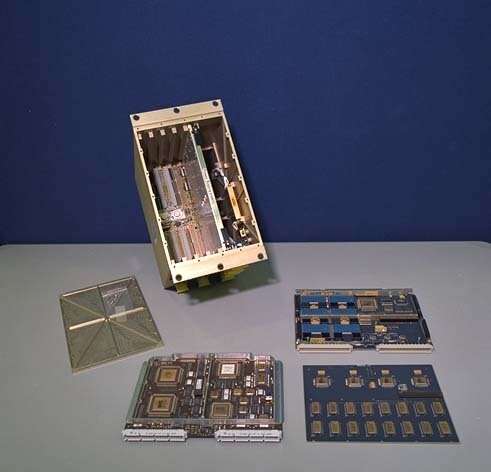
    ERC32-based ISS flight computer

    Then, for ERC32’s follow-on microprocessor came the concept of starting over from scratch.

    “The idea in the second half of the 1990s was not just to rely on this existing SPARC open architecture but to take full control of the functionality, which meant making our own design,” explained Roland.

    Development of the LEON microprocessor was initiated by two then ESA staff André Pouponnet and Jiri Gaisler, in coordination with their division head, Richard Creasey.

    Ariane 5 runs on single version ERC32 chip

    Not that the small ESA team did everything themselves: by initially releasing a reduced version of the LEON design as open source code to a worldwide community of users, including many universities, they crowdsourced valuable debugging feedback ahead of manufacturing (for more information, see the link: LEON: The making of a microprocessor for space).

    Boasting a five-fold performance improvement on the ERC-32, ESA’s LEON2-FT is once more manufactured by Atmel. Features are etched onto its underlying semiconductor at 180 nanometre scale, compared to the single-chip ERC32’s 500 nm. The smaller the scale, of course, the more computing power can be crammed onto an individual chip.

    To give an idea of scale, an individual atom measures a few nanometres across while a typical human hair is about 60 000 nm to 100 000 nm wide. Manufacturing at such a scale sounds impressive but the commercial semiconductor industry is typically operating several generations ahead of the space industry.

    (Continued in: LEON's first flights).
    Rate this

    Views

    Share

    • Currently 0 out of 5 Stars.
    • 1
    • 2
    • 3
    • 4
    • 5
    Rating: 0/5 (0 votes cast)

    Thank you for rating!

    You have already rated this page, you can only rate it once!

    Your rating has been changed, thanks for rating!

    16
    facebook
    twitter
    reddit
    google plus
    digg
    tumbler
    digg
    blogger
    myspace

    Related articles

    LEON: the space chip that Europe built02 January 2013

    LEON: the space chip that Europe built02 January 2013 Just like home computers, the sophisticated capabilities of today’s space missions are made possible by the power of their processor chips. ESA’s coming Alphasat telecom satellite, the Proba-V microsatellite, the Earth-monitoring Sentinel family and t...

    Vessel detection

    LEON's first flights02 January 2013

    Vessel detection

    LEON's first flights02 January 2013 The AT697 (LEON2-FT) flew for the first time in 2008, launched to ESA’s Columbus module on the Space Station within a prototype computer payload called the ERNObox.

    LEON: the making of a microprocessor for space02 January 2013

    LEON: the making of a microprocessor for space02 January 2013 The chances are whatever hardware you are reading this on would not cope well with space. Assuming its mechanical structure survived the launch acceleration and vibration, it would then face sustained hard vacuum and temperature extremes. And within a...

    LEON: a new recipe for chips02 January 2013

    LEON: a new recipe for chips02 January 2013 How to go about designing a microprocessor? The first step is to think about what it needs to do, in this case serve as a general purpose processor for space-based computer systems.

    • Data Systems
    • Microelectronics website
    • European Components Initiative (ECI)
    • Alphasat/Alphabus
    • Sentinels
    • Proba-V
    • IXV
    • Bepicolombo overview
    • Automated Transfer Vehicle (ATV)
    • About Ariane 5
      • DMS-R: ESA's Data Management System for the Russian Segment of the ISS
      • Rosetta

    Connect with us

    • RSS
    • Youtube
    • Twitter
    • Flickr
    • Google Buzz
    • Subscribe
    • App Store
    • LATEST ARTICLES
    • · CryoSat hits land
    • · Ariane 5 completes seven launches …
    • · Measuring skull pressure without t…
    • · Malargüe station inauguration
    • · The solar wind is swirly
    • FAQ

    • Jobs at ESA

    • Site Map

    • Contacts

    • Terms and conditions
