Decoding Mars’s Cryptic Region
Mars Express's OMEGA instrument has given planetary scientists outstanding new clues to help solve the mystery of Mars's so-called 'cryptic region'.
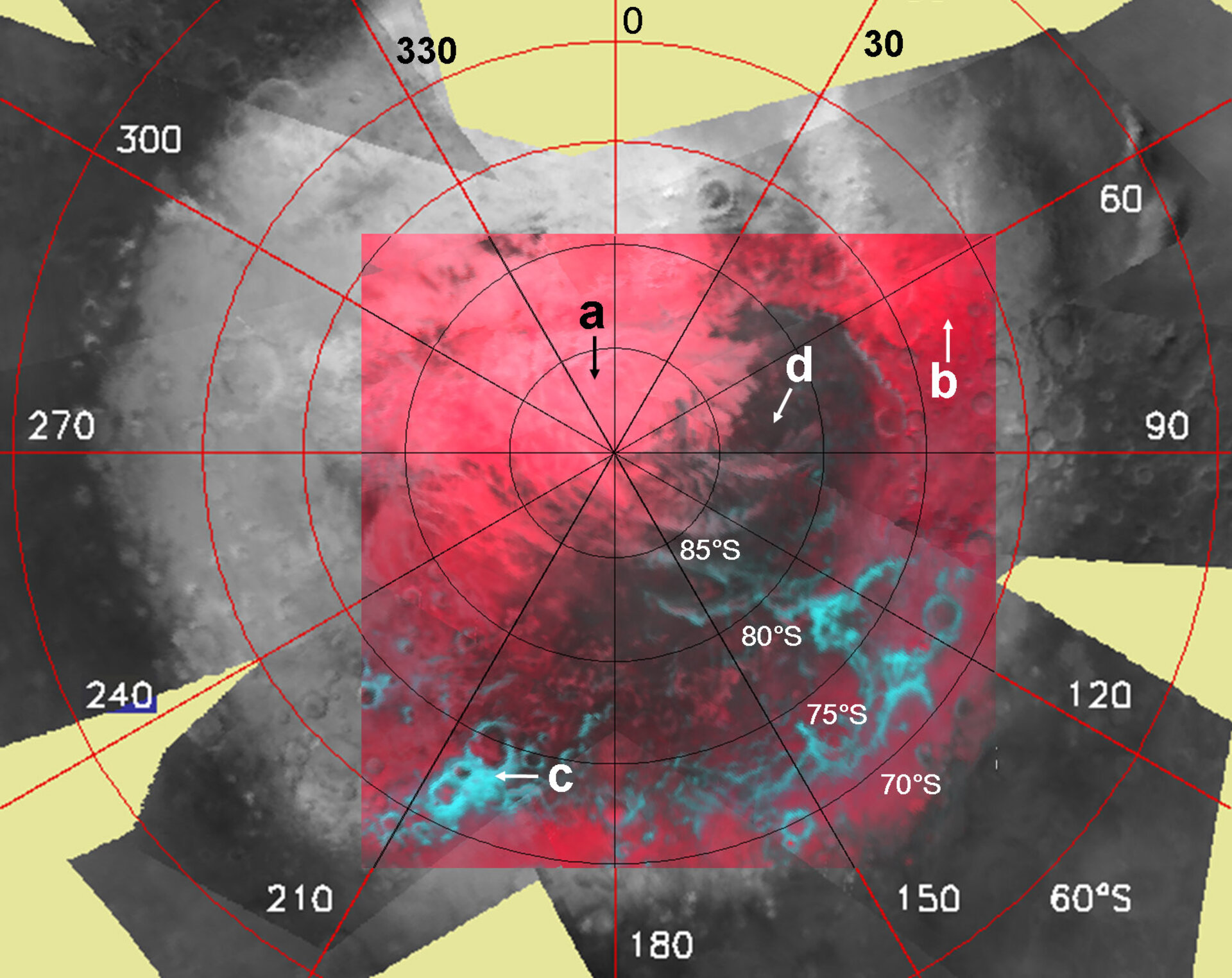
In the 1970s, orbiter missions around Mars revealed that during southern spring, large areas near Mars's south pole became much darker than the rest of the seasonal ice cap. How could this area be in the polar region and not be covered in bright ice? Intrigued, planetary scientists called the area the 'cryptic region' of the south seasonal cap.
The mystery deepened in the late 1990s when new observations showed that the temperature of the cryptic region was close to -135º Celsius. At that temperature, carbon dioxide ice had to be present. So, scientists developed the idea that a one-metre-thick slab of clear carbon dioxide ice covered the cryptic region, allowing the dark surface underneath to be seen.
However, the new observations from Mars Express's OMEGA instrument show that this interpretation cannot be correct. OMEGA measures the amount of visible and infrared radiation bouncing off the Martian surface. In so doing, it detects minerals and ices on the surface by charting the specific wavelengths of radiation they absorb.
Carbon dioxide ice (dry ice) absorbs infrared light strongly at specific wavelengths. "We see only weak absorptions in the infrared, which would indicate little carbon dioxide ice in the cryptic region," says Yves Langevin, Institut d'Astrophysique Spatiale, Orsay, France, who led the analysis of the OMEGA results.
The only way to reconcile the apparently conflicting observations is that there is indeed a thick slab of dry ice in this area, but its surface is so heavily covered by dust that few of the Sun’s rays make it to the deeper layers and back again.
How does the dust get on top of the slab? The answer could be provided by the mysterious markings that dot the cryptic region. Known as spots, 'spiders' and 'fans' depending upon their shapes, they were discovered in 1998–1999 by NASA's Mars Global Surveyor.
Planetary scientists believe they are caused by sunlight passing through the clear ice and heating the soil underneath. This causes pressure to build up in carbon dioxide bubbles below the ice until a geyser erupts throwing dust onto the surface, creating the spots and fans. In this model, the spiders result from erosion of the underlying surface by rapid gas flows below the ice. Langevin believes that this process could significantly contribute to the dust contamination of the icy surface, which OMEGA observed.
"In terms of physics, this is a straightforward process and would go a long way towards explaining our observations," says Langevin. However, there are major questions remaining, such as why are spiders, spots and fans only observed in a small fraction of the cryptic region? And why are areas not covered by spots and fans already relatively dark.
To clarify these points, Langevin must wait until the next southern spring equinox on Mars, in 2007. During the long winter, the Sun cannot be seen from the south pole and a pristine layer of ice should build up over the cryptic region. Langevin wants to observe the cryptic region close to the spring equinox, before the Sun has touched it and started the venting process. This will tell him when the dust geysers form and whether they are the ice slab’s only source of dust contamination.
So, whilst not as cryptic as it once was, Mars's south polar region still has a few mysteries left.
Note for editors
These findings appeared in the 17 August 2006 issue of the scientific journal Nature, in the article titled "No signature of clear CO2 ice from the 'cryptic' regions in Mars' south seasonal polar cap," by Y.Langevin et al. (Nature 442, 790-792, 17 August 2006) | doi:10.1038/nature05012).
For more information
Yves Langevin, OMEGA co-investigator, Institut d'Astrophysique Spatiale - IAS, Orsay, France
Email: yves.langevin @ ias.u-psud.fr
Jean-Pierre Bibring, OMEGA Principal Investigator, Institut d'Astrophysique Spatiale - IAS, Orsay, France
Email: jean-pierre.bibring @ ias.u-psud.fr
Agustin Chicarro, ESA Mars Express Project Scientist
Email: agustin.chicarro @ esa.int