• → European Space Agency

      • Space for Europe
      • Space News
      • Space in Images
      • Space in Videos
    • About Us

      • Welcome to ESA
      • DG's News and Views
      • For Member State Delegations
      • Business with ESA
      • ESA Exhibitions
      • ESA Publications
      • Careers at ESA
    • Our Activities

      • Space News
      • Observing the Earth
      • Human Spaceflight
      • Launchers
      • Navigation
      • Space Science
      • Space Engineering
      • Operations
      • Technology
      • Telecommunications & Integrated Applications
    • For Public

    • For Media

    • For Educators

    • For Kids

    • ESA

    • Space Science

    • Our Universe
    • About Space Science
    • ESA's 'Cosmic Vision'
    • Science missions
    • Mission navigator
    • Target groups
    • For Media
    • For Scientists
    • For Kids
    • Multimedia
    • Science images
    • Science videos
    • Animations
    • Downloads
    • Sounds from space
    • Resources
    • Reference section
    • Services
    • FAQs
    • Glossary
    • Help
    • Portal terms of use
    • Comments
    • Follow us
    • RSS feeds
    • ESA Sci on Twitter
    • ESA Space Science Images on Flickr
    • ESA 3D on Flickr

    ESA > Our Activities > Space Science

    Nebula NGC 3603

    Extreme star cluster in new Hubble images

    2 October 2007

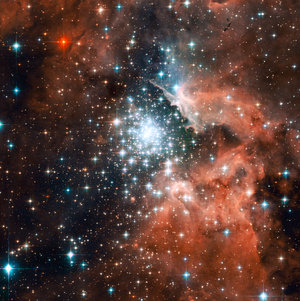
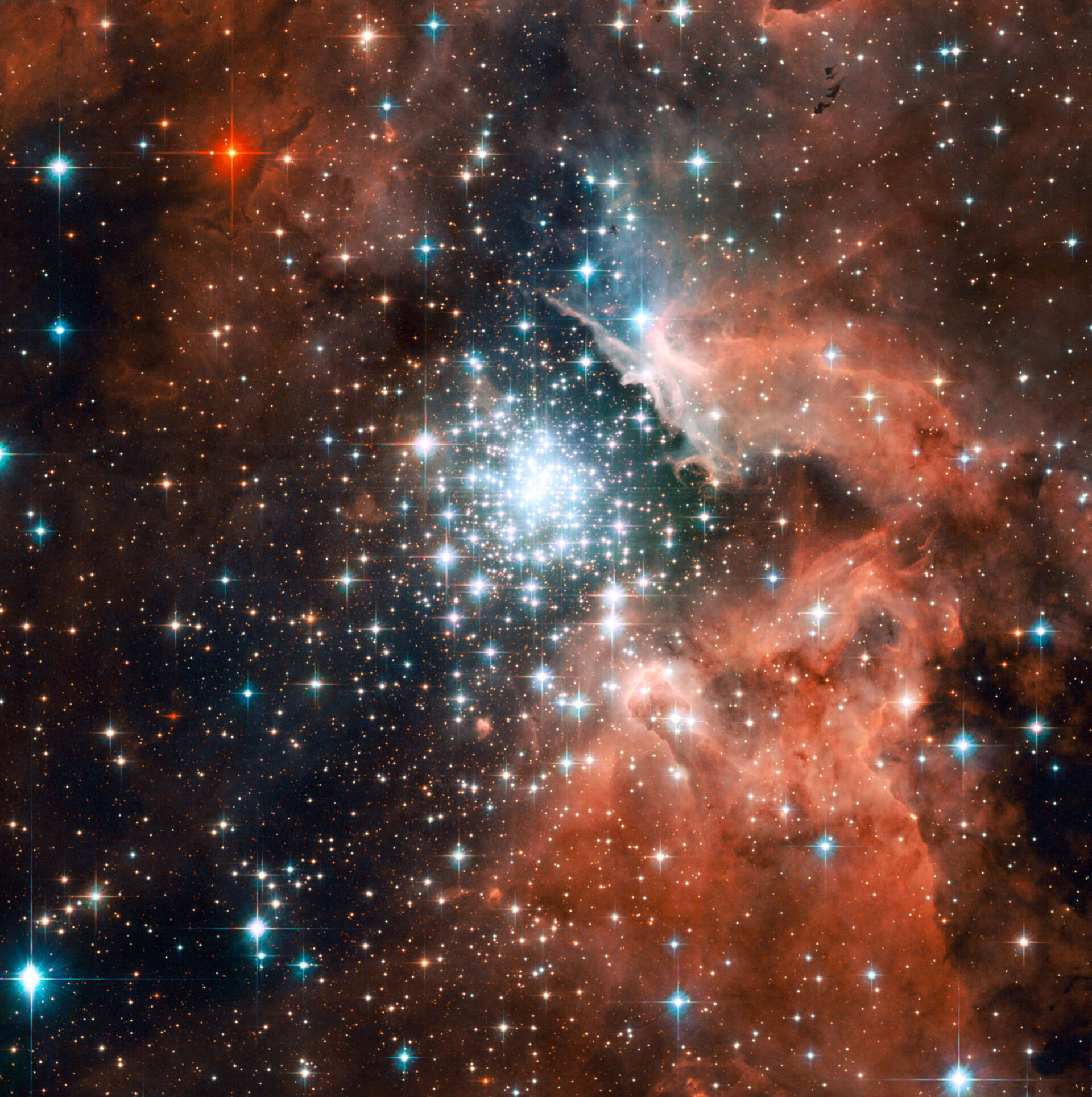
    The gigantic nebula NGC 3603 hosts one of the most prominent, massive, young clusters in the Milky Way. Hubble has been observing this prime location for star formation studies.

    NGC 3603 is located in the Carina spiral arm of the Milky Way, about 20 000 light-years from the Solar System.

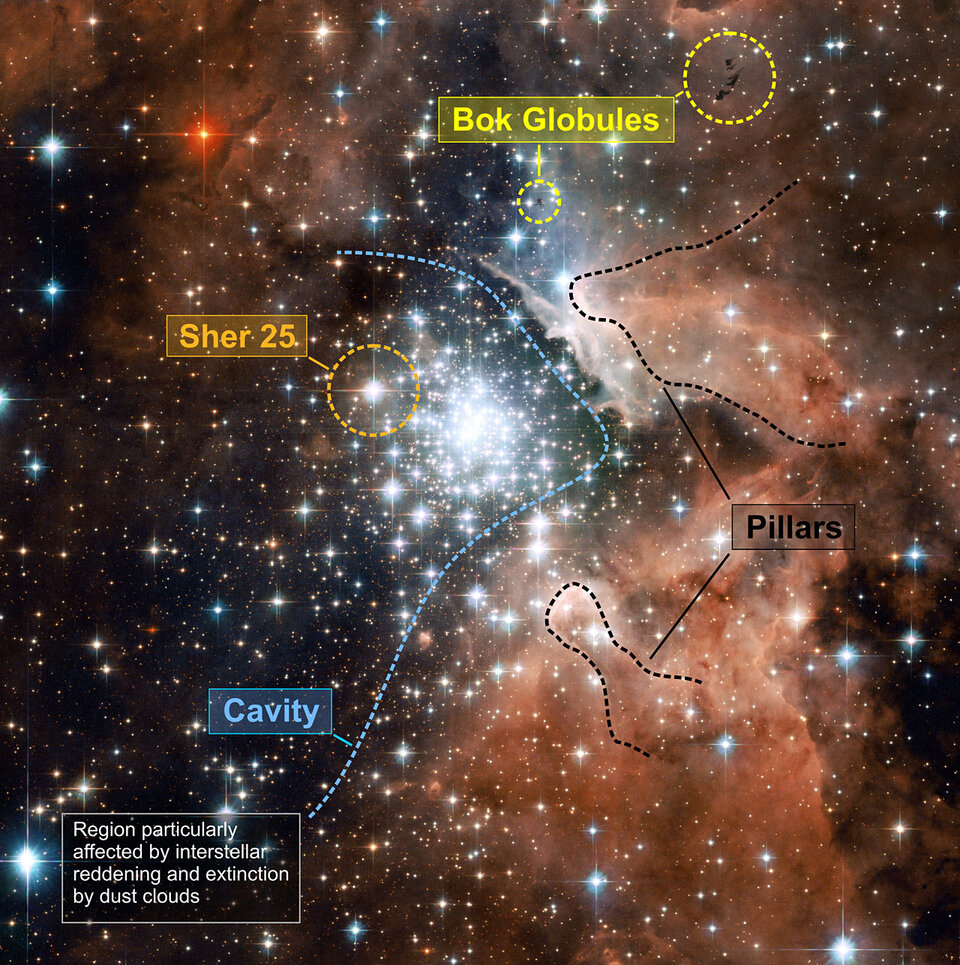
    Images from the NASA/ESA Hubble Space Telescope show a young star cluster surrounded by a vast region of dust and gas. Most of the bright stars in the image are hot, blue stars. They produce ultraviolet radiation and violent winds that have formed an enormous cavity in the gas and dust surrounding the cluster.

    Zooming into NGC 3603
    Zooming into NGC 3603

    The image shows many stars with differing masses but similar ages inside the young cluster. Stars of different masses evolve at a different pace, so this makes it possible to study several types of stars at varying stages in their lives, in detail. Astronomers can compare clusters of different ages with one another and determine which properties (such as temperature and brightness) change as the stars get older.

    Nebula NGC 3603

    Dr Jesús Maíz Apellániz from Instituto de Astrofísica de Andalucía, Spain, is leading the Hubble investigation. According to him, the cluster appears to gather the most massive stars at its core. His team has discovered that the distribution of different types of stars at the centre of this dense cluster is similar to that of other young clusters in the Milky Way.

    Apellániz's team has also found that the three brightest stars in the centre appear to be more massive than theoretical limits allow. In fact, these ‘heavyweights’ may actually consist of two or perhaps more individual massive stars whose light has blended together. Even with Hubble’s resolution, it is not possible to separate the individual stars in each of the three systems.
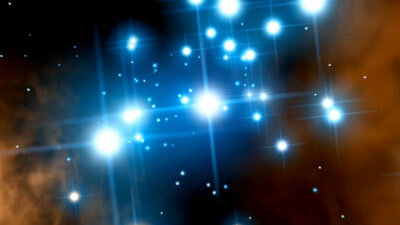
    The heart of NGC 3603
    The heart of NGC 3603

    This finding agrees with a recent discovery by Dr. Anthony Moffat from the Université de Montréal, Canada. He used ESO’s Very Large Telescope (VLT) and Hubble’s Near Infrared Camera and Multi-Object Spectrograph (NICMOS) to measure the movements of the individual stars in two of the three systems. Dr. Moffat measured the largest star’s mass to be roughly 115 times that of the Sun - which is within acceptable limits for conventional theory.
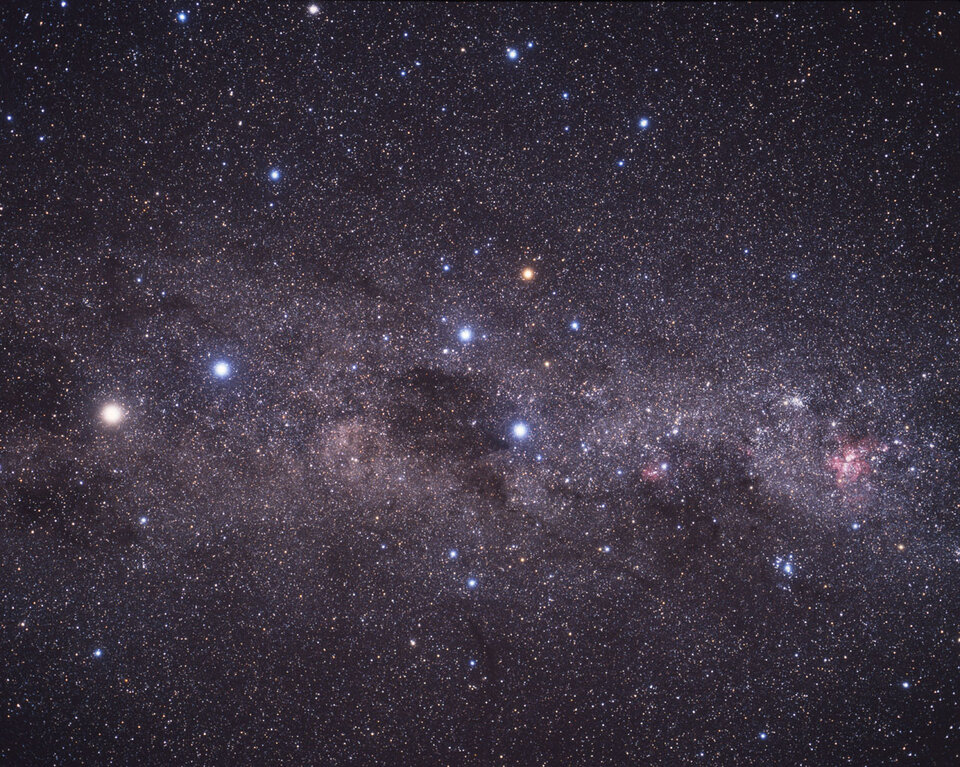
    The Milky Way

    The swirling nebula of NGC 3603 contains around 400 000 solar masses of gas. Lurking within this vast cloud are a few Bok globules, named after Bart Bok who first observed them in the 1940s.

    Bok globules are dark clouds of dense dust and gas with masses of about ten to fifty times that of the Sun. They resemble insect cocoons and are in the process of collapsing under their own weight, forming new stars. Bok globules appear to be some of the coldest objects in the Universe.

    NGC 3603 was first discovered by Sir John Herschel in 1834. It is known to harbour a blue supergiant star called Sher 25, believed to be on the verge of exploding as a supernova. It is often known as the Milky Way counterpart of the predecessor of the now-famous supernova SN 1987A in the Large Magellanic Cloud.
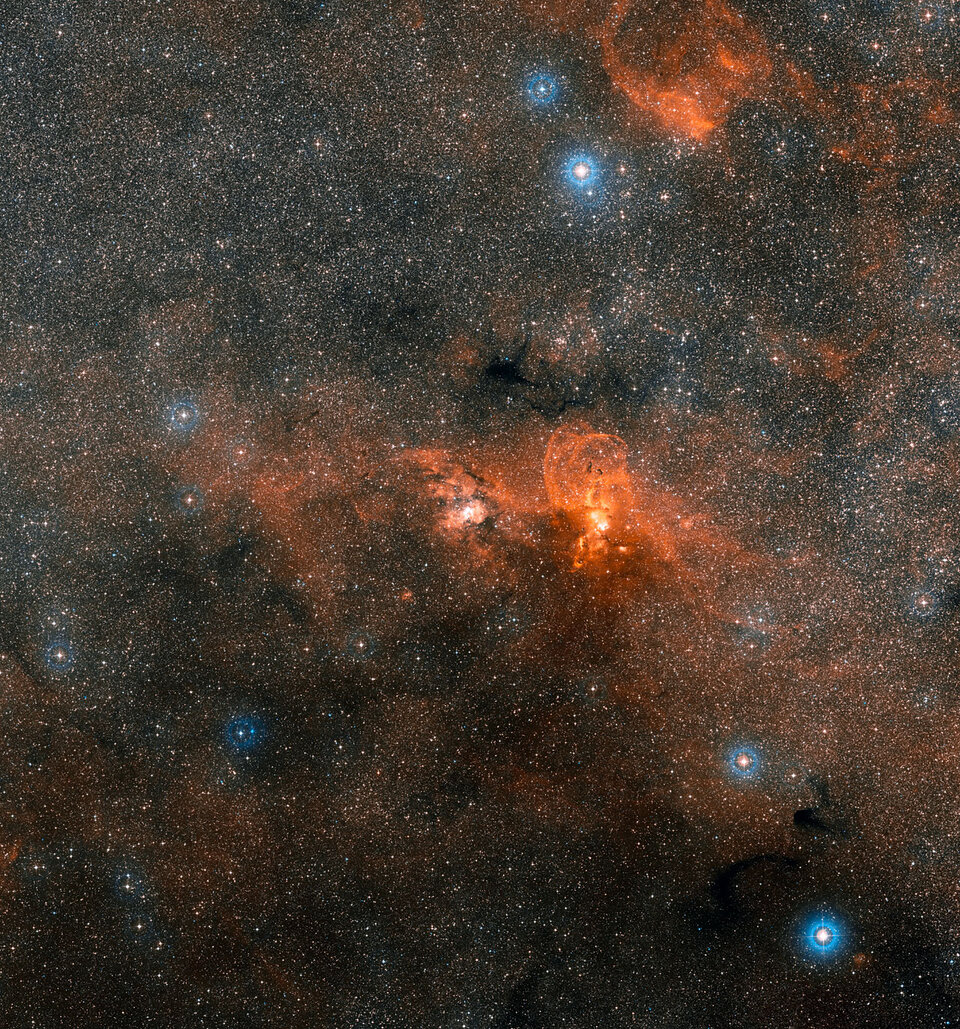
    The region of NGC 3603

    Notes for editors:

    The Hubble Space Telescope is a project of international cooperation between NASA and ESA.

    For more information:

    Jesús Maíz Apellániz, Instituto de Astrofísica de Andalucía, Spain
    Email: Jmaiz @ iaa.es

    Lars Lindberg Christensen, Hubble/ESA, Garching, Germany
    Email: Lars @ eso.org

    Ray Villard, Space Telescope Science Institute, Baltimore, USA
    Email: Villard @ stsci.edu

    Rate this

    Views

    Share

    • Currently 0 out of 5 Stars.
    • 1
    • 2
    • 3
    • 4
    • 5
    Rating: 0/5 (0 votes cast)

    Thank you for rating!

    You have already rated this page, you can only rate it once!

    Your rating has been changed, thanks for rating!

    374
    Tweet
    • More about...
    • Hubble overview
    • Hubblecast
    • Related articles
      • Extreme star cluster in new Hubble images
        • Hubble and Spitzer find 'Lego-block' galaxies in early Universe
          • Hubble uncovers the Veil Nebula
            • Stellar fireworks through Hubble’s eyes
              • Hubble sees dark matter ring in a galaxy cluster
                • Hubble sees multiple star generations in a globular cluster
                • Hubble rescue story
                  • Spectacular star birth pictures on Hubble’s 17th birthday
                    • Hubble’s view of barred spiral galaxy NGC 1672
                      • Hubble sees ‘Comet Galaxy’ being ripped apart by galaxy cluster
                        • The colourful demise of a Sun-like star
                          • New stars shed light on the past
                            • First 3D map of the Universe’s dark matter scaffolding
                            • Unfolding the Universe’s Dark Matter
                              • Latest views of the V838 Monocerotis light echo from Hubble
                              • Related Links
                              • This story at the Hubble European Information Centre
                              • Hubble European Information Centre

    Connect with us

    • RSS
    • Youtube
    • Twitter
    • Flickr
    • G+
    • Facebook
    • Livestream
    • Subscribe
    • App Store
    • ESA Science Twitter

    Follow ESA science

    • LATEST ARTICLES
    • · ESA astronaut Timothy Peake set fo…
    • · Space drives e-mobility
    • · Proba-V opens its eyes
    • · First new Galileo satellite arrive…
    • · Next destination: space
    • FAQ

    • Jobs at ESA

    • Site Map

    • Contacts

    • Terms and conditions