• → European Space Agency

      • Space for Europe
      • Space News
      • Space in Images
      • Space in Videos
    • About Us

      • Welcome to ESA
      • DG's News and Views
      • For Member State Delegations
      • Business with ESA
      • ESA Exhibitions
      • ESA Publications
      • Careers at ESA
    • Our Activities

      • Space News
      • Observing the Earth
      • Human Spaceflight
      • Launchers
      • Navigation
      • Space Science
      • Space Engineering
      • Operations
      • Technology
      • Telecommunications & Integrated Applications
    • For Public

    • For Media

    • For Educators

    • For Kids

    • ESA

    • Space Science

    • Our Universe
    • About Space Science
    • ESA's 'Cosmic Vision'
    • Science missions
    • Mission navigator
    • Target groups
    • For Media
    • For Scientists
    • For Kids
    • Multimedia
    • Science images
    • Science videos
    • Animations
    • Downloads
    • Sounds from space
    • Resources
    • Reference section
    • Services
    • FAQs
    • Glossary
    • Help
    • Portal terms of use
    • Comments
    • ESA Press Releases
    • Follow us
    • RSS feeds
    • ESA Sci on Twitter
    • ESA Space Science Images on Flickr
    • ESA 3D on Flickr

    ESA > Our Activities > Space Science

    DSC_0065

    Gaia’s instruments installed and ready for testing

    17 September 2012

    The payload module of ESA’s billion-star surveyor Gaia is integrated and ready for the next stage of rigorous testing it must undergo before launch next year.

    Once in space, Gaia will make precise measurements of the positions and motions of a billion stars. The information will be used to create a 3D map of stars in our home Galaxy, the Milky Way, revealing information about its composition, formation and evolution.

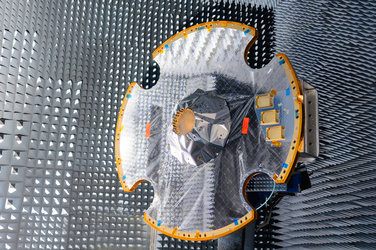
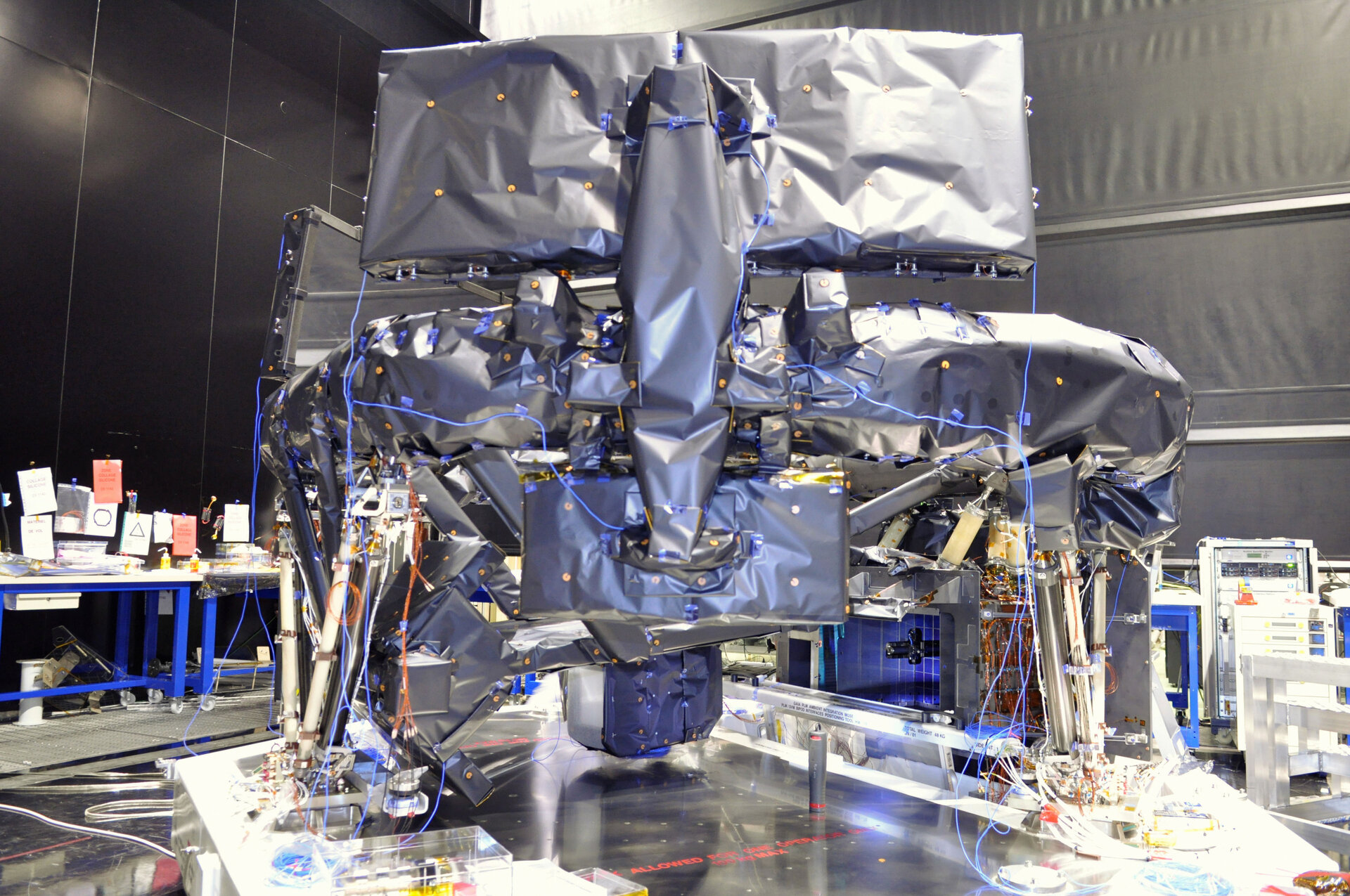
    This latest image shows the payload module in the Astrium cleanroom in Toulouse, France.

    The module is covered in grey and silver multilayer insulation fabric that protects the spacecraft’s optics and mirrors from the cold environment of space.

    Nearest to the camera, the rear of one of Gaia’s main telescope mirrors and one of the tertiary mirrors are visible. The second main mirror is just visible towards the back left of the image.

    The blue panel seen below and to the right of the image is the Focal Plane Assembly with its charge-coupled device sensors.

    This focal plane array will carry the largest digital camera ever built, with nearly a billion pixels.

    The integration process included the Radial Velocity Spectrometer (seen below the smaller mirror), which will help to measure the motions of stars, and the Basic Angle Monitor, which will ensure that the separation angle between the two telescopes is monitored in order to make precise distance measurements of stars. All of the optical components were also carefully aligned.

    The payload module will be mated to the service module, which houses units that provide resources such as thermal control, propulsion, communication, and attitude and orbit control, at the beginning of next year.

    Gaia will be launched from Europe’s Spaceport in French Guiana at the end of 2013.

    Rate this

    Views

    Share

    • Currently 0 out of 5 Stars.
    • 1
    • 2
    • 3
    • 4
    • 5
    Rating: 0/5 (0 votes cast)

    Thank you for rating!

    You have already rated this page, you can only rate it once!

    Your rating has been changed, thanks for rating!

    43
    facebook
    twitter
    reddit
    google plus
    digg
    tumbler
    digg
    blogger
    myspace
    • Archive
      • Image of the week archive
      • Space Live
        Space Live
        Space science image gallery
      • More about
        • Gaia overview
          • Gaia factsheet
          • Related articles
            • Dialling down the heat on ESA’s billion-star surveyor
              • Gaia checks out of antenna testing
                • Gaia spreads its wings
                  • Gaia to lift off from Europe’s Spaceport on a Soyuz launcher
                    • ESA selects prime contractor for Gaia astrometry mission
                      • Most extensive mapping of Milky Way a step closer
                        • Keeping ESA’s ‘lady of space’ cool
                          • The billion-pixel camera
                            • Mapping the Galaxy, and watching our backyard
                            • In depth
                            • This article in depth
                            • Gaia in depth
                            • Follow us
                            • ESA Space Science Image of the Week on Flickr
                            • ESA 3D on Flickr
                            • ESA Sci on Twitter

    Connect with us

    • RSS
    • Youtube
    • Twitter
    • Flickr
    • Google Buzz
    • Subscribe
    • App Store
    • ESA Science Twitter

    Follow ESA science

    • LATEST ARTICLES
    • · CryoSat hits land
    • · Ariane 5 completes seven launches …
    • · Measuring skull pressure without t…
    • · Malargüe station inauguration
    • · The solar wind is swirly
    • FAQ

    • Jobs at ESA

    • Site Map

    • Contacts

    • Terms and conditions