• → European Space Agency

      • Space for Europe
      • Space News
      • Space in Images
      • Space in Videos
    • About Us

      • Welcome to ESA
      • DG's News and Views
      • For Member State Delegations
      • Business with ESA
      • ESA Exhibitions
      • ESA Publications
      • Careers at ESA
    • Our Activities

      • Space News
      • Observing the Earth
      • Human Spaceflight
      • Launchers
      • Navigation
      • Space Science
      • Space Engineering
      • Operations
      • Technology
      • Telecommunications & Integrated Applications
    • For Public

    • For Media

      • Media
      • ESA TV
      • Videos for professionals
      • Photos
    • For Educators

    • For Kids

    • ESA

    • Launch Special

    • Planck

    • Herschel

    • ESA Science

    • About Planck

      • Science objectives
      • Planck highlights
      • History of microwave astronomy
    • The Microwave Universe

      • Why the microwave
      • Key questions
    • The spacecraft

      • Vital stats
      • Telescope
      • Instruments
      • Sophisticated spacecraft
    • The mission

      • Journey
      • Launch and early operations
      • Operating Planck
    • Meet the team

      • Planck Project Scientist: An interview with Jan Tauber
      • Herschel and Planck Programme Manager: An interview with Thomas Passvogel
    • Multimedia
    • Planck images
    • Planck videos
    • Science@ESA vodcast

    ESA > Our Activities > Space Science > Planck

    Planck instruments integrated – a leap towards launch

    Integration of HFI and LFI
    Top view of the focal plane assemblies of the two Planck instruments
    5 December 2006

    Earlier this month, ESA's Planck has reached an important milestone in its development. The 'focal plane units' of the two instruments to be flown on the spacecraft were integrated into a single assembly by Alcatel Alenia Space’s premises in Cannes, France.

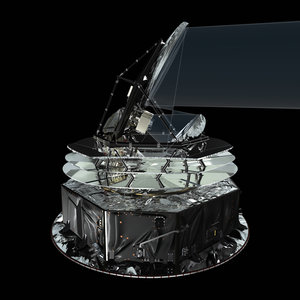
    To achieve its mission objectives – mapping the Cosmic Microwave background at the widest frequency range ever, to study the fossil radiation from the Big Bang - Planck will fly two instruments: the High Frequency Instrument (HFI) and the Low Frequency Instrument (LFI).

    Integration of HFI and LFI
    Integration of HFI and LFI

    Once in orbit, the Planck telescope will collect microwave radiation and will focus it onto the instruments' detector arrays in the two focal plane units. These units have just been integrated into a single assembly during a delicate procedure performed by Alcatel Alenia Space engineers on 20 November 2006.

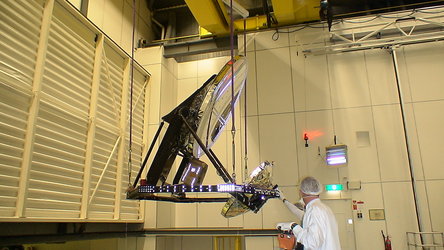
    The surgeon-like, 4-hour long operation consisted of making HFI 'descend' into LFI in such a way to prevent any contact between the two instruments. Following the successful integration, the combined HFI and LFI unit is now ready to be mated and aligned with the Planck telescope, which is already available for integration on the Planck spacecraft.


    Note to editors

    The High Frequency Instrument (HFI) was designed and built by a Consortium of scientists and Institutes from France, the United Kingdom, Canada, Germany, the United States, Ireland, The Netherlands, Denmark, Switzerland, Spain and Italy. The Consortium is led by Jean-Loup Puget (Principal Investigator) of the Institut d'Astrophysique Spatiale in Orsay (France), and Francois Bouchet (deputy Principal Investigator) of the Institut d'Astrophysique de Paris.

    The Low Frequency Instrument (LFI) was designed and built by a Consortium of scientists and Institutes from Sweden, Denmark, Spain, Italy, the United States, Germany, Finland, the United Kingdom, The Netherlands, Switzerland and Norway. The Consortium is led by Reno Mandolesi (Principal Investigator) of the Istituto Fisica Spaziale e Fisica Cosmica (IASF) in Bologna (Italy).

    Several funding agencies contributed to the instruments hardware: CNES (F), ASI (I), NASA (USA), PPARC (UK), Tekes (FIN), Spain, and ESA.

    For more information

    Thomas Passvogel, ESA Herchel/Planck Project Manager
    Email: thomas.passvogel @ esa.int

    Jan Tauber, ESA Planck Project Scientist
    Email: jan.tauber @ esa.int

    Rate this

    Views

    Share

    • Currently 0 out of 5 Stars.
    • 1
    • 2
    • 3
    • 4
    • 5
    Rating: 0/5 (0 votes cast)

    Thank you for rating!

    You have already rated this page, you can only rate it once!

    Your rating has been changed, thanks for rating!

    33
    Tweet
    • More about...
      • Herschel overview
        • Planck overview
        • Related articles
          • Planck instruments integrated – a leap towards launch
            • Planck instruments ready for integration
              • ESA’s Planck satellite builds on Nobel-prize-winning science
                • ESA’s Herschel and Planck launcher contract signed
                  • Planck telescope behaves well in cold vacuum
                    • Max Planck: Originator of quantum theory
                      • Travelling back in time
                        • Is the Universe finite or infinite? An interview with Joseph Silk
                          • Observations: Seeing in microwave wavelengths
                            • What are Lagrange points?
                              • Cosmic Microwave Background (CMB) radiation
                                • The largest telescope mirror ever put into space
                                  • Why infrared astronomy is a hot topic
                                    • Caroline and William Herschel: Revealing the invisible
                                      • L2, the second Lagrangian Point
                                      • Related links
                                      • Integration of Planck's Two Instruments
                                      • Arianespace
                                      • About Ariane 5 ECA
                                      • Ariane 5 ECA

    Connect with us

    • RSS
    • Youtube
    • Twitter
    • Flickr
    • G+
    • Facebook
    • Livestream
    • Subscribe
    • App Store
    • LATEST ARTICLES
    • · The fast winds of Venus are gettin…
    • · ExoMars 2016 set to complete const…
    • · Herschel ends operations as orbiti…
    • · Europe’s largest spaceship reache…
    • · ATV ready to nose up to Station
    • FAQ

    • Jobs at ESA

    • Site Map

    • Contacts

    • Terms and conditions