• → European Space Agency

      • Space for Europe
      • Space News
      • Space in Images
      • Space in Videos
    • About Us

      • Welcome to ESA
      • DG's News and Views
      • For Member State Delegations
      • Business with ESA
      • ESA Exhibitions
      • ESA Publications
      • Careers at ESA
    • Our Activities

      • Space News
      • Observing the Earth
      • Human Spaceflight
      • Launchers
      • Navigation
      • Space Science
      • Space Engineering
      • Operations
      • Technology
      • Telecommunications & Integrated Applications
    • For Public

    • For Media

    • For Educators

    • For Kids

    • ESA

    • Rosetta

    • ESA Science

    • About Rosetta

      • Europe's comet chaser
      • Why 'Rosetta'?
    • About the spacecraft

      • The Rosetta orbiter
      • Orbiter: Instruments
      • The Rosetta lander
      • Lander: Instruments
    • About the journey

      • The long trek
      • Debris of the Solar System: Asteroids
      • Asteroid (2867) Steins: a portrait
      • Life and survival in deep space
      • Long-distance communication
      • The Rosetta ground segment
    • About the arrival

      • Comets - an introduction
      • Comet 67P/Churyumov- Gerasimenko
      • Comet rendezvous
      • Giotto - ESA's first comet mission
    • Meet the team
    • Mission Manager
    • Project Scientist
    • Multimedia
    • VideoTalk
    • 3D Flash 'model'
    • Rosetta images
    • Rosetta videos
    • Rosetta Animations
    • Rosetta wallpaper
    • Life of a comet
    • Services
    • Frequently asked questions
    • Comments

    ESA > Our Activities > Space Science > Rosetta

    Rosetta camera view of Tempel 1 brightness

    Animated false-colour representation of comet brightness
    4 July 2005

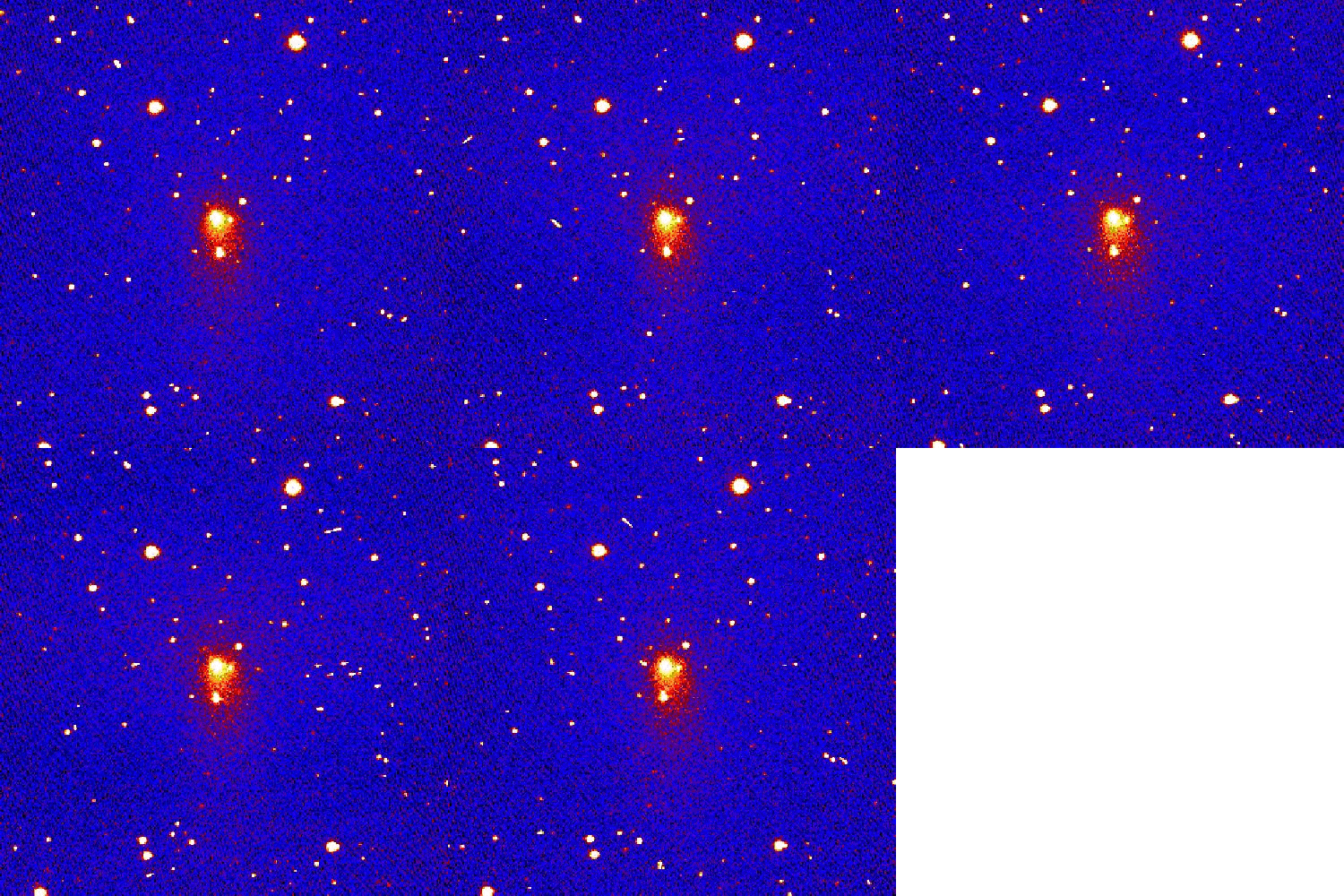
    These animations, composed of images taken by the OSIRIS Narrow Angle Camera on board ESA's Rosetta spacecraft, shows how the brightness of Comet 9P/Tempel 1 developed after impact.

    False-colour representation of comet brightness (still)

    The separate false-colour images in this sequence from OSIRIS were taken at five-minute intervals around the impact time of 07:52 CEST (05:52 GMT/UT).

    Although in the false-colour images (a still seen here at right) the increase in visual brightness is not so obvious, it becomes very clear in the animated surface plot below.


    Increase in visual brightness plotted in 3D

    In this second animation, at left, the brightness of image pixels seen by OSIRIS is plotted 'three-dimensionally', i.e. the brighter they are, the higher they are in the plot.

    Still from animated surface plot

    Here a still image shows the first and last image from the animated sequence above.

    A 'light curve' of Comet 9P/Tempel 1

    Using its clear filter, the OSIRIS Narrow Angle also produced a 'light curve' of Comet 9P/Tempel 1. This shows how the comet's intensity varies in time, starting from impact.

    The light curve shows that about 30 minutes after impact the brightness of the comet had increased by five times.

    After this phase, scientists also noticed that the brightness level fluctuated for about one hour with no overall increase, then seemed to decrease, but much more slowly than the initial increase.

    As more data come in from Rosetta, ESA scientists will be able to refine images and results.

    For more information:

    Gerhard Schwehm, ESA Rosetta Project Scientist
    E-mail: gerhard.schwehm @ esa.int

    Rate this

    Views

    Share

    • Currently 0 out of 5 Stars.
    • 1
    • 2
    • 3
    • 4
    • 5
    Rating: 0/5 (0 votes cast)

    Thank you for rating!

    You have already rated this page, you can only rate it once!

    Your rating has been changed, thanks for rating!

    78
    Tweet
    • ESA's comet chaser
    • More about...
      • Rosetta factsheet
        • XMM-Newton factsheet
          • Hubble factsheet
          • NASA Deep Impact
          • ESO Deep Impact news
          • Related articles
            • Life of a comet
              • Tempel 1: Biography of a comet
                • Rosetta monitors Deep Impact
                  • XMM-Newton to observe Deep Impact
                    • Hubble sees outburst from Deep Impact comet
                      • ESA observes Deep Impact from Earth
                        • Dust and gas from Comet 9P/Tempel 1 seen by ESA OGS
                          • Tempel 1 is weak X-ray source, XMM-Newton confirms

    Connect with us

    • RSS
    • Youtube
    • Twitter
    • Flickr
    • G+
    • Facebook
    • Livestream
    • Subscribe
    • App Store
    • LATEST ARTICLES
    • · ESA astronaut Timothy Peake set fo…
    • · Space drives e-mobility
    • · Proba-V opens its eyes
    • · First new Galileo satellite arrive…
    • · Next destination: space
    • FAQ

    • Jobs at ESA

    • Site Map

    • Contacts

    • Terms and conditions