Rosetta monitors Deep Impact
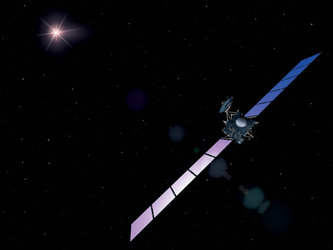
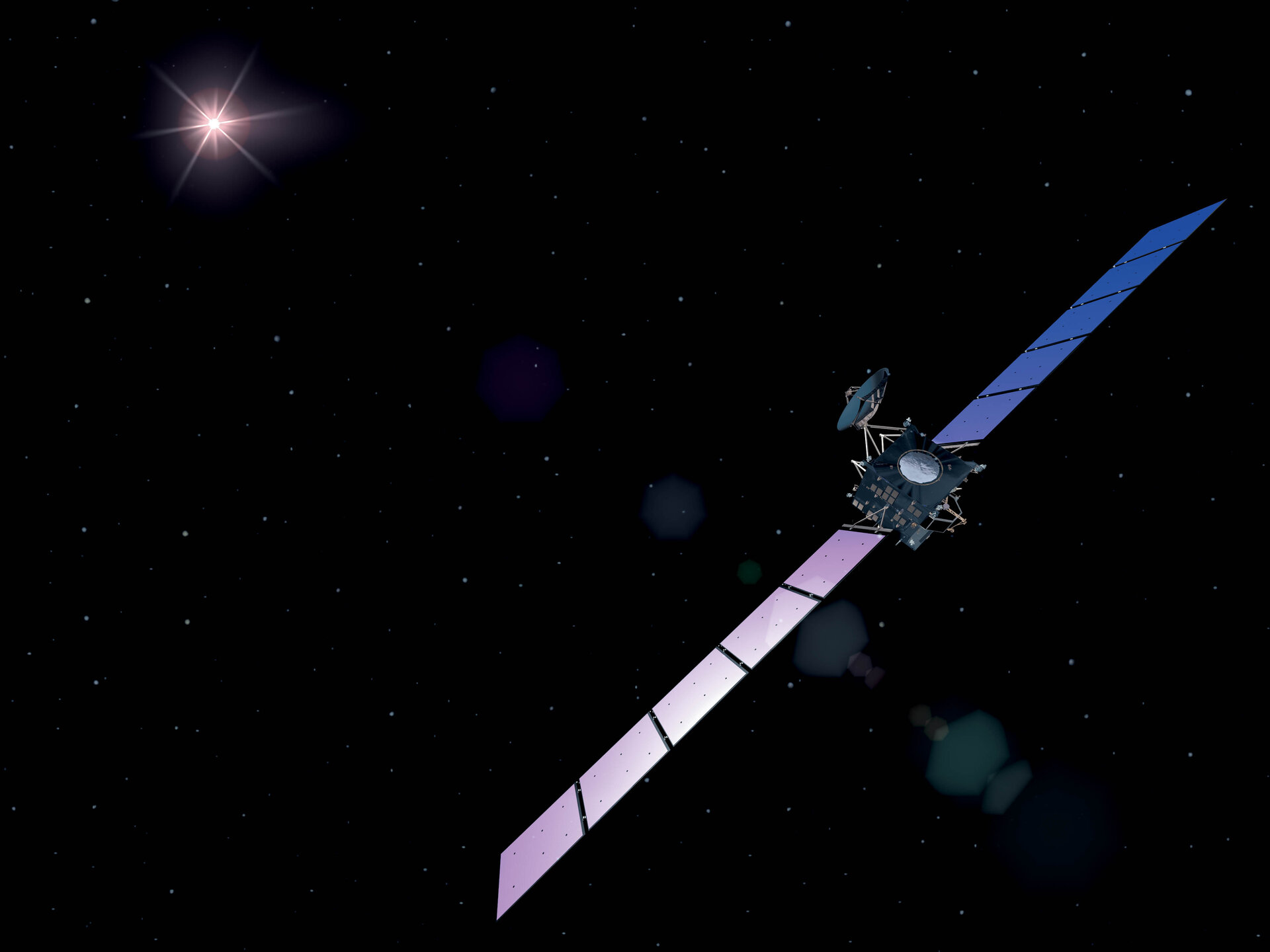
ESA’s comet chaser Rosetta will take part in one of the world’s largest astronomical observation campaigns - the Deep Impact event - while on its cruise to Comet 69P/Churyumov-Gerasimenko. Rosetta will be watching from 29 June to 14 July 2005.
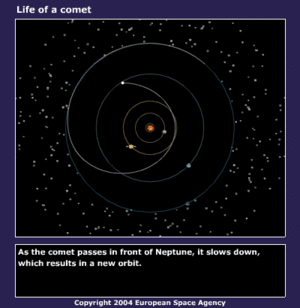
Deep Impact is a NASA mission to send a 370 kg copper ‘impactor’ probe to Comet 9P/Tempel 1 on 4 July 2005. Tempel 1 is a short-period comet, whose orbit runs between those of Mars and Jupiter. There is scientific interest in comets because their composition carries important information about the origin of the Solar System, as they have remained basically unchanged since then.
Rosetta, with its set of very sensitive instruments for cometary investigations, will use its capabilities to observe Tempel 1 before, during and after the impact. At a distance of about 80 million kilometres from the comet, which will be lying about 90 degrees from the Sun, Rosetta will be in the most privileged position to observe the event from space.
The observing geometry will be favourable for observations with Rosetta’s microwave spectrometer, MIRO, and the VIRTIS visual and IR mapping spectrometer. MIRO will concentrate on the chemical composition and temperature of the gas. VIRTIS will analyse thermal emission by the comet to determine the composition of the dust ejected, and thus reveal the comet’s mineralogy.
In addition, Rosetta will be the spacecraft carrying the best available ultraviolet instrument, ALICE, to monitor the event. ALICE will analyse the gas coming from the impact and tell about its chemical composition.
The Rosetta OSIRIS imaging system will also provide images of the comet’s nucleus from a far-away distance. Scientists also hope to make a 3D reconstruction of the dust cloud around the comet by combining the OSIRIS images with those taken from ground observatories.
Rosetta’s observations will provide a unique data set complementary to the observations from the Deep Impact spacecraft and the ground-based telescopes. Before impact, Rosetta will observe Tempel 1 during three full rotations of the comet around its axis. This allows characterising the variations of the comet’s state over rotation and time, and preparing for the observations during and after impact.
Rosetta will look at the comet continuously. In the initial phase (starting on 29 June 01:34 CEST), when the comet is expected to change only slowly due to its rotation, Rosetta will take the time to study or ‘dwell’ on several areas on the coma of Tempel 1.
About fifteen minutes before impact (due about 07:52 CEST), Rosetta will start observing the comet with shorter dwell time, as fast changes are expected due to the impact. At 09:19, about one hour and a half after impact, Rosetta will go back to the monitoring mode as before the impact for 10 more days.

Rosetta will contribute to the major objectives of the Deep Impact mission.
The spacecraft’s instruments will measure the composition of the crater and its ejected material – a cloud of dust and gas cloud expected to expand and reach its maximum brightness about 10 hours after impact. Rosetta will also monitor the changes in the natural outgassing of the comet following the impact.
With these observations, Rosetta may also help to confirm if the impact has permanently triggered new activity on the comet.
For more information:
Gerhard Schwehm, ESA Rosetta Project Scientist
E-mail: gerhard.schwehm @ esa.int