• → European Space Agency

      • Space for Europe
      • Space News
      • Space in Images
      • Space in Videos
    • About Us

      • Welcome to ESA
      • DG's News and Views
      • For Member State Delegations
      • Business with ESA
      • ESA Exhibitions
      • ESA Publications
      • Careers at ESA
    • Our Activities

      • Space News
      • Observing the Earth
      • Human Spaceflight
      • Launchers
      • Navigation
      • Space Science
      • Space Engineering
      • Operations
      • Technology
      • Telecommunications & Integrated Applications
    • For Public

    • For Media

    • For Educators

    • For Kids

    • ESA

    • Venus Express

    • ESA Science

    • Europe goes to Venus

      • Tribute to the cryptic planet
      • Penetrating an impenetrable world
      • Past missions to Venus
    • About Venus Express

      • Venus Express mission facts
      • Venus Express objectives
      • The spacecraft
      • Orbiter instruments
      • The launcher
      • Operating Venus Express
    • About Venus

      • Venusian geography
      • The surface
      • Acid clouds and lightning
      • Greenhouse effect, clouds and winds
      • Venus compared to Earth
    • Meet the team

      • International collaboration
      • Project Manager: An interview with Don McCoy
      • Project Scientist: An interview with Håkan Svedhem
      • Launch Campaign Manager: An interview with Michael Witting
      • Spacecraft Operations Manager: An interview with Andrea Accomazzo
      • Venus Express Flight Control Team
      • Principal Investigators
    • Multimedia
    • Venus Express images
    • Venus Express videos
    • VideoTalk
    • 3D Flash 'model'
    • Build a model (pdf)
    • Wallpapers
    • Screensavers
    • Services
    • Comments

    ESA > Our Activities > Space Science > Venus Express

    Venus Express seeks out gases below the clouds

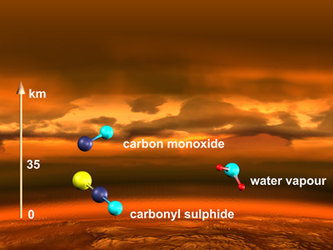
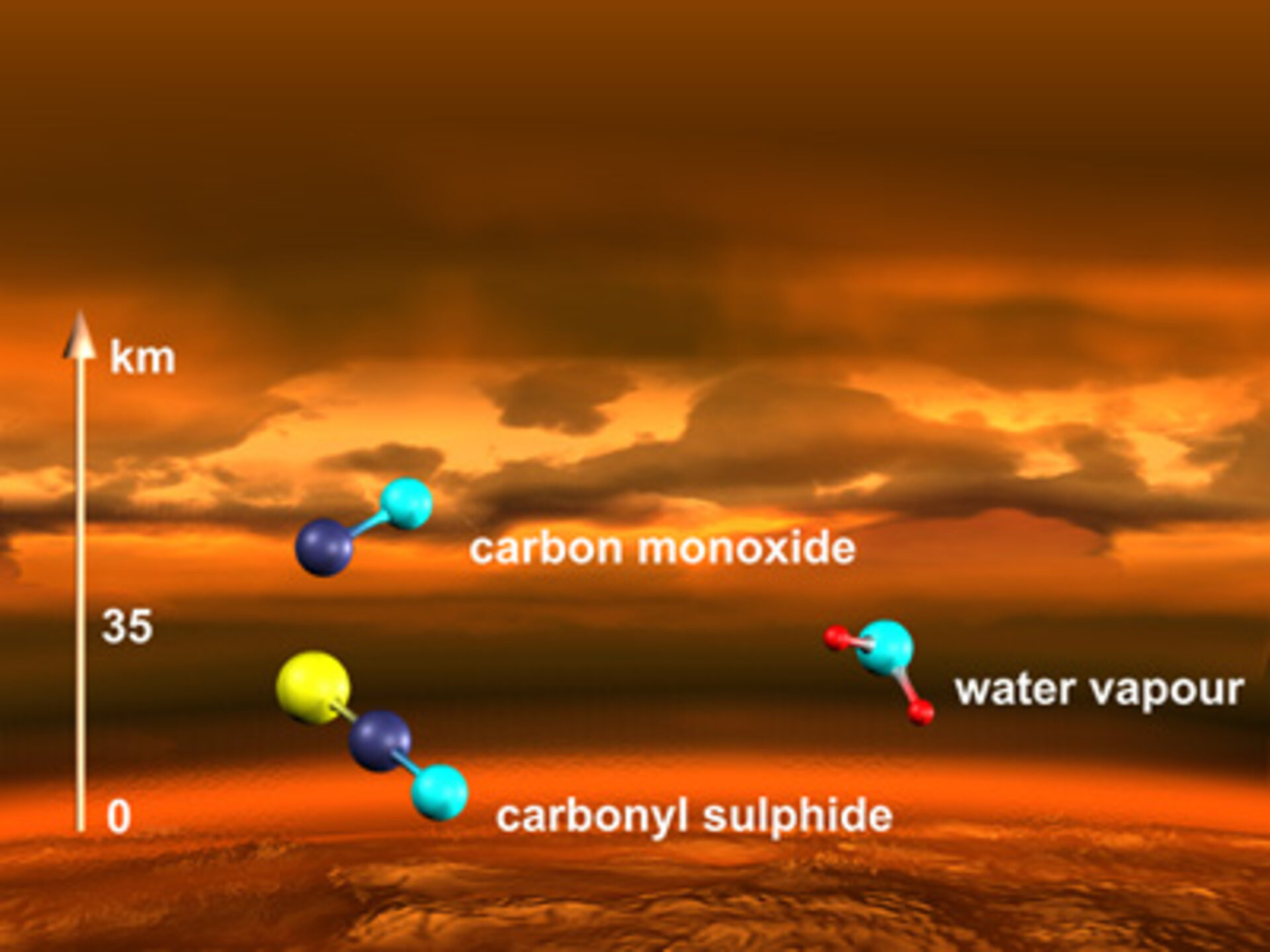
    Molecules in the Venusian atmosphere
    Molecules in the Venusian atmosphere
    4 February 2008

    ESA’s Venus Express has recently ‘peeled back’ the thick clouds around Venus to provide the most accurate and wide-ranging map of water vapour and other gases in the lower atmosphere to date.

    As a planet, Venus does not radiate a significant amount of visible light. But because of the searing temperatures below its thick cloud layer, reaching 200°C at an altitude of 35 km and more than 450°C at the surface, there is great deal of infrared radiation coming from beneath.

    At certain wavelengths, or infrared ‘windows’, this radiation can pass through the thick clouds, carrying information on what lies below. For example, its intensity, and how it peaks or dips at certain wavelengths, can tell us a lot about the composition of the atmosphere.

    Thanks to the unique ability of its VIRTIS spectrometer to use these spectral windows, Venus Express has mapped the atmosphere over many orbits and has covered the lower atmosphere for the first time.

    The atmosphere of Venus is dominated by carbon dioxide but as VIRTIS looked on, it detected the signature of carbon monoxide, an unusual find in the planet’s deep atmosphere. Looking further, in higher resolution, scientists also found carbonyl sulphide and water vapour. Since the early 1980s these molecules were known to exist on Venus, but before Venus Express they had never been measured and mapped so extensively and accurately.

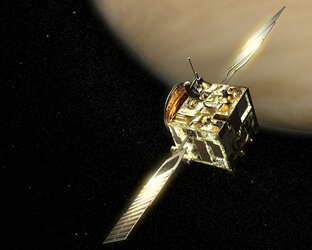
    Venus Express
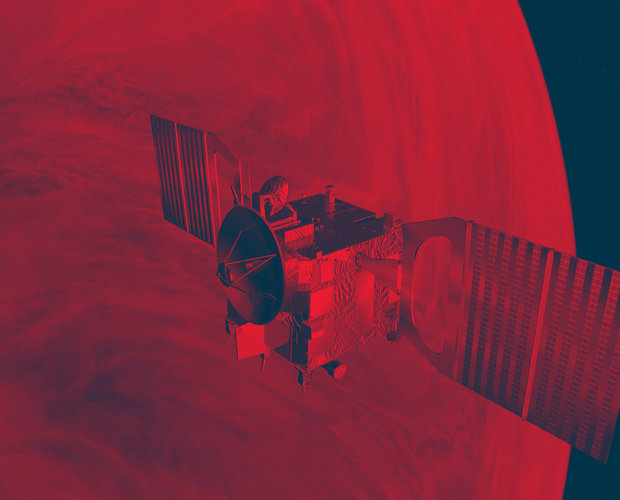
    Artist's impression of Venus Express

    Carbon monoxide is such a rarity on Venus that it can be used as a tracer to monitor circulation patterns in the atmosphere. It is like studying the flow of fluorescent ink dropped into a liquid to reveal the circulation pattern in the liquid itself.

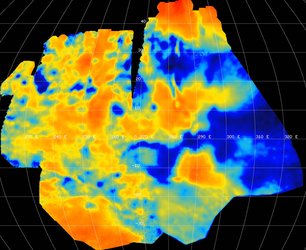
    The presence of carbonyl sulphide is usually linked to carbon monoxide: wherever there is abundant carbonyl sulphide, there will be little carbon monoxide and vice versa. Past observations have already suggested that this is the case, and VIRTIS has mapped the distribution with greater accuracy.

    The results confirm what meteorological models have shown: that such an inverse relationship between the abundances of molecules is due to the large-scale circulation of the atmosphere. The air rises at the equator to higher altitudes and moves towards higher latitudes, both north and south, where it descends, transporting the gases as it goes along.

    The existence and abundance of water vapour in Venus’s atmosphere has been a subject of debate for many years because the molecule is very difficult to monitor in the lower atmosphere from space. Venus Express has now detected and measured and mapped the amount of water vapour in the lower atmosphere, with unprecedented spatial resolution.


    Notes for editors:

    The findings have been reported in ‘Variability of CO, OCS And H2O Below The Clouds of Venus From VIRTIS-H Night-side Spectra,’ by E. Marcq, B. Bezard, P. Drossart, G. Piccioni and the VIRTIS Team, presented at the American Astronomical Society’s Division of Planetary Sciences meeting in October 2007.

    For more information:

    Pierre Drossart, Observatoire de Paris, France
    Email : Pierre.Drossart @ obspm.fr

    Giuseppe Piccioni, IASF-INAF, Italy
    Email : Giuseppe.Piccioni @ iasf-roma.inaf.it

    Håkan Svedhem, ESA Venus Express Project Scientist
    Email : Hakan.Svedhem @ esa.int
    Rate this

    Views

    Share

    • Currently 0 out of 5 Stars.
    • 1
    • 2
    • 3
    • 4
    • 5
    Rating: 0/5 (0 votes cast)

    Thank you for rating!

    You have already rated this page, you can only rate it once!

    Your rating has been changed, thanks for rating!

    79
    Tweet
    • Looking at Venus
    • ESApod: Venus Express
    • Related articles
    • Venus Express educational film
      • Venus Express seeks out gases below the clouds
      • Interviews: the martian water cycle and climate
        • ESA to present the latest Venus Express results to the media
          • Lifting the Venusian veil, two years since launch
            • Setting stars reveal planetary secrets
              • 500 days at Venus, and the surprises keep coming
                • Venusian rendezvous results: chapter one
                  • Venus Express and MESSENGER to look at Venus in tandem
                    • Ground-based observatories join forces with Venus Express
                      • Join ESA on the Venus observation campaign
                      • In depth
                      • This article in depth
                      • Venus Express in-depth

    Connect with us

    • RSS
    • Youtube
    • Twitter
    • Flickr
    • G+
    • Facebook
    • Livestream
    • Subscribe
    • App Store
    • LATEST ARTICLES
    • · ESA astronaut Timothy Peake set fo…
    • · Space drives e-mobility
    • · Proba-V opens its eyes
    • · First new Galileo satellite arrive…
    • · Next destination: space
    • FAQ

    • Jobs at ESA

    • Site Map

    • Contacts

    • Terms and conditions