Comet dust brought back to Earth: paving the way for Rosetta
Scientists around the world eagerly await the arrival of sample particles from Comet Wild 2, which are being brought back to Earth by the US Stardust spacecraft on 15 January this year.
The NASA Stardust mission was launched over seven years ago and has travelled several thousand millions of kilometres in deep space, chasing Comet Wild 2.
In January 2004, the spacecraft encountered the comet to collect samples of particles ejected from its nucleus.
This was achieved with a sample canister containing cells filled with ‘Aerogel’, an extremely lightweight, porous material based on silicon technology, ideal for slowing down the fast-moving dust particles and collecting them. These particles are moving at ‘hypervelocities’, i.e. speeds of up to seven kilometres per second.
During the encounter with Wild 2, the canister was exposed to the cometary particles and then retracted inside the spacecraft and stored in its Sample Return Capsule. The spacecraft then began its two-year journey back to Earth to return carrying its precious cargo. Also a sample of interstellar dust was collected during the journey.

When we want to understand the origin and evolution of the Solar System, comets are among the most informative of its inhabitants. They formed four and a half thousand million years ago and have remained almost unchanged since then.
Studying them can provide important clues about the origin of the material out of which the Solar System formed, and could even help in understanding the origins of life on Earth.
"Missions like Stardust provide not only valuable data by the first-ever study in terrestrial laboratories of particles ejected from a known comet and collected in the very close vicinity to it," said Gerhard Schwehm, ESA’s Rosetta Project Scientist.
"Results from such missions, which include ESA’s Giotto spacecraft to Comet Halley in 1986, are also very important for the preparation and fine-tuning of the scientific investigations on future cometary missions, such as the European comet-chaser Rosetta."
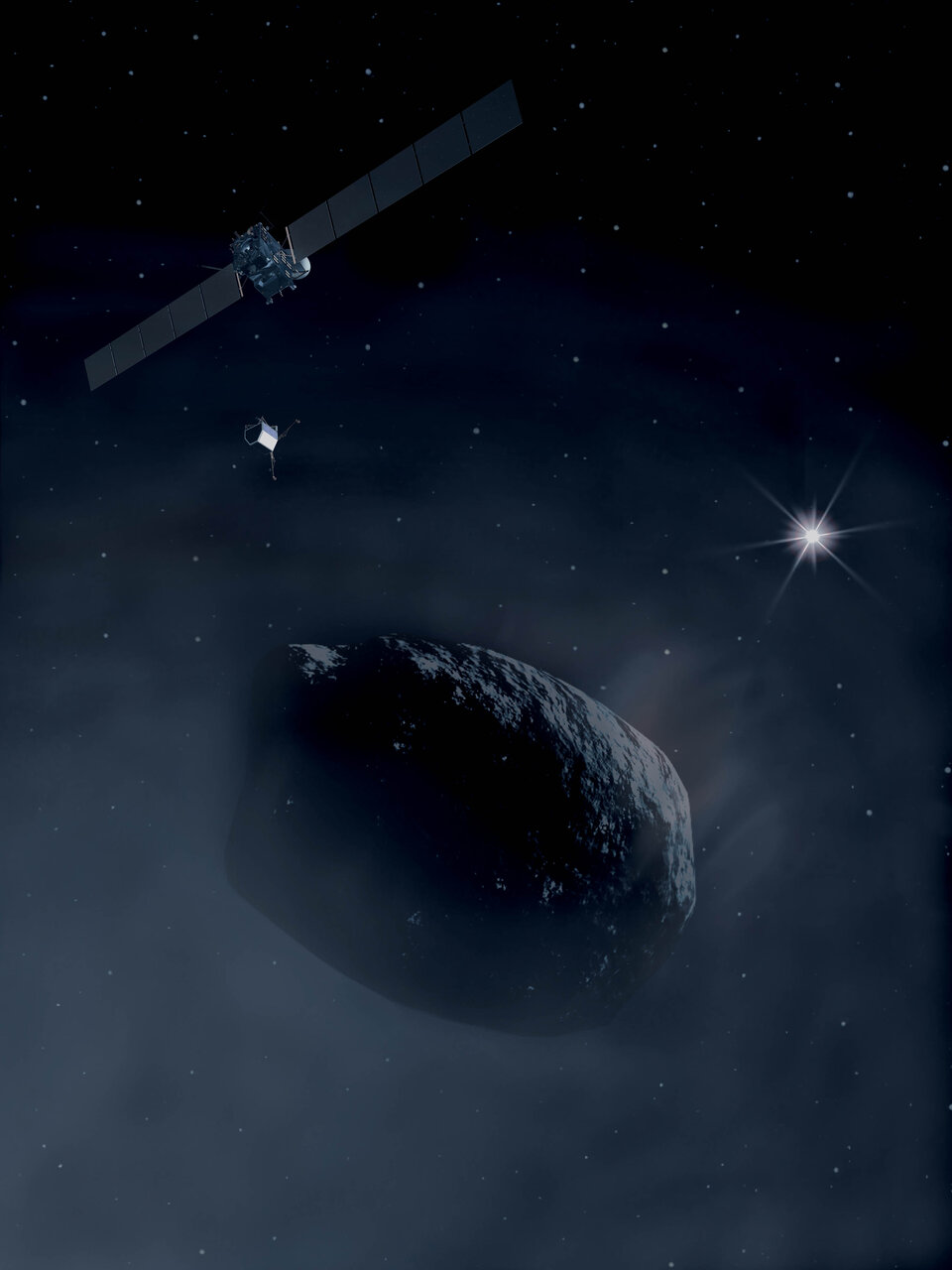
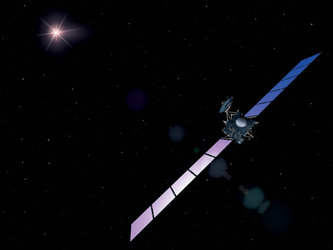
Launched in 2004, Rosetta is now travelling on a long route around the Sun to rendezvous with Comet Churyumov-Gerasimenko in 2014 and deliver a lander onto its surface.
With Stardust, scientists will have access to information about particles collected from the ‘coma’, the halo of dust and gas surrounding the comet tail.
"These tiny particles, mostly micrometres in size, will be cut into even finer pieces and will be analysed with the very best instruments and at the highest level of detail for Earth-based labs," continued Schwehm.
"With Rosetta, we will study the comet in situ in all its aspects – the tail, the coma and even the surface, the comet ‘mantle’. Instead of bringing the comet material to our laboratories, Rosetta will take the ‘laboratory’ to the comet.
"In particular, our sophisticated suite of instruments will allow us not only to fully characterise the comet’s particle content – chemical composition and other physical properties – but also the volatile content. This means we don’t potentially lose any of these properties during a transport back to Earth," he adds.
"However, thanks to Stardust, the analysis of coma particles on Earth will provide the whole scientific community with an unprecedented close-up view. For instance, the analysis of the ‘isotopic ratio’ of the elements in the dust grains (finding the percentage and the nature of ‘decayed’ atoms in the dust) gives important information about where and how this material was formed," concluded Schwehm.
Notes to editors:
Stardust is a mission in NASA's Discovery Programme of lower cost, highly focused Solar System investigations. It is a collaborative mission between NASA, universities and industry partners.
Among its three dedicated science packages, the mission hosts a fully European experiment – the Comet and Interstellar Dust Analyser (CIDA), built by the Max Planck Institut für Extraterrestrische Physik, Germany.
The purpose of the instrument, derived from the design of an instrument flown on ESA’s Giotto mission and the Russian Vega spacecraft to Comet Halley, is to intercept cometary dust for a real-time preliminary analysis of its chemical composition.
Another European contribution is provided by the Planetary and Space Science Research Institute of the Open University, UK. This includes the design and provision of sensors for the Dust Flux Monitoring instrument, dust coma modelling, development of sample extraction and characterisation techniques in Aerogel. This group also builds strongly on their experience gained in their involvement on the Giotto mission.
Rosetta's main objective is to rendezvous with Comet 67P/Churyumov-Gerasimenko. It will study the nucleus of the comet and its environment in great detail for a period of nearly two years, and land a probe on its surface. ESA's Rosetta will be the first mission ever to orbit and land on a comet.
For more information:
Gerhard Schwehm, ESA Rosetta Project Scientist
E-mail: gerhard.schwehm @ esa.int
Michel van Baal, ESA/ESTEC Communications Office
Tel: (office hours) +31 71 565 3006
Tel: (weekend) +31 651 181 553
E-mail: michel.van.baal @ esa.int