Rosetta gets first glimpse of Deep Impact target
ESA’s Rosetta comet-chaser spacecraft has acquired its first view of the Deep Impact target, Comet 9P/Tempel 1.
This first Rosetta image of the Deep Impact campaign was taken by its Navigation Camera (NAVCAM) between 08:45 and 09:15 CEST on 28 June 2005.
The image shows that the spacecraft now points towards Comet 9P/Tempel 1 in the correct orientation. The NAVCAM is pointing purposely slightly off-target to give the best view to the science instrumentation.
The NAVCAM system on board Rosetta was activated for the first time on 25 July 2004. This system, comprising two separate independent camera units (for back-up), will help to navigate the spacecraft near the nucleus of Comet 67P/Churyumov-Gerasimenko in ten years time.
In the meantime though, the cameras can also be used to track other objects, such as Comet Tempel 1, and the two asteroids that Rosetta will be visiting during its long cruise, Steins and Lutetia.
The cameras perform both as star sensors and imaging cameras (but not with the same high resolution as some of its other instruments), and switch functions by means of a refocusing system in front of the first lens.
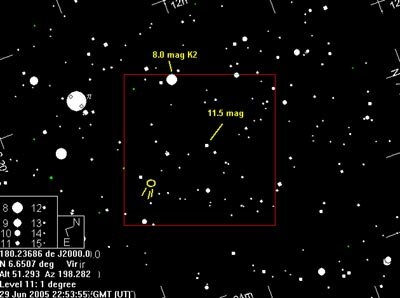
The magnitude of Comet Tempel 1 is at the detection limit of the camera: it is not as easily visible in the raw image and the image here is a composite of 20 exposures of 30 seconds each.
The comet is the fuzzy object with the tail in the lower left of the image. The faintest stars visible in this image are about 13th magnitude, the bright star in the upper left is about 8th magnitude. The image covers about 0.5 degrees square, and celestial north is to the right.