Call for Media: Giotto and Rosetta – 25 years of comet science
ESA PR 17 2011 Twenty-five years ago, ESA's Giotto spacecraft made its mark in deep space. Passing Halley’s comet at a distance of only 600 km, Giotto was the first mission to perform a close comet flyby.
It was nearly destroyed by the encounter but the images it took changed our picture of comets forever. Comets are the primitive remnants of the Solar System, representing the unused building blocks that missed out on forming the planets. As such, they provide an invaluable glimpse into what made up the planets.
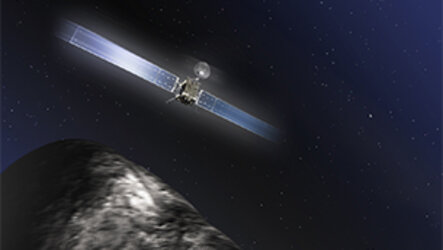
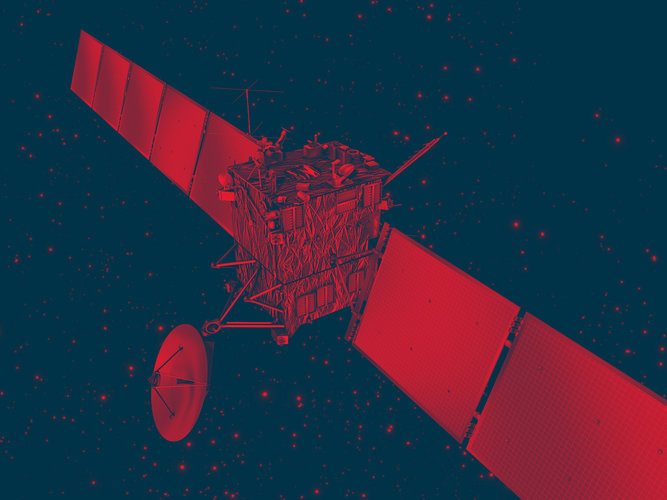
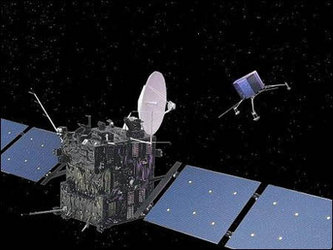
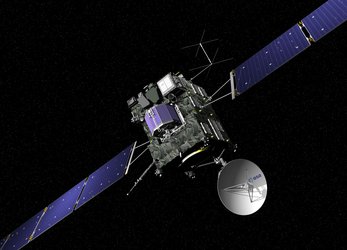
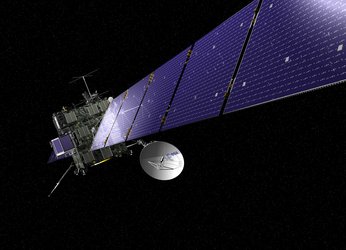
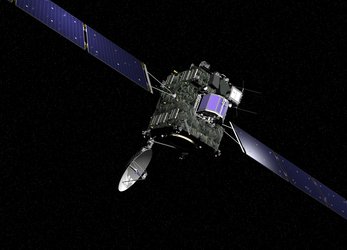
Since Giotto, the torch of comet science has been handed over to Rosetta, ESA's comet-chaser. Rosetta, launched on an Ariane 5 in 2004, will rendezvous with comet 67/P Churyumov–Gerasimenko in 2014, orbiting it for long-term studies and releasing a lander onto the icy surface for in-situ investigations.
Rosetta broke a record in July 2010 when it became the most distant spacecraft ever to operate on solar power alone. As it moves ever further from the Sun, Rosetta must hibernate for the last leg of its long journey because there will be insufficient sunlight to power its systems.
Giotto did a similar thing 25 years ago. As Giotto awoke, so will Rosetta to provide more clues to one of the most interesting questions of science today: did comets bring water and the chemicals necessary for life to Earth?
Media representatives are invited to learn about 25 years of cometary science, from Giotto to Rosetta and beyond, at ESA on 15 June at the European Space Operations Centre, in Darmstadt, Germany.
The event will start in the afternoon at 16:30 CEST. The programme will feature a retrospective of the remarkable Giotto mission and its achievements. It will present the highlights of comet science, and feature the expectations and challenges for Rosetta and its daunting goal to land on a comet to identify its constituents.
Presenters include the ESA Director of Science and Robotic Exploration, Alvaro Gimenez, the ESA Director of Human Spaceflight and Operations, Thomas Reiter, former ESA Director of Science and Robotic Exploration, David Southwood, as well as leading Solar System and planetary scientists, including Roger Bonnet, Executive Director of the International Space Science Institute, and Uwe Keller, Max Planck Institute for Solar System Research.
The event will be webstreamed live at www.esa.int
Media representatives who wish to attend the event at ESOC are kindly requested to register via the following link:
http://www.esa.int/export/SPECIALS/ESOC/SEMLUW58BOG_0.html
For further information, please contact:
Bernhard von Weyhe
ESOC/EAC Communication Office
Tel: +49 6151 - 90 4204 / +49 6151 - 90 2516
Email: bvw @ esa.int