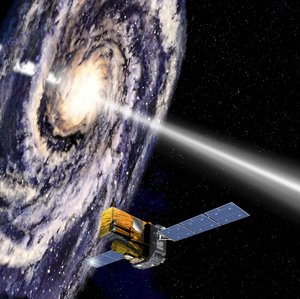
Integral – tracking extreme radiation across the Universe
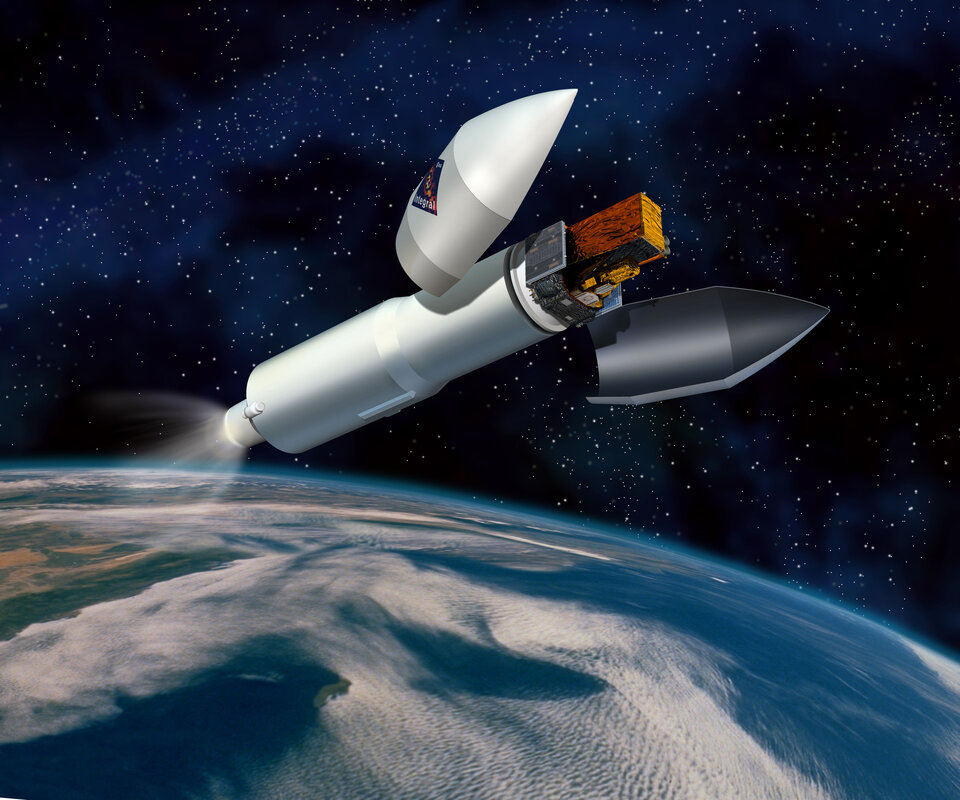
INFO 8-2002. Integral is the International Gamma Ray Astrophysics Laboratory of the European Space Agency. It is a co-operative mission with Russia and is scheduled for launch on 17 October 2002 from the Baikonur Cosmodrome, Kazakhstan, on a Russian Proton rocket, the Russian contribution to the programme.
It is the world's most advanced gamma-ray telescope and will provide first-hand observations of the celestial objects that release some of the most energetic radiation of the Universe. In particular, scientists have designed Integral to simultaneously capture gamma rays, X-rays, and visible light from these objects, allowing astronomers on Earth to fully analyse them.
Gamma rays are released by the most violent events in the Universe. Unlike the serene beauty of the stars that we can see with our own eyes, the gamma-ray Universe is a place of wild explosions, cosmic collisions, and matter being sucked into black holes or trapped in super-strong magnetic fields. So far, astronomers have only had glimpses of this violence; Integral will bring it into sharp focus.
Exploring the turbulent Universe

Gamma rays carry large quantities of energy away from the violent events where they are created, such as supernova explosions, black holes, and the mysterious gamma-ray bursts. Integral will find a lot more out about these powerful gamma-ray sources.
Very massive stars end their lives in big explosions called supernovae. These outbursts liberate more energy than the combined light of millions upon millions of stars, much of it in the form of gamma rays. New chemical elements are created as results of such explosions. In fact, all atoms heavier than iron are created due to such explosions. For this reason, we call supernovae the chemical factories of the Universe. However, we do not know completely how new atoms are created when a star explodes. Integral will look into it as one of its first scientific objectives.
After the explosion, each supernova leaves behind a dead 'heart'. This heart is incredibly dense and can be either a neutron star or a black hole. Both can generate gamma rays because they possess incredibly strong gravitational fields that can capture passing dust, gas, and possibly larger celestial objects. When matter falls through a gravitational field, it heats up and releases energy. In the case of neutron stars and black holes, the energy released is very intense and is given off in the form of x-rays and gamma rays.
As well as black holes from supernovae, called stellar black holes, the Universe contains a variety of far more massive black holes that are found at the core of some galaxies, the galactic black holes. Galactic black holes also give off gamma rays, and with such awesome power that you can detect them almost halfway across the known Universe.
As well as making the most accurate studies of these objects to date, Integral will also investigate the mysterious blasts of gamma rays that explode across the Universe about once a day, the gamma-ray bursts. They can last just a few seconds and can come from any direction in space. The origin of gamma-ray bursts has remained unexplained for years, from their first observation in the late 1960s. Today, many scientists think that gamma ray bursts could be linked to the death throes of the very first stars. Alternatively, they could be generated by colliding neutron stars, or could be caused by the explosion of supermassive stars at the end of their lives, the hypernovae. Integral's instruments will study gamma-ray bursts with the highest accuracy ever and may discover something about their origins.
Integral’s instruments
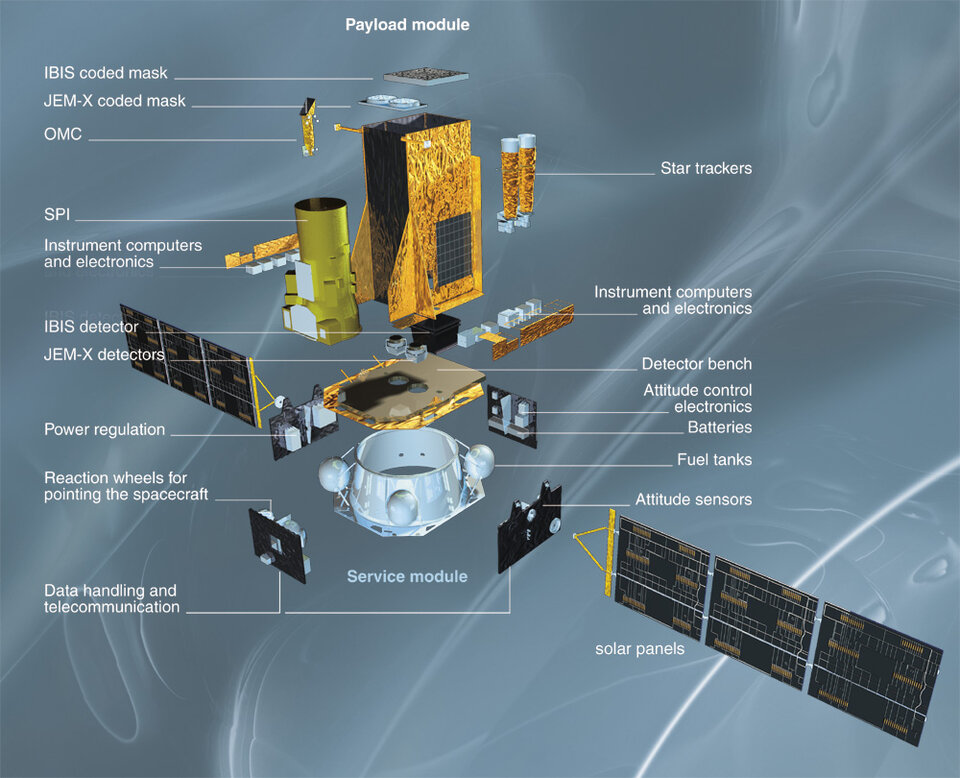
Integral has four instruments to give the spacecraft maximum versatility in its task of studying the gamma-ray Universe. Designed to complement each other, their combined observations will allow scientists to get a very complete and accurate picture of each celestial target at different wavelengths.
The first two are dedicated gamma-ray instruments. Imager on Board the Integral Satellite (IBIS) is the sharpest-resolution gamma-ray camera ever built. Spectrometer on Integral (SPI) will measure the energy of gamma rays with exceptional accuracy. In particular, it will be more sensitive to fainter radiation than any previous gamma-ray spectrometer. The other two instruments are designed to provide complementary scientific data about Integral’s targets. The Joint European X-Ray Monitor (JEM-X) will make observations simultaneously with the main gamma-ray instruments and will provide images at X-ray wavelengths. The Optical Monitoring Camera (OMC) will do the same but at visible-light wavelengths. The total weight of the four instruments is about 2 tonnes, roughly half the launch weight of Integral.
Integral's orbit and operations
After launch, Integral will follow an elliptical orbit that is inclined by 51.6° to the Earth’s equator. In this orbit, it will cycle between 9000 kilometres and 153 000 kilometres above Earth, completing one revolution of the Earth every 72 hours. This eccentric orbit is necessary because there are ‘radiation belts’ that surround the Earth and these would interfere with Integral’s ability to see gamma rays. It is important for Integral to be outside these belts. Its elliptical orbit is designed to keep it outside the radiation belts for 90% of its trajectory around Earth.
Once Integral is in orbit, it must communicate with Earth to download its scientific data and to receive commands. Communicating with and controlling Integral is a task spread over a number of different sites. Firstly, astronomers submit proposals for observations to the Integral Science Operations Centre (ISOC) at Noordwijk, The Netherlands. Experts at ISOC evaluate the proposals and draw up a list of targets and detailed observation schedules for Integral. The schedules are sent to the Mission Operations Centre (MOC) at the European Space Operations Centre (ESOC) in Darmstadt, Germany. There everything is transformed into commands that Integral will understand. Signals to and from Integral go through two tracking stations, one at Redu in Belgium, the second at Goldstone in California, United States. The MOC also ensures the correct performance of the spacecraft.
After Integral has collected observations, the raw science data is forwarded to the Integral Science Data Centre (ISDC) in Versoix near Geneva, Switzerland. There it is converted into usable data files, archived, and distributed to the astronomical community. A worldwide network of space science institutes and observatories will receive the data very quickly. This is essential especially when sudden and short-lasting phenomena such as gamma-ray bursts occur. In this case, all observatories need to receive the information within one minute to be able to point their telescopes immediately at the area of the sky where the gamma-ray burst has been detected.
Building Integral
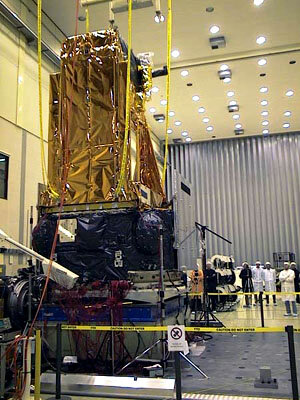
Integral was selected as a mission by ESA in June 1993. The prime contractor for the spacecraft was Alenia Aerospazio, Turin, Italy. Alenia involved 26 subcontracting companies from 12 European countries to build the spacecraft’s service module. This provides the essentials for the spacecraft such as power (via solar panels), satellite control, and the communications link to the ground. Alenia was also responsible for integrating the four science instruments on-board the spacecraft, known collectively as the payload module. Four consortia of academic and industrial partners, variously located throughout Europe, built the instruments.
Integral has faced many technological challenges. However, the greatest was finding a way to focus gamma rays, which are so powerful they pass through ordinary mirrors. To overcome this, Integral’s gamma-ray instruments and its X-ray monitor use a technique called coded-mask imaging. Instead of focusing, the coded mask blocks some gamma rays, creating a recognisable shadow on the detector beneath. Ground computer systems process the data coming from the gamma-ray detector looking for this shadow. Once it finds the shadow pattern, it groups the gamma rays together, forming an image. Gamma rays from different astronomical objects enter the instruments at different angles and so cast different shadows, allowing gamma rays from multiple sources to be separated.
Integral has been developed and built at a cost of 330 million Euros. This price does not include the cost of launch, which Russia is providing free in exchange for observing time on Integral. Neither does the cost include the price of the science instruments, which have been provided by academic and industrial consortia. To reduce costs, the design for the service module was reused from ESA’s XMM-Newton satellite.
Note to editors: historical perspective on gamma-ray astronomy
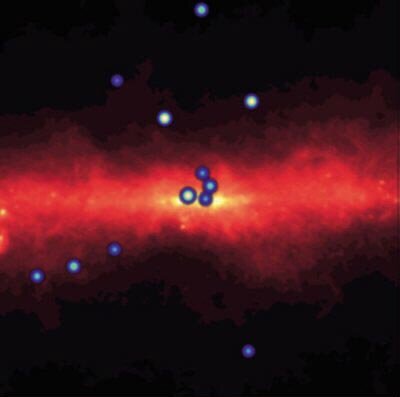
Scientists have placed small gamma-ray detectors on satellites since the early 1960s. However, the most extraordinary discovery came in the late 1960s from a series of military satellites designed to monitor the ban on nuclear bombs being tested on Earth. These satellites detected the appropriately named gamma-ray bursts, which explode without warning about once a day, from random directions in the sky.
In 1972, the NASA probe SAS-2 confirmed that the Universe is bathed in a perpetual shower of gamma rays. In 1975, ESA launched the gamma-ray satellite COS-B, that worked until being switched off in 1982. COS-B produced the first map of the gamma-ray sky and identified a number of bright gamma ray sources. It was followed by the Russian-French mission GRANAT, in 1989-1998, and NASA’s Compton Gamma-ray Observatory (CGRO), in 1991-2000. The CGRO satellite greatly increased our understanding of gamma-ray astronomy. Soon we can expect Integral to dazzle the world with the next leap in technology.