Hubble uncovers the Veil Nebula
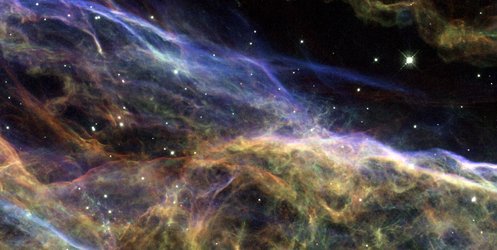
The NASA/ESA Hubble Space Telescope has captured three magnificent sections of the Veil Nebula - the shattered remains of a supernova that exploded some 5 to 10 000 years ago.
Although we don’t usually think about it, the stars twinkling in the night sky don’t shine forever. How long a star lives depends on how big and heavy it is. The bigger the star, the shorter its life. When a star significantly heavier than our Sun runs out of fuel, it collapses and blows itself apart in a catastrophic supernova explosion.
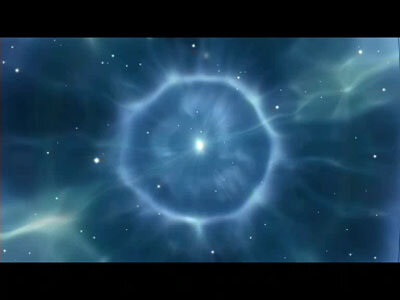
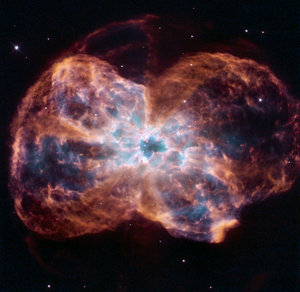
A supernova releases so much light that it can outshine a whole galaxy of stars put together. The exploding star sweeps out a huge bubble in its surroundings, fringed with actual stellar debris along with material swept up by the blast wave. This glowing, brightly-coloured shell of gas forms a nebula that astronomers call a ‘supernova remnant’. Such a remnant can remain visible long after the initial explosion fades away.
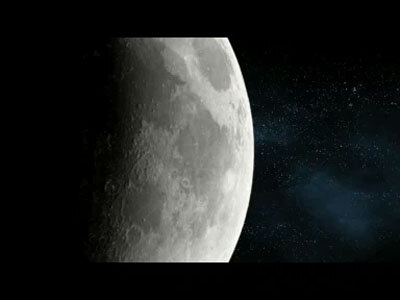
A series of three new images taken with the NASA/ESA Hubble Space Telescope reveals magnificent sections of one of the most spectacular supernova remnants in the sky – the Veil Nebula. The entire shell spans about 3 degrees, corresponding to about six full moons. The small regions captured in the new Hubble images provide stunning close-ups of the Veil. Fascinating smoke-like wisps of gas are all that remain visible of what was once a Milky Way star.
Scientists estimate that the supernova explosion occurred some
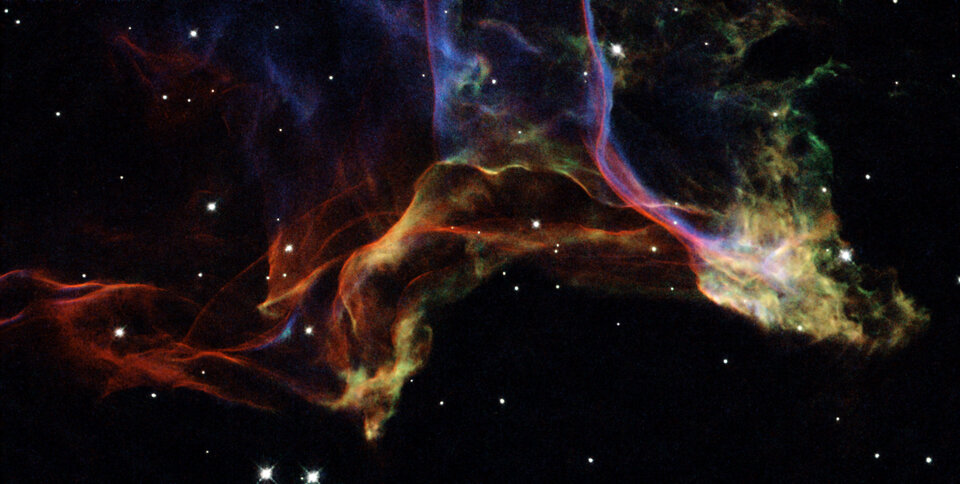
The intertwined rope-like filaments of gas in the Veil Nebula result from the enormous amounts of energy released as the fast-moving debris from the explosion ploughs into its surroundings and creates shock fronts. These shocks, driven by debris moving at 600 000 kilometres per hour, heat the gas to millions of degrees. It is the subsequent cooling of this material that produces the brilliantly coloured glows.
Like the larger scale ground-based observations, the high-resolution Hubble images display two characteristic features: sharp filaments and diffuse emission. These correspond to two different viewing geometries: sharp filaments correspond to an edge-on view of a shock front, and diffuse emission corresponds to a face-on view of it.
The Hubble images of the Veil Nebula are striking examples of how processes that take place hundreds of light-years away can sometimes resemble effects we see around us in our daily life. The structures have similarities to the patterns formed by the interplay of light and shadow on the bottom of a swimming pool, rising smoke or ragged cirrus clouds.
Why are astronomers interested in studying supernovae and their remnants? Supernovae are extremely important for understanding our own Milky Way. Although only a few stars per century in our Galaxy will end their lives in this spectacular way, these explosions are responsible for making all chemical elements heavier than iron in the Universe. Many elements, such as copper, mercury, gold, iodine and lead that we see around us here on Earth today were forged in these violent events billions of years ago. The expanding shells of supernova remnants were mixed with other material in the Milky Way and became the raw material for new generations of stars and planets.

The chemical elements that constitute the Earth, the planets and animals we see around us – and as a matter of fact our very selves – were built deep inside ancient stars and in the supernova explosions that result in the nebula we are seeing here. The green in the grass and the red of our blood are indeed the colours of stardust.
The Veil Nebula is a prototypical middle-aged supernova remnant, and is an ideal laboratory for studying the physics of supernova remnants: it is fairly nearby, has a large angular size and has a relatively small amount of foreground extinction.
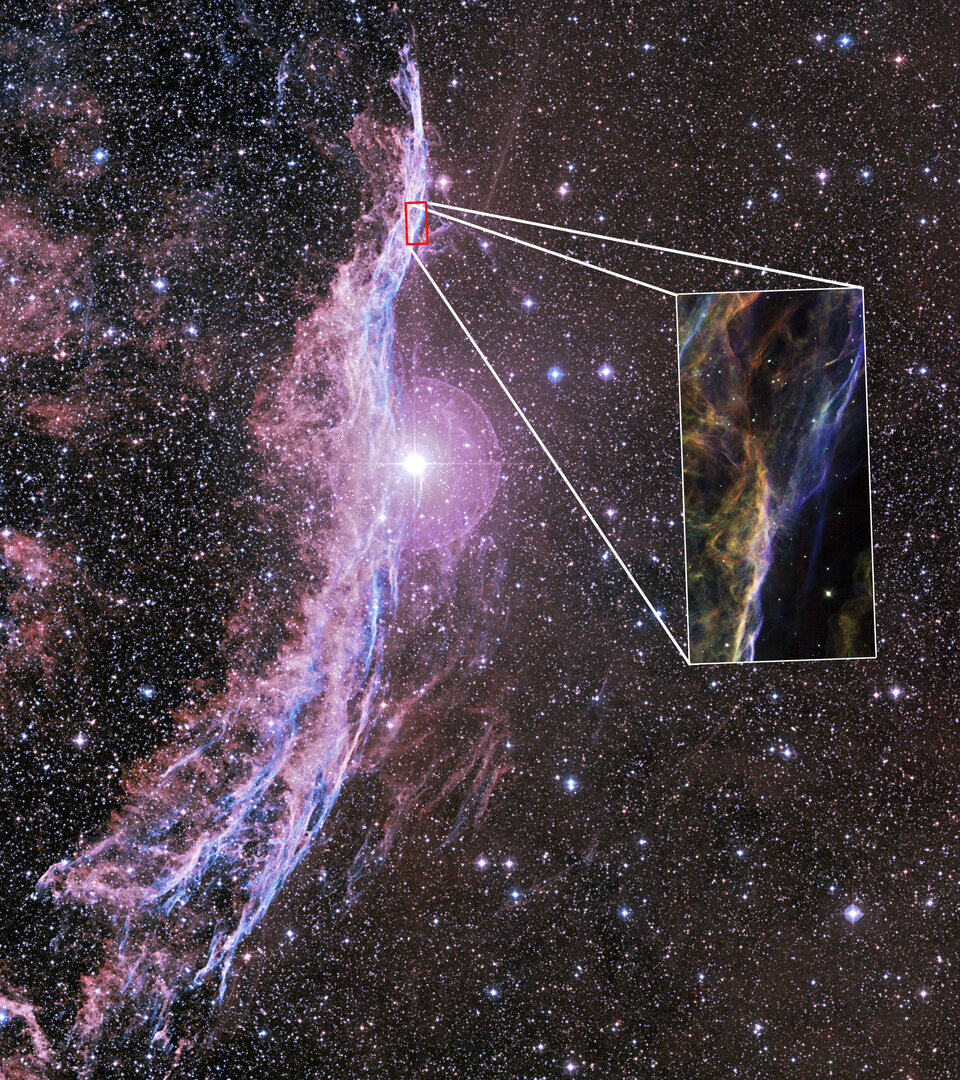
lso known as Cygnus Loop, the Veil Nebula is located in the constellation of Cygnus, the Swan. It is about 1 500 light-years away from Earth. One of the most remarkable parts of the remnant is the so-called Witch’s Broom Nebula (seen to the right in the overview image). The bright blue star – dubbed 52 Cygni and unrelated to the supernova explosion – can be observed with the naked eye on a clear summer’s night.
The images were taken with Hubble's Wide Field and Planetary Camera 2 (WFPC2). The colour is produced by composite of three different images. The different colours indicate emission from different kinds of atoms excited by the shock: blue shows oxygen, green shows sulphur, and red shows hydrogen.
Notes for editors:
The Hubble Space Telescope is a project of international cooperation between NASA and ESA.
For more information:
Lars Lindberg Christensen, Hubble/ESA, Garching, Germany
E-mail: lars @ eso.org
Alessandra Aloisi, ESA/ Space Telescope Science Institute, USA
E-mail: aloisi @ stsci.edu
Ray Villard, Space Telescope Science Institute, Baltimore, USA
E-mail: villard @ stsci.edu