Mars500 diary: week four and still alive!
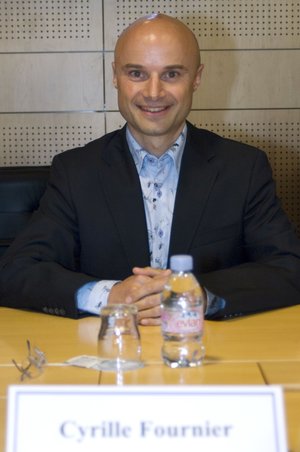
Four weeks into their stay inside the isolation facility in Moscow, the Mars500 crew is busy with scientific experiments. In the latest diary entry, ESA-selected crewmember Cyrille Fournier describes how one experiment looks at how blue light might help a crew on their way to Mars.
Cyrille Fournier writes:
Time is flying by so fast. We didn't even manage to enjoy last week's poker games as we had to quickly get on with our experiments!
We have decided to describe here, and in the weeks to come (I hope, in a way that everybody can understand!), one of the numerous experiments that ESA is backing and that we are carrying out throughout the isolation.
Today I will detail an experiment proposed by a group of Austrian, Swiss, Dutch and French scientists that aims to understand the influence of blue-coloured light on our mood and performance Yes, it may be surprising, but depending on the type of coloured light our eye receives, this may affect our psychomotricity!
On a sunny day on Earth, the Sun sends us white light, really white, composed of all the visible spectra colours. By the way, you can see the decomposition of this white light into its components when you see a rainbow! The water droplets just separate the different parts of the white light and we can then see the whole spectra.

Generally, this would not be the case if we could do the same with our electrical sources of light, simply because the light they are generating is not completely white. Depending on the source of light, the colour is more yellowish (filament bulbs) or greenish (some neon lights).
Scientists have recently discovered that the retina (the light-sensitive layer in the back of our eyes) does not only contain rods and cones, responsible for our vision of light and colours, but a third sensor, the ganglion, which is not directly responsible for vision, but which is sensitive to blue light. What for? To reset the brain's circadian clock - our internal clock based on the day-and-night alternation (or cycle).
We do not notice it, but the day-and-night alternation (and how we realise it) is very important - lots of our body's functions depend on it. OK, our organism does not only refer to this visual signal of day-and-night to understand the circadian cycle but also on different details, like the times of our three daily meals and regular sleep hours, for example. Significantly change one of these elements and you may alter your perception of the circadian cycle.
What happens then if our circadian clock is confused? Excellent question!

Well, it can lead to significant changes in mood, our sleep quality, our capacity to learn and/or our alertness, for instance. This is why we want to understand how exposure to a blue-coloured light, set during specific hours, may improve those factors in a group of people who cannot see the sky (this is us!).
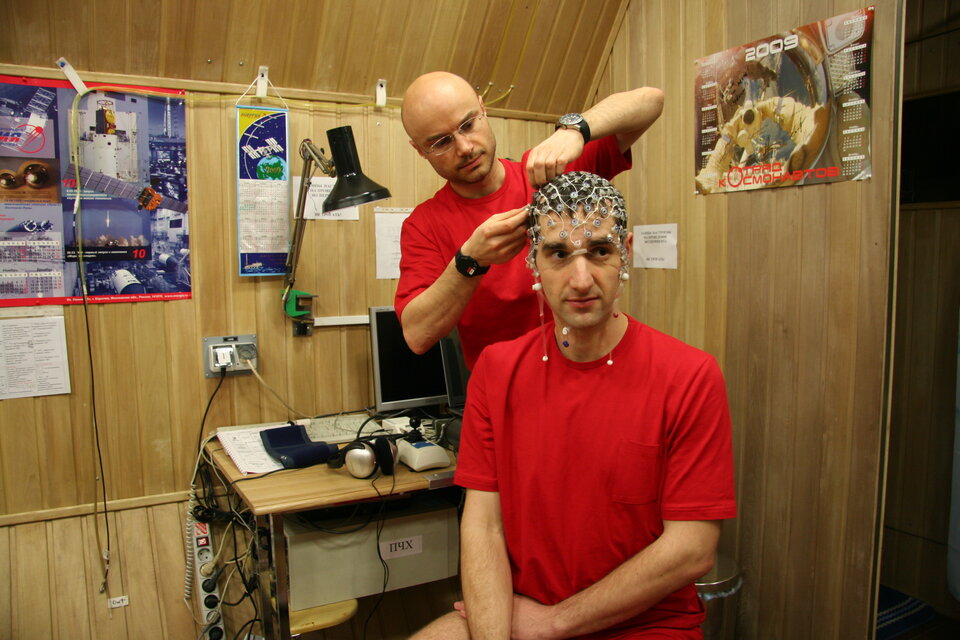
Actually, for the time being, we are wearing around our necks a little sensor that analyses the light in the module. This will be the basic data. Then, during the 520-day Mars500 experiment, a blue-coloured light will be introduced every once in a while and we will see how the crewmembers feel!
A last word on this: it does not only concern guys like us, cosmonauts or astronauts. These results, if they are proven, may help people who suffer from sleep problems, those who are working in a closed environment and – why not – we may have at home, one day, a device that could make the light bluer during daytime (even if the sky is grey) so that we can feel much better and less mood-impacted by bad weather!
I must not forget to give you some news about Oleg’s Hall of Fame. We already had our historic and current political leaders pinned on the walls of our crew module, and now we also have our writers! Indeed, Oleg managed to get some images of Alexander Pushkin, Johann-Wolfgang Goethe and Victor Hugo. He quickly printed them out and now they are pinned up next to Peter the 1st, Bismark and Charles de Gaulle! I can’t wait to see what (or who) he will find next!
Last Wednesday (22 April), was quite an interesting day as it was the International Earth Day. I have to say here that just because we are preparing a human mission to Mars, we are not getting less interested in our planet, on the contrary!
For this occasion, the whole crew made an extra effort to save our resources. Well, we cannot get too far as our resources (oxygen, water, electricity) are limited anyway because of the project itself, but we still tried to enforce some simple resource-saving actions, like switching off the light when leaving a module and trying to use less water when doing the washing-up or washing our hands.
We do not know the exact impact of our actions, but this could not hurt our Blue Planet anyway. And as far as I could see, these acts were not just limited to one day. I noticed several times some energy-saving actions both from our Russians crewmates as well as from the European side.
The end of our week was somehow the consequence of its beginning. As we were quite tired after our rotating 24-hour shifts, our weekend was very calm and we managed all to get back the sleeping hours we missed a few days earlier. So that once again, we will start a new week (already the fifth) in good shape and ready for some further experiments, actions, good mood, some stress but also laughter!
We wish you all also a very good week, wherever you are on our planet and we’ll talk to you very soon!