Landing on Titan – the new movies
A little more than one year after the spectacular descent of ESA’s Huygens on Saturn’s giant moon Titan, scientists from the probe’s Descent Imager/Spectral Radiometer (DISR) have released two new movies of the descent.
These represent the best visual product from the mission obtained so far and the most realistic way yet to experience the landing on a far-away world. These movies were built thanks to the data collected by DISR on 14 January 2005, during the 147-minutes plunge through Titan's thick orange-brown atmosphere to a soft sandy riverbed. The data were analysed for months after the landing.

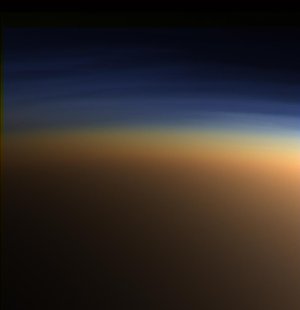
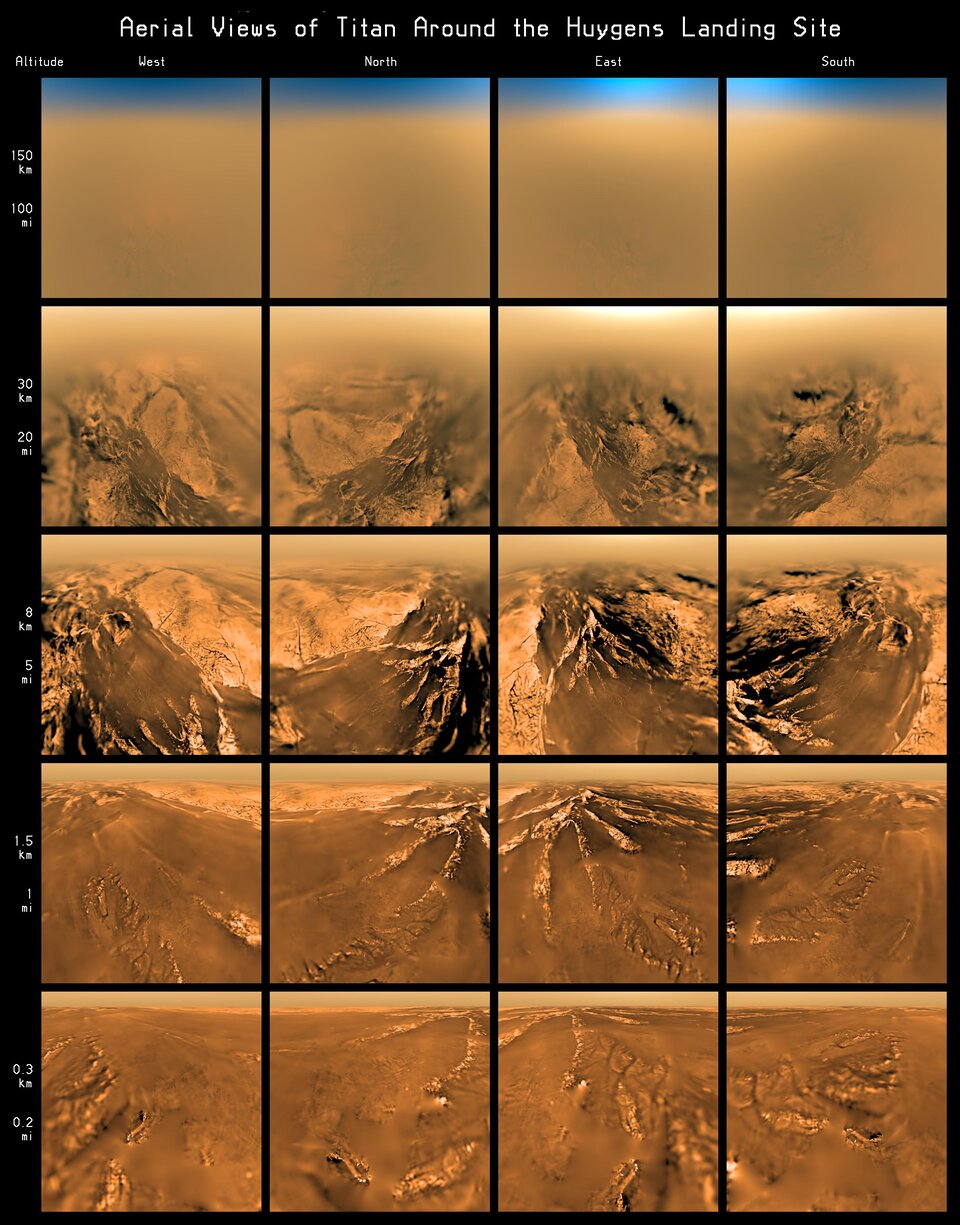
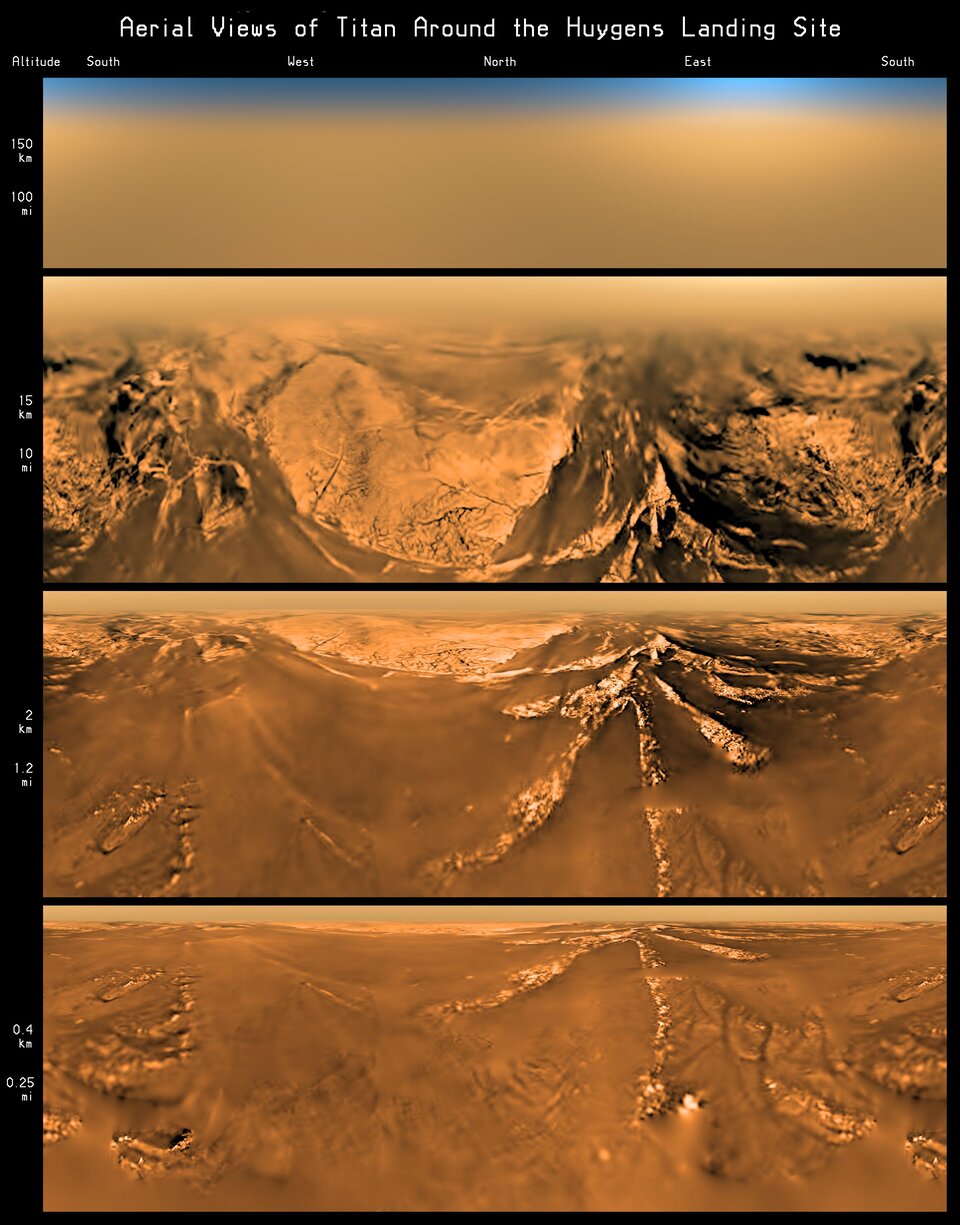
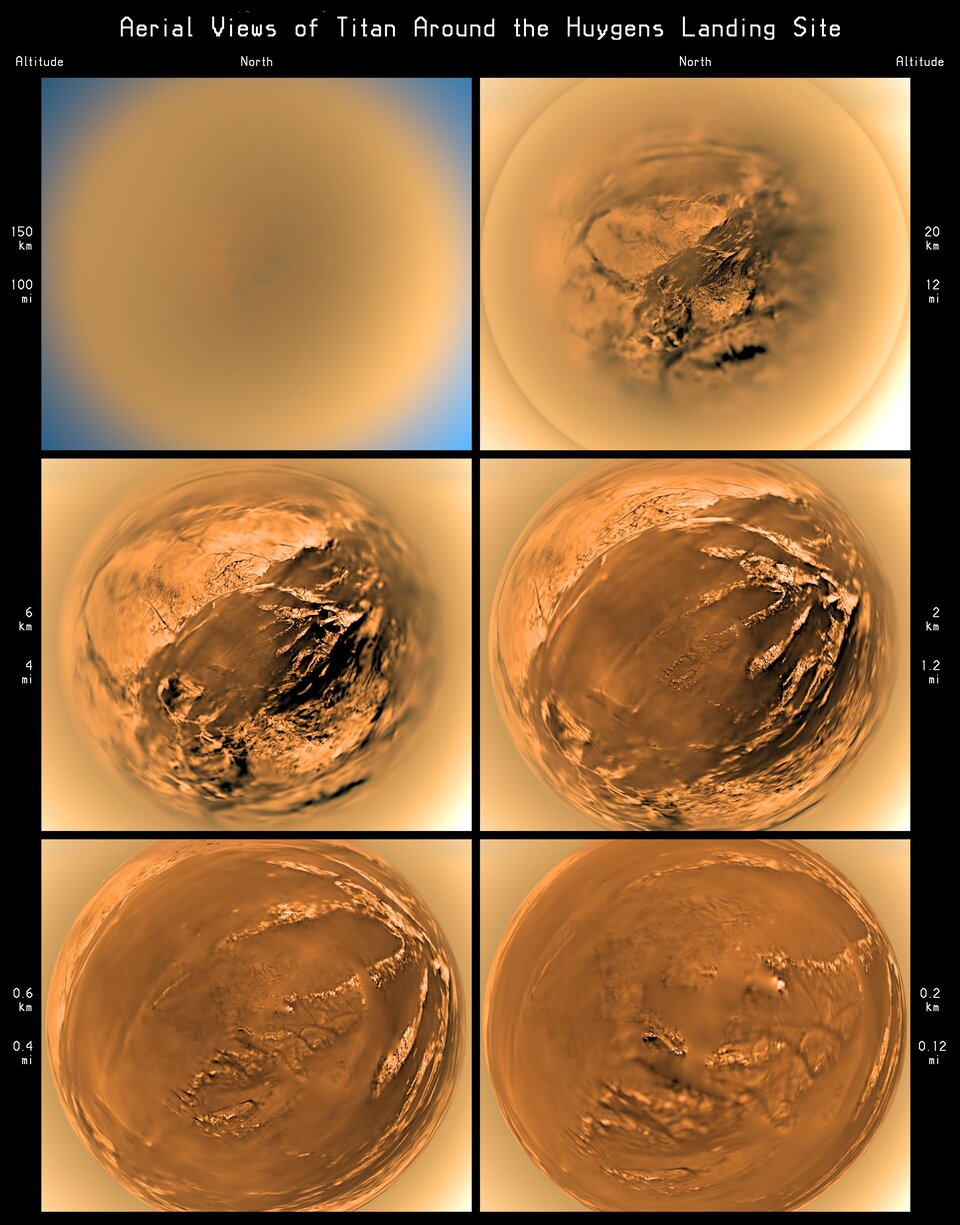
The movie ‘View from Huygens on 14 January 2005’ shows in 4 minutes 40 seconds what the probe actually ‘saw’ within the few hours of the descent and the eventual landing. "At first the Huygens camera just saw haze over the distant surface," said DISR team member Erich Karkoschka, from the DISR team at the University of Arizona and creator of the movies.
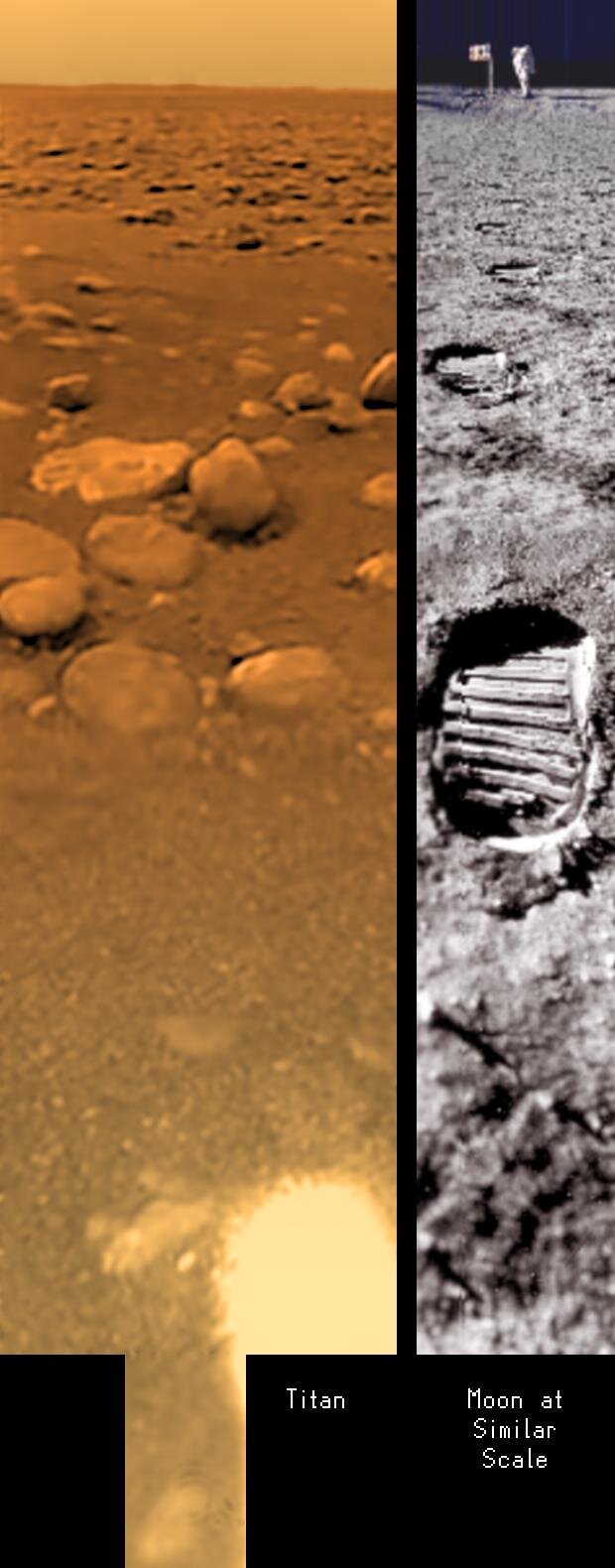
"The haze started to clear only at about 60 kilometres altitude, making it possible to resolve surface features as large as 100 metres," he continued. "But only after landing could the probe's camera resolve little grains of sand millions and millions times smaller than Titan. A movie is a perfect medium to show such a huge change of scale."
The second, more technical movie (called ‘DISR movie’), shows DISR's 4-hour operating life in less than five minutes, too. A detailed caption to explain how the movie is structured is provided with the video.
The scientists analysed Huygens' speed, direction of motion, rotation and swinging during descent, represented in this movie. The video also features Huygens' trajectory views from the south, indication of the large and unexpected parachute movements, the changing direction of view as Huygens rotates along with the relative positions of the sun and Cassini, and a clock to follow the actual sequence of events.
Sounds from a left speaker trace Huygens' motion, with tones changing with rotational speed and the tilt of the parachute. There are also clicks that clock the rotational counter, as well as sounds for the probe's heat shield hitting Titan's atmosphere, parachute deployments, heat shield release, jettison of the DISR cover and touch-down.
Sounds from a right speaker go with DISR activity. There's a continuous tone that represents the strength of Huygens' signal to Cassini.
"DISR was a very complicated instrument," Karkoschka said. "It had to be programmed to take its 3500 exposures in a way to get the most science. It had to decide where and when to take exposures."
DISR was designed in the early to mid 1990s, when the best images returned by the Voyager missions showed Titan as a featureless, hazy disk. "We didn't know the dynamics of Titan's atmosphere very well, and we didn't know how fast Huygens would rotate and swing," Karkoschka said. "It was an extremely challenging programming task to make DISR work well under every imaginable condition."
"These movies really demonstrate that the Huygens camera was very well designed for the job," said Jean-Pierre Lebreton, Huygens Project Scientist and Mission Manager at ESA. "They show so many different details of a landscape that covers only a tiny fraction (one thousandth) of Titan’s surface. This makes me dream of what a possible future mission to Titan may return from this wonderful and fascinating Earth-like world", he concluded.
Note to editors:

The Huygens probe landing was the most distant touch-down ever made by a human-built spacecraft.
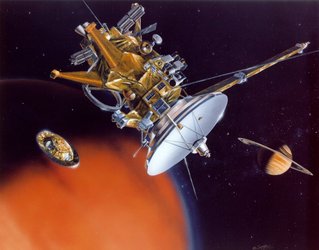
The Cassini-Huygens mission to Saturn and Titan is a joint mission of NASA, the European Space Agency (ESA) and the Italian Space Agency (ASI). ESA supplied and manages the Huygens probe that descended to Titan's surface on 14 January 2005.
NASA's Jet Propulsion Laboratory, a division of the California Institute of Technology in Pasadena, manages the mission for NASA's Science Mission Directorate in Washington, D.C. NASA funded the Descent Imager-Spectral Radiometer, which was built by Lockheed Martin.

The DISR team members, headed by Research Professor Martin Tomasko at University of Arizona’s Lunar and Planetary Laboratory (LPL), are based throughout the United States and Europe, with the largest contributing groups from the University of Arizona in the United States, the Max Planck Institute in Germany, and the Paris Observatory in Meudon, France.
DISR was developed by the University of Arizona (with NASA funding) and by Lockheed Martin researchers.
For more information:
Jean-Pierre Lebreton, ESA Huygens Project Scientist
Email : jean-pierre.lebreton @ esa.int
Marti Tomasko, DISR Principal Investigator, University of Arizona, USA
Email: mtomasko @ hindmost.lpl.arizona.edu
Erich Karkoschka, DISR team, University of Arizona, USA
Email: erich @ pirl.lpl.arizona.edu
Chuck See, DISR team, University of Arizona, USA
Email: csee @ lpl.arizona.edu