The infrared revolution
There are several open questions that astronomers hoped to be able to answer by using Herschel to observe in the infrared.
When and how did the first galaxies form?

Today, galaxies fill the Universe. They are distributed in curved walls surrounding huge areas of emptiness – like bubbles in a foam bath. Each galaxy contains several hundred thousand million stars. However, it has not always been like this. There was a time when galaxies simply did not exist.
Astronomers have long been wondering when galaxies formed, how they formed, if they all formed at about the same time in cosmic history, and whether the first galaxies were like those we see now. Galaxies are made of stars and interstellar matter, and this raises other questions: did stars form in the same manner throughout cosmic history? Were all kinds of stars present at all times, and did they always form at the same rate? Does the situation change depending on the type of galaxy and the age of the Universe?
Astronomers call the era before 'first light' and galaxy formation 'the dark ages'. It is an appropriate name. No current instrument can peer into that era, since no light was emitted. Not long after the Big Bang, however, the first stars started to form, possibly in small clusters. These stars had no heavy atoms. Most likely they were very massive, therefore subject to a short lifetime and a violent death.
Like a chemical factory, the first stars created the first heavy atoms, enriching the raw material from which the next generation of stars would form. The clusters of stars started to merge and grow, triggering the birth of more stars, which, in turn, created more material for future stars. In this way, the first galaxies were born as vast collections of star clusters. These galaxies would often collide and merge to form larger galaxies, triggering new intense bursts of star formation, and space quickly became the Universe of galaxies we see today.
However, this scenario of galaxy formation and evolution leaves many open questions. For instance, with the arrival of the space observatories, we now know that when the Universe was half its present age, galaxies were quite different.
Fundamental new insights into galaxy formation and evolution came from the NASA/ESA Hubble Space Telescope, from pioneering infrared observatories such as the international Infrared Astronomical Satellite (IRAS), ESA’s Infrared Space Observatory (ISO), and more recently, JAXA's Akari and NASA's Spitzer space telescope.
IRAS made the completely unexpected discovery that some galaxies emit almost all their energy in the infrared. These are usually galaxies that are forming stars at a very high rate: up to thousands of times faster than the rate in our Galaxy today. To peer into the unsolved mysteries of galaxy formation, astronomers needed a much larger infrared space telescope. Herschel looked at the emission from dust heated by the Universe's stellar ‘baby booms’ at the epoch of most intense star formation – inside ‘baby galaxies’ at work.
How and where do stars form?
Stars are shy, at least during their early lives. They begin to form inside clouds of gas and dust in the interstellar medium, within thick dust cocoons that protect them until the moment they hatch. In the pre-stellar core, as these cocoons are called, gravity squeezes gas and dust into the centre of the clump. This heats the gas. The heat must radiate into space before the embryonic star can complete its collapse and finish its formation.
In the course of their lives, stars act as cosmic recyclers that transform lighter atoms into heavier ones, and as they age and die, they disperse them back into the interstellar medium from which new generations of stars eventually form. These heavier elements are crucial for the creation of planets and for life itself. But the processes by which stars form remain poorly understood.
Pre-stellar cores are deeply embedded in clouds that are incredibly cold. This makes them invisible to all telescopes except those designed to collect radio or infrared radiation. ISO unveiled more than a dozen of these cocoons, but Herschel shed light on the entire process of star and planet formation. With its large telescope and spectral coverage that extends to very long wavelengths, Herschel was designed to study the earliest unknown stages of star birth and take a complete census of stars forming in our galactic neighbourhood.
Where and how do planetary systems form and evolve?

After a star is born, leftover gas and dust swirl around the young star, forming a circumstellar disc of gas and dust. The grains of dust in this disc are the seeds of future planets. Once most of the dust has collapsed together to form the planets, the disc disappears, leaving behind only a thin ring of debris.
Astronomers have indirectly detected a number of planetary systems outside our own. Although the planets themselves are difficult to image directly, observations in the infrared will help understand how these planetary systems formed and evolved.
Herschel's instruments analysed the chemistry at work in the circumstellar material and even looked for chemical traces of life. Both protoplanetary discs and debris rings are favourite targets for infrared space telescopes. Many have been studied in particular by Spitzer, and Herschel extended this into new regimes.
ISO and Spitzer have shown that the formation of planets around stars must be a common event. According to the observations, discs of dust and gas surround almost all young stars, but their lifetime is fairly short – only a few million years. This indicates that the planet-making process is quite rapid, with smaller bodies contributing to the material that eventually forms planets. There is also evidence that discs of debris can be seen around mature stars. Herschel was designed to thoroughly investigate the nature of circumstellar material for stars of all ages.
The origins of the Solar System
Our Solar System formed about 4500 million years ago, out of the proto-solar nebula. This primeval cloud contained the raw material that formed both the Sun itself and the planets. To reconstruct precisely how the process took place, astronomers need to study the detailed chemical compositions of the atmospheres and surfaces of the planets and their moons, and especially the chemical composition of the comets. Comets are mostly made of water ice, methane and carbon dioxide. They are the best fossils of the early Solar System because they are made of unprocessed material from the proto-solar nebula. In the atmosphere of a planetary body, the original components are altered by subsequent chemical reactions; in a comet, they are held in a deeply frozen state.
Studying the chemical composition of comets will also shed new light on the question of the origin of Earth's oceans. According to some hypotheses, impacting objects of various kinds, such as comets and asteroids, brought most of the water to our planet early in the history of the Solar System. Herschel had the, then unprecedented, capability to analyse the chemical composition of the Solar System’s various bodies.
The elements and chemistry of the Universe
Stars are the chemical factories of the Universe. Every atom in the Universe (with the exception of the three lightest elements, hydrogen, helium and lithium) is the result of stellar activity. Many chemical elements, including those essential for life such as carbon, nitrogen and oxygen, are created in the nuclear fires that burn inside stars, while heavier elements such as iron are produced during violent supernova explosions.
When stars age and eventually die, they spread the processed material back to the interstellar medium, either gently or in violent explosions, depending on how massive the star was at the beginning of its life. Many chemical compounds, including those essential for life, are produced around ageing stars, and in the interstellar material enriched by them. Huge amounts of water and complex molecules of carbon, both essential for life, have been detected in the material surrounding stars. Human beings and other life forms on Earth, as well as our planet itself, are literally stardust.
Most molecules show their unmistakable chemical signature at infrared and submillimetre wavelengths. This made Herschel the ideal tool for detecting and studying them. Herschel studied the chemistry of many regions in the Universe, from stars and their environments to other galaxies. It observed chemical-rich objects such as molecular clouds, where over a hundred different molecules have been discovered. Some of these molecules need the isolation of space to exist. On Earth, they would rapidly react with other molecules and so can be created only in highly specialised laboratories.
The Milky Way, other galaxies near and far, and cosmology
Much of what we have learnt about the physics and chemistry of the interstellar medium, how stars form, live, and die, and recycle and enrich the interstellar medium, has been learned from studying our own Galaxy, the Milky Way. But the Milky Way is only one galaxy in a Universe containing millions of millions of galaxies. With Herschel we were able to explore these aspects in detail also in other relatively nearby galaxies.
The far-infrared and submillimetre wavelengths that Herschel studied are crucial to understand the physical processes and properties of the interstellar medium, the interplay between star formation and the interstellar medium in galaxies, and how this may depend on the environment in that particular galaxy.
Low-metallicity dwarf galaxies are known to exhibit dust and gas properties different from more metal-rich galaxies such as the Milky Way. Herschel provided the first opportunity to study the dust and gas in extremely low metallicity environments that have not yet experienced repeated recycling. This data is helping scientists understand primordial conditions in the interstellar medium and star formation in the young Universe.
Herschel provided decisive new insight by performing observations that have not been possible before: in nearby dwarf galaxies, infrared dominated galaxies at different redshifts, a survey of dust in galaxies along the Hubble sequence, and high redshift quasars. Herschel also surveyed all galaxies in a nearby galaxy cluster, and it performed a survey of galaxy clusters.
Finally, thanks to its superior angular resolution in the far-infrared, Herschel enabled us to resolve the far-infrared cosmic background into sources to a degree that was not possible before. Taken all together, Herschel enabled us to provide a much more detailed answer to the eternal question: "How did the Universe become what it is today?"
Continuing the quest
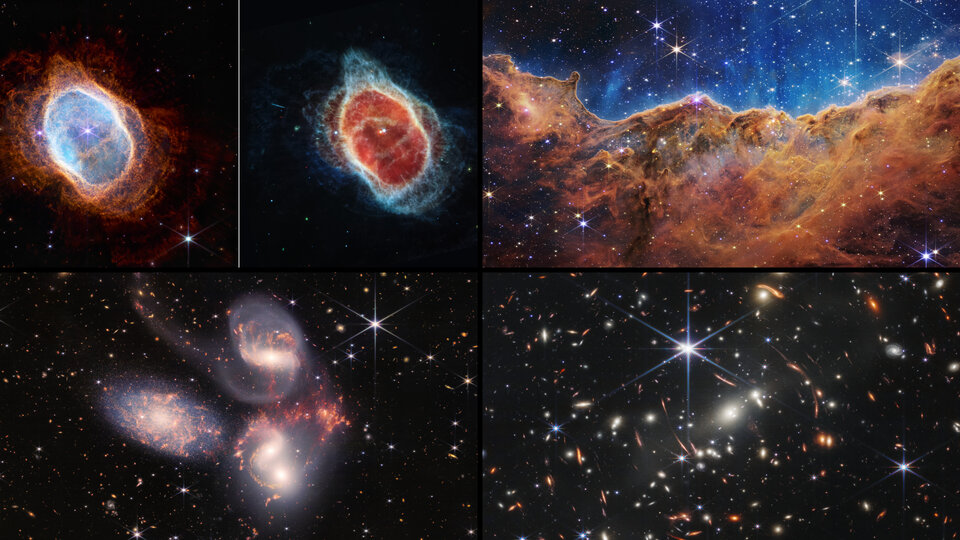
Observations in the infrared have revolutionised astronomy, revealing previously hidden aspects of the Universe that changed our perception of the world. With each new mission, we build on the knowledge gained through those that came before and build an even clearer picture of how our Universe and its origins.
On 25 December 2021, the James Webb Space Telescope (Webb) was launched from Europe's Spaceport in French Guiana. This NASA, ESA, Canadian Space Agency (CSA) partnership was designed to answer outstanding questions about the Universe and to make breakthrough discoveries in all fields of astronomy.
Just seven months into its mission, Webb delivered the deepest, sharpest infrared image of the distant Universe so far. The mission is expected to last between five and ten years, with a treasure trove of discoveries yet to be revealed.