ESAHome
   
Space Science
About Space ScienceESA's 'Cosmic Vision'Science & Technology in-depth
Multimedia
Science imagesScience videosAnimationsDownloadsSounds from space
Media centre
Press ReleasesPress kitsESA Television
Resources
Reference sectionGlossaryFAQs
Science missions
Services
HelpLegal disclaimerCommentsSubscribe
Follow us
RSS feedsESA Sci on Twitter


Bookmark and Share


Article Images
Never-before-seen views of the ringed planet
 
2 March 2007

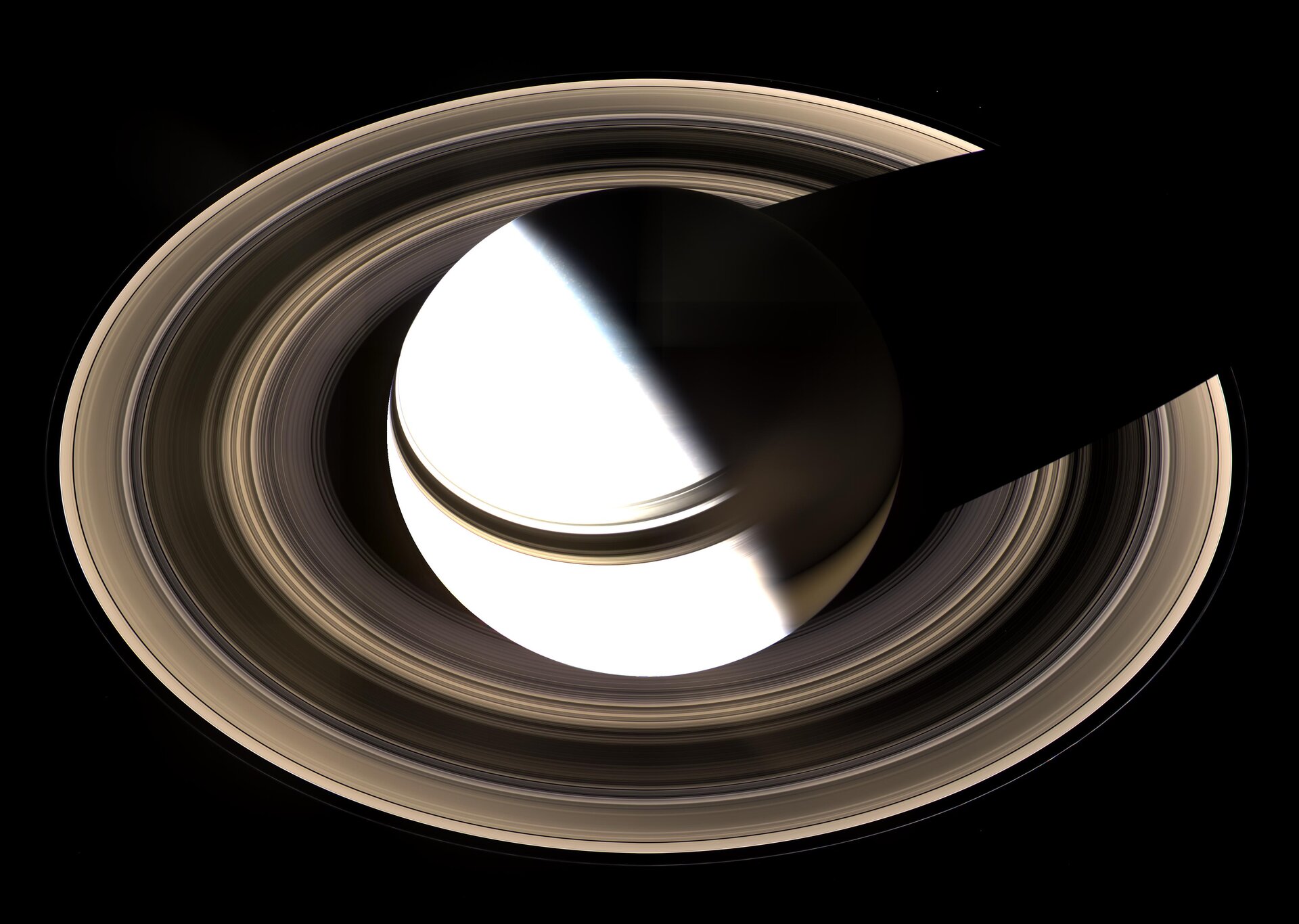
Saturn's rings
Download:
 HI-RES JPEG (Size: 656 kb)  HI-RES TIFF (Size: 4207 kb)
Surely one of the most gorgeous sights the solar system has to offer, Saturn sits enveloped by the full splendour of its stately rings in this mosaic of 36 images taken by Cassini over the course of about 2.5 hours, as the spacecraft scanned across the entire main ring system. This view looks toward the unlit side of the rings from about 40 °above the ring plane.

Taking in the rings in their entirety was the focus of this particular imaging sequence obtained by the Cassini spacecraft’s wide-angle camera on 19 January 2007, at a distance of approximately 1.23 million kilometres from Saturn. Image scale is 70 kilometres per pixel.

The camera exposure times were just right to capture the dark-side of its rings, but longer than that required to properly expose the globe of sunlit Saturn. Consequently, the sunlit half of the planet is overexposed. Between the blinding light of day and the dark of night, there is a strip of twilight on the globe where colourful details in the atmosphere can be seen. Bright clouds dot the bluish-grey northern polar region here. In the south, the planet's night side glows golden in reflected light from the rings' sunlit face.

Saturn's shadow stretches completely across the rings in this view, in contrast to what Cassini saw when it arrived in 2004.

Credits: NASA/JPL/Space Science Institute


Download:
 HI-RES MOV (Size: 38 300 kb)
This spectacular movie sequence of Saturn and its ring system was obtained thanks to clear-filter images taken with the Cassini spacecraft wide-angle camera on 17 January 2007, at a distance of approximately 900 000 kilometres from Saturn. The image scale is 48 kilometres per pixel. This movie begins with a view looking toward the lit side of the rings from about 9° below the ring plane and ends when the spacecraft is 8° above the ring plane.

The movie captures Saturn's rings during a ring plane crossing - which Cassini makes twice per orbit - from the spacecraft's point of view. The movie begins with a view of the sunlit side of the rings. As the spacecraft speeds from south to north, the rings appear to tilt downward and collapse to a thin plane, and then open again to reveal the un-illuminated side of the ring plane, where sunlight filters through only dimly. The striking contrast between the sunlit and unlit sides of the ring plane can now be fully appreciated, thanks to the sense of continuity in time and space provided by this brief clip.

The movie consists of 34 images taken over the course of 12 hours as Cassini pierced the ring plane. Additional frames were inserted between the original images in order to smooth the motion in the sequence (a scheme called ‘interpolation’).

Six moons careen through the field of view during the sequence. The first large one is Enceladus, whose slanted motion from the upper left to centre right nicely illustrates the inclination of its orbit with respect to the rings. The second large one, seen in the second half of the movie, is Mimas, going from right to left.

Credits: NASA/JPL/Space Science Institute


Saturn's rings second view
Download:
 HI-RES JPEG (Size: 462 kb)  HI-RES TIFF (Size: 5211 kb)
Cassini, the robotic emissary flying high above Saturn, captured this view of an alien copper-coloured ring world. The overexposed planet has deliberately been removed to show the unlit rings alone, seen from an elevation of 60°, the highest Cassini has yet attained.

The view is a mosaic of 27 images taken with the Cassini spacecraft wide-angle camera on 21 January 2007, over the course of about 45 minutes and at a distance of approximately 1.6 million kilometres from Saturn. Image scale is 90 kilometres per pixel.

The planet's shadow carves a dark swath across the ring plane at the right. Several moons of Saturn are also visible in this image: Epimetheus (116 kilometres across) at the 1 o'clock position, Pandora (84 kilometres across) at the 5 o'clock position, Janus (181 kilometres across) at the 10 o'clock position.

Bright clumps of material in the narrow F ring moved in their orbits between each of the colour exposures, creating a chromatic misalignment that provides some sense of the continuous motion in the ring system. Radially extending lens-flare artefacts, which result from light being scattered within the camera optics, are present in the view.

Credits: NASA/JPL/Space Science Institute


At Saturn and TitanViews on approach to Saturn
More about...
More on Cassini-Huygens spacecraft
Related articles
Huygens landing site to be named after Hubert CurienCassini images mammoth cloud engulfing Titan’s North PoleThe jet stream of TitanHuygens’s second landing anniversary – the surprises continueTitan has liquid lakes!Tallest mountains ever seen on Titan imaged by CassiniVast polar ethane cloud observed on Titan’s north poleHuygens Scientific Archive data set releasedHow the world watched HuygensTitan's pebbles 'seen' by Huygens radioCassini's radar spots 'Great Lakes' on TitanLanding on Titan – the new moviesMovie of Titan's surface in the infraredA simulated view from Huygens
Related links
ESA Planetary Science archive (PSA)Cassini-Huygens at JPLCassini-Huygens at NASAItalian Space Agency (ASI)


   Copyright 2000 - 2012 © European Space Agency. All rights reserved.