ESA closes in on the origin of Mars’ larger moon
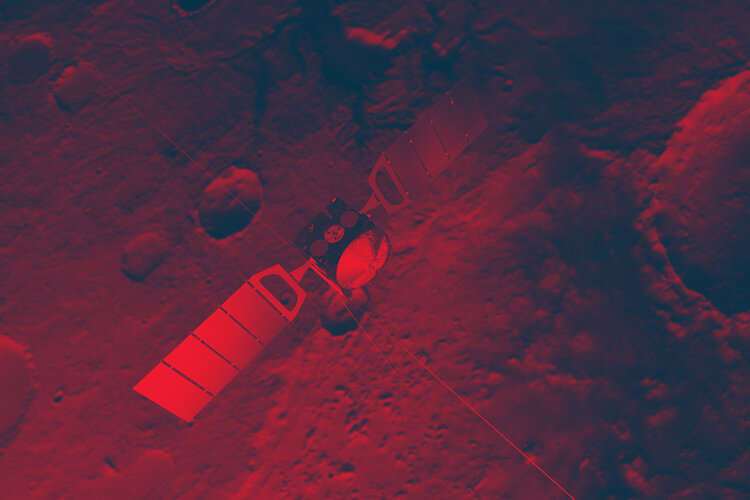
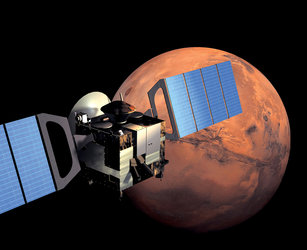
European space scientists are getting closer to unravelling the origin of Mars’ larger moon, Phobos. Thanks to a series of close encounters by ESA’s Mars Express spacecraft, the moon looks almost certain to be a ‘rubble pile’, rather than a single solid object. However, mysteries remain about where the rubble came from.
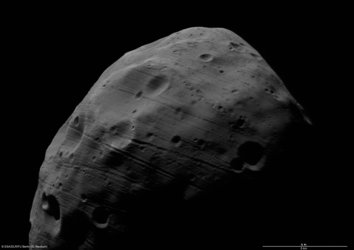
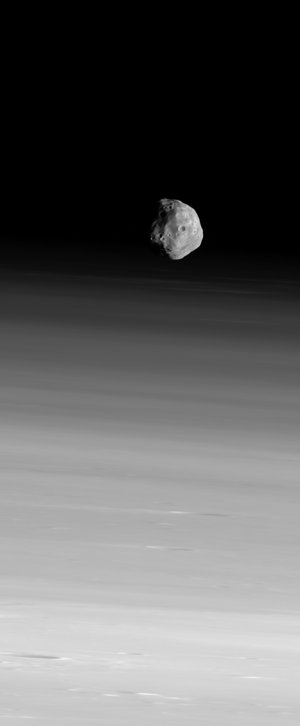
Unlike Earth, with its single large moon, Mars plays host to two small moons. The larger one is Phobos, an irregularly sized lump of space rock measuring just 27 km x 22 km x 19 km.
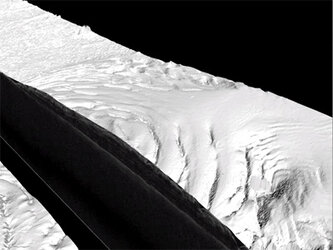
During the Summer, Mars Express made a series of close passes to Phobos. It captured images at almost all fly-bys with the High Resolution Stereo Camera (HRSC). A team led by Gerhard Neukum, Freie Universität Berlin, also involving scientists from the German Aerospace Centre (DLR), is now using these and previously collected data to construct a more accurate 3D model of Phobos, so that its volume can be determined with more precision.
In addition, during one of the nearest fly-bys, the Mars Express Radio Science (MaRS) Experiment team led by Martin Pätzold, Rheinisches Institut fuer Umweltforschung at the University of Cologne, carefully monitored the spacecraft’s radio signals. They recorded the changes in frequency brought about by Phobos’ gravity pulling Mars Express. This data is being used by Tom Andert, Universität der Bundeswehr Muenchen and Pascal Rosenblatt, Royal Observatory of Belgium, both members of the MaRS team, to calculate the precise mass of the martian moon.
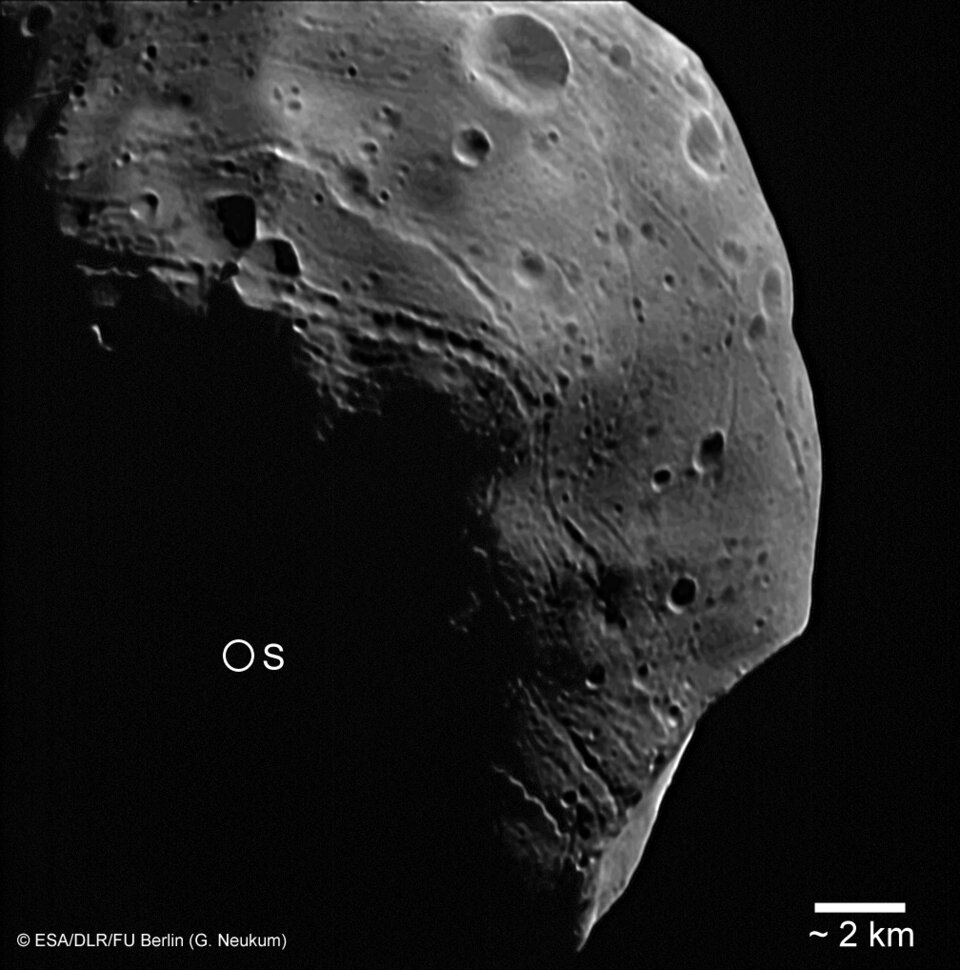
Putting the mass and volume data together, the teams will be able to calculate the density. Eventually, this will be a new important clue to how the moon formed.
Previously, radio tracking from the Soviet Phobos 88 mission and from the spacecraft orbiting Mars in the past decades had provided the most accurate mass. “We can be ten times more precise in our frequency shift measurements today,” says Rosenblatt.
The team’s current mass estimate for Phobos is 1.072x10¹⁶ kg, or about one billionth the mass of the Earth.
Preliminary density calculations suggest that it is just 1.85 grams per cubic centimetre. This is lower than the density of the martian surface rocks, which are 2.7-3.3 grams per cubic centimetre, but very similar to that of some asteroids.

The particular class of asteroids that share Phobos’ density are known as D-class. They are believed to be highly fractured bodies containing giant caverns because they are not solid. Instead, they are a collection of pieces, held together by gravity. Scientists call them rubble piles.
Also, spectroscopic data from Mars Express and previous spacecraft show that Phobos has a similar composition to these asteroids. This suggests that Phobos, and probably its smaller sibling Deimos, are captured asteroids. However, one observation remains difficult to explain in this scenario.

Usually captured asteroids are injected into random orbits around the planet that gravitationally tie them, but Phobos orbits above Mars’ equator – a very specific case. Scientists do not yet understand how it could do this.
In another scenario, Phobos could have been made of martian rocks that were blasted into space during a large meteorite impact. These pieces have not fallen completely together, thus creating the rubble pile.
So the question remains, where did the original material come from – Mars’ surface or the asteroid belt? The MARSIS radar on board Mars Express has also collected historic data about Phobos’ subsurface. This data, together with that from the moon’s surface and surroundings gathered by the other Mars Express instruments, will also help put constraints on the origin. It’s clear though that the whole truth will only be known when samples of the moon are brought back to Earth for analysis in laboratories.

This exciting possibility might soon become reality because the Russians will attempt to do this with the Phobos-Grunt mission, to be launched next year. To land on Phobos, they will require the precise knowledge of the mass as measured by the MaRS Experiment in order to navigate correctly, and are also making use of the HRSC images to select the landing site.
Note for editors

Many more Phobos pictures are accessible following this link.
Between 23 July and 15 September 2008 Mars Express performed a series of eight fly-bys of the martian moon Phobos, at distances ranging between 4500 and 93 km from the centre of the moon, conducting some of the most detailed investigations of the Moon to date. In observing Phobos, Mars Express benefits from its highly elliptical orbit which takes it from a closest Mars approach of 270 km above the surface up to a maximum of 10 000 km from the planet's centre, crossing the 9 400 km orbit of the moon. Like our Moon, Phobos always shows the same side to the planet, so it is only by flying outside the orbit that it becomes possible to observe the far side. The other spacecraft presently orbiting Mars do so at much lower altitudes, and therefore only see the planet-facing side of the moon.

The High-Resolution Stereo Camera (HRSC) collected pictures of the moon’s surface with the highest resolution possible, in colour and in 3-D, and provided images of areas never glimpsed before. By September, also the Super Resolution (SRC) Camera, part of the HRSC experiment, collected plenty of images. During the second fly-by, all efforts were concentrated on accurately determining the mass of the moon using the MaRS experiment.
The Visible and Infrared Mineralogical Mapping Spectrometer, OMEGA, the Planetary Fourier Spectrometer, PFS, and the Ultraviolet and Infrared Atmospheric Spectrometer, SPICAM, gathered details on the surface composition, geochemistry and temperature of Phobos.

The MARSIS radar collected information on the topography of the moon’s surface and on the structure of its interior. The Energetic neutral atoms analyser, ASPERA studied the environment around Phobos, in particular the plasma that surrounds the moon and also the interaction of the moon with the solar wind.
For more information
Gerhard Neukum, HRSC Principal Investigator, Freie Universität Berlin, Germany
Email: gneukum @ zedat.fu-berlin.de
Martin Pätzold, MaRS Principal Investigator, Rheinisches Institut fuer Umweltforschung, University of Cologne
Email: Paetzold @ geo.uni-koeln.de
Pascal Rosenblatt, MaRS science team, Royal Observatory of Belgium
Email: Pascal.Rosenblatt @ oma.be
Tom Andert, Universität der Bundeswehr Muenchen, Germany
Email: Tom.Andert @ unibw-muenchen.de
Agustin Chicarro, ESA Mars Express Project Scientist
Email: Agustin.Chicarro @ esa.int