Rebirth of an icon: Hubble's first images since Servicing Mission 4
Astronomers today declared the NASA/ESA Hubble Space Telescope a fully rejuvenated observatory ready for a new decade of exploration, with the release of observations from four of its six operating science instruments.
"This is one more important step in the confirmation of this wonderful mission. We Europeans are proud to be part of this and heartily congratulate the engineers, astronauts and scientists who got us to this point," said ESA's Director of Science and Robotic Exploration, David Southwood.
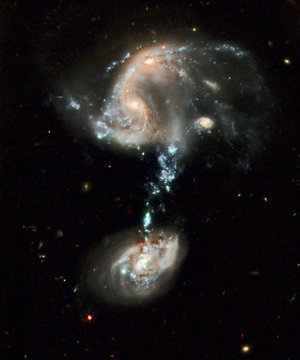
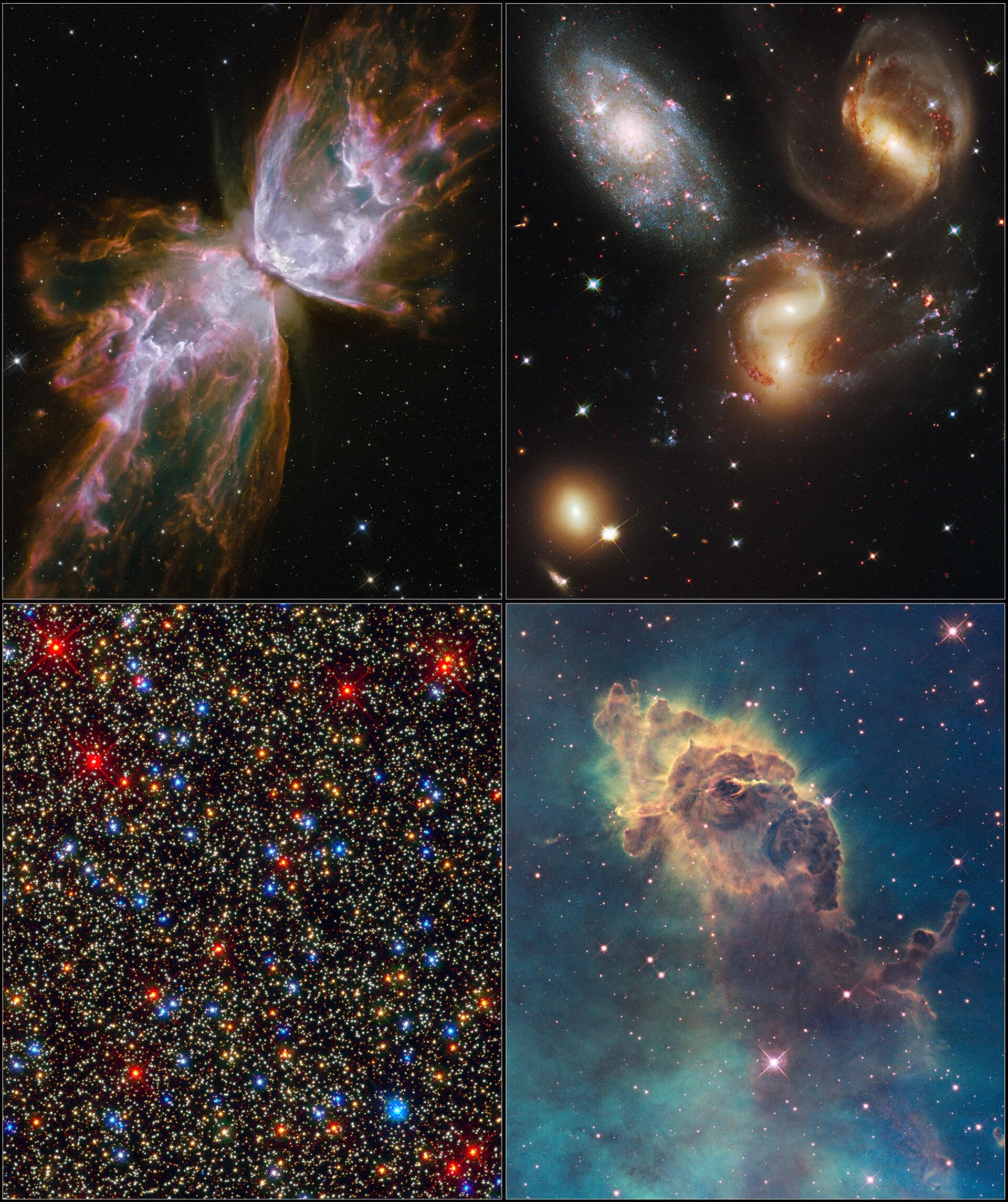
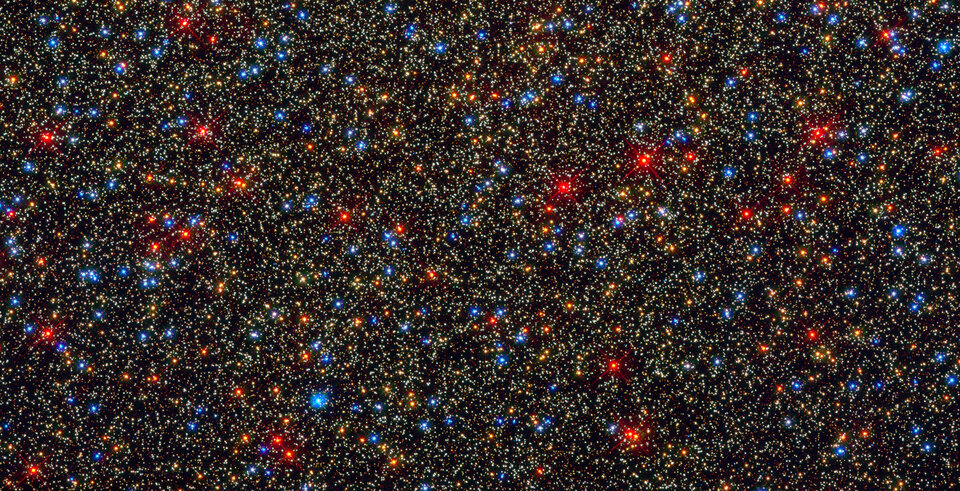
Topping the list of exciting new views are colourful multi-wavelength pictures of far-flung galaxies, a densely packed star cluster, an eerie ‘pillar of creation’ and a butterfly-shaped nebula. Hubble's suite of new instruments now allows it to study the Universe's across a wide swath of the light spectrum, from ultraviolet light all the way to near-infrared light.

In addition, scientists released spectroscopic observations that slice across billions of light-years to map the structure of the cosmic web that permeates the Universe and also the distribution of the chemical elements that are fundamental to life as we know it.
"This marks a new beginning for Hubble," said Ed Weiler, associate administrator for NASA's Science Mission Directorate at NASA Headquarters. "The telescope was given an extreme makeover and is now significantly more powerful than ever — well equipped to last well into the next decade."
The new instruments are more sensitive to light and therefore will significantly improve Hubble's observing efficiency. The space telescope is now able to complete observations in a fraction of the time that was needed with earlier generations of Hubble instruments. Therefore the space observatory today is significantly more powerful than it has ever been.

"We couldn't be more thrilled with the quality of the images from the new Wide Field Camera 3 (WFC3) and the repaired Advanced Camera for Surveys (ACS), and the spectra from the Cosmic Origins Spectrograph (COS) and the Space Telescope Imaging Spectrograph (STIS). The targets we've selected to showcase Hubble's capabilities reveal the great range of capabilities in our newly upgraded Hubble," said Keith Noll, leader of the team at the Space Telescope Science Institute in Baltimore, USA, that planned the early release observations.
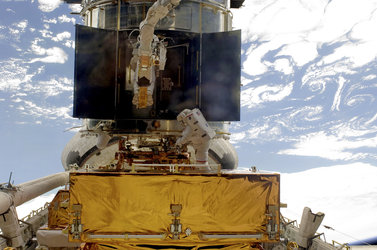
These results are compelling evidence of the success of the STS-125 Servicing Mission in May, which has brought the premier space observatory to the peak of its scientific performance. Two new instruments, the WFC3 and COS, were installed, and two others, the ACS and STIS, were repaired at the circuit board level.
Mission scientists also announced today that the Near Infrared Camera and Multi-Object Spectrometer (NICMOS) was brought back into operation during the three months of calibration and testing.
"On this mission we wanted to replenish the 'toolkit' of Hubble instruments that scientists around the world rely on to carry out their cutting-edge research," said David Leckrone, Senior Hubble Project Scientist at NASA's Goddard Space Flight Center in Greenbelt, USA. "Prior to Servicing Mission 4 we had only three unique instrument channels still working, and today we have a total of 13. I'm very proud to be able to say, 'mission accomplished'."
For the past three months scientists and engineers at STScI and the Goddard Space Flight Center have been focusing, testing and calibrating the instruments. Hubble is one of the most complex space telescopes ever launched, and the Hubble Servicing Mission astronauts performed major surgery on the 19-year-old observatory's multiple systems. This orbital verification phase was interrupted briefly on 19 July to observe Jupiter in the aftermath of a collision with a suspected comet.
Hubble now enters a phase of full science observations. The demand for observing time will be intense. Astronomers look forward to using the telescope to conduct a broad range of observations: from studying the population of Kuiper Belt objects at the fringe of our Solar System, to observing the birth of planets around other stars, to probing the composition and structure of extrasolar planetary atmospheres.
There are ambitious plans to take the deepest-ever near-infrared portrait of the Universe to reveal never-before-seen infant galaxies that existed when the Universe was less than 500 million years old. Other planned observations will attempt to shed light on the behaviour of dark energy, a repulsive force that is pushing the Universe apart at an ever-faster rate.
Notes for editors:
The Hubble Space Telescope is a project of international cooperation between ESA and NASA. It was launched in 1990. The partnership agreement between ESA and NASA was signed on 7 October 1977; as a result of this agreement European astronomers have guaranteed access to 15% of Hubble's observing time.
For more information:
Colleen Sharkey, Hubble/ESA, Garching, Germany
E-mail: csharkey @ eso.org