Sounds from space
Sounds of Enceladus

The NASA/ESA/ASI Cassini-Huygens spacecraft detected an atmosphere on Saturn's icy moon Enceladus.
Cassini's MAG magnetometer instrument observed 'ion cyclotron' waves in the vicinity of the moon. These waves are organised fluctuations in the magnetic field that provide information on what electrically charged molecules (ions) are present. This audio file shows the power of these waves near Enceladus.
Song of the Sun

Low-frequency vibrations from the Sun recorded by the ESA/NASA SOHO spacecraft.
This audio clip explains how the atmospheric circulation inside the Sun causes very low frequency 'sound' to be produced (listen from 1:23).
Dawn in space

'Dawn chorus' signals detected by ESA Cluster’s WBD (Wide Band Data) instrument.
High-energy electrons get trapped in the Earth’s radiation belts. When they are accelerated by the electromagnetic field, they produce this familiar sound. With the help of missions studying particles in space like the four Cluster spacecraft, ESA scientists are investigating how the electrons are accelerated and how the sound like the 'dawn chorus' of birds is created.
Atmospheric squeaking

A 'whistler' is audibly emitted in the atmosphere.
Whistlers were first occasionally heard at the end of the 19th century on long-distance telephone lines. They are electromagnetic emissions produced in the atmosphere, but their cause is still partly unclear. They originate from thunderstorms or meteorites, or even after earthquakes. Once produced, the sounds travel along closed magnetic field lines from one hemisphere to the other. Studying them can yield information about the Earth's atmosphere, ionosphere, and magnetosphere up to very long distances. This one is a lightning strike recorded by Cluster (courtesy of Prof. D. Gurnett, University of Iowa).
Cassini-Huygens passing through Saturn's rings

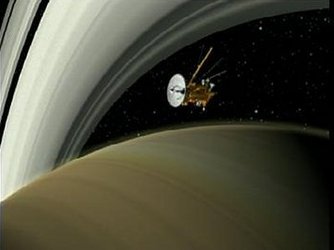
NASA/ESA/ASI Cassini-Huygens spacecraft is hit by millions of dust particles as it goes through a gap in Saturn's icy rings.
Although the ring gaps appear empty, they are not. The spacecraft ploughed through these dust particles at a speed of about 70 000 kilometres per hour! These impacts, converted into audible sounds, resemble hail hitting a tin roof.
Auroral 'Star Wars'

Sound of an Auroral Kilometric Radiation (AKR) collected by Cluster resembles the one of R2D2, the little robot from 'Star Wars'.
Earth can generate radio emissions in a natural way. The most intense of these emissions is a phenomenon called Auroral Kilometric Radiation (AKR). It is produced in the auroral zones at an altitude between 3000 and 20 000 kilometres. Afterwards, the sounds escape outward in the space from the magnetic field lines. AKR intensifies during magnetic and auroral substorms so you can use it as a remote indicator of geomagnetic activity. The Wide Band (WBD) instrument on-board Cluster recorded this sound and made the first direct determination of the locations of an AKR (courtesy of Prof. D. Gurnett, University of Iowa).
Marsquake!

ESA's Mars Express mission being tested on a special shaker in Toulouse, France.
Every space probe undergoes dramatic vibration stress during launch that could damage the delicate instruments on board. ESA needs to ensure before launch that the spacecraft is tough enough to face the adventurous trip.
Wailing of the Leonids
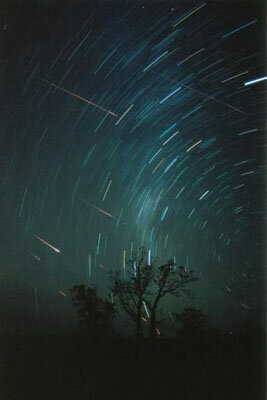
Tracks left behind by the November 2000 Leonids shower, as detected by ESA scientists.
Each time a meteor crosses the atmosphere, it leaves behind a short trail of ionised particles. This trail reflects high-frequency radio signals from stations around the world for just a few seconds. The motion of the meteor trail due to the upper atmosphere winds changes the frequency of the reflected signal (Doppler effect). You 'hear' the trail as it is blown around by the winds before it is eventually dispersed.