Faint gamma-ray bursts do actually exist
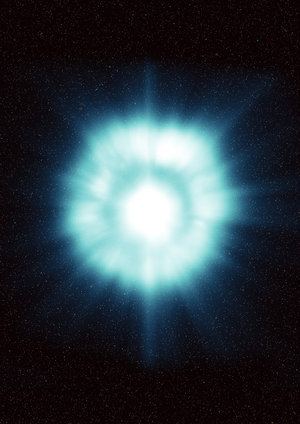
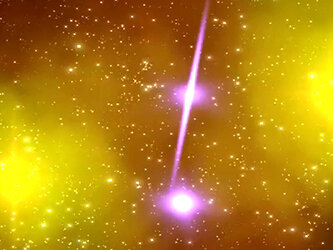
Gamma-ray bursts, powerful glares of high-energy that wash through the Universe once every day or so are, for a brief time, the brightest objects in the gamma-ray sky. ESA’s Integral gamma-ray observatory has observed several low-luminosity gamma-ray bursts, confirming the existence of an entire population of weaker bursts hardly noticed so far.
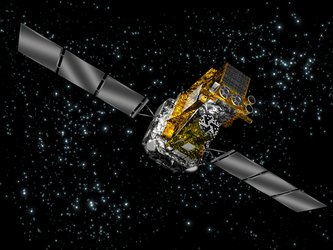
When it comes to detecting gamma-ray bursts (or GRBs), Integral is equipped with the most sensitive detector ever launched into space – the IBIS imager. Its field of view is very well shielded from any background radiation, making the detection of faint gamma-ray signals possible.
Astronomers estimate that about 1400 GRBs per year occur but, because no one knows when and where they are going to appear, only a part of them happen to be detected. Integral detects an average of 10 GRBs per year, and has collected data about 47 of them during four and a half years of operations.
When studying IBIS gamma-ray burst data, Prof. Lorraine Hanlon from the School of Physics, University College Dublin, Ireland, and her colleagues, realised that some of the faintest bursts have distinctive gamma-ray emission, and also present faint afterglows in the lower-energy X-ray and visible wavelengths.
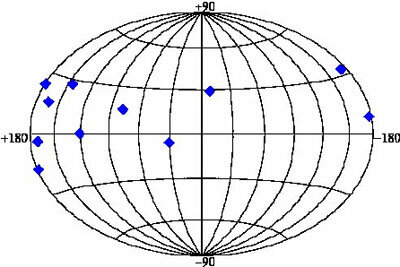
Since, in general, GRBs are colossal explosions of energy triggered by the collision of very massive and compact objects such as neutron stars or black holes, or by the explosion of incredibly powerful supernovae, or hypernovae, one may think that these bursts are perceived as faint just because they take place very far away from us, in the remote corners of the Universe.
However, Prof. Hanlon and colleagues noticed that these faint bursts, just at the sensitivity threshold of IBIS, seem to originate in our cosmic neighbourhood, within the nearby clusters of galaxies.
“If the bursts we have studied are so ‘close’ in cosmological terms, it means that they are faint from the beginning,” says Hanlon. “From this we can deduce that the processes triggering them could be less energetic than those generating the more powerful bursts we are more used to observing.”
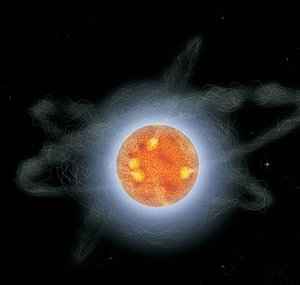
The study team suggests that the faint bursts may be generated by the collapse of a massive star that does not present the characteristics of a supernova, or by the merger of two white dwarfs (small and dense stars about the size of Earth), or by the merger of a white dwarf with a neutron star or a black hole.
“Past observations had already hinted the existence of faint GRBs, and thanks to Integral’s sensitivity we can now say that an entire population of them exist,” added Hanlon. “Actually, their rate may even be higher than that of the most luminous GRBs but, just because they are weaker, we may be only able to see those which are relatively close by.”
“More Integral observations in the coming years will definitively help us understand the phenomenon of faint GRBs, and to explore the nature of this newly observed population,” she concluded.
Notes for editors:
The results appeared in the Astronomy & Astrophysics journal (June 2008), in a paper titled: “Global characteristics of GRBs observed with Integral and the inferred large population of low-luminosity GRBs”, by S. Foley, S. McGlynn, L. Hanlon, B. McBreen (University College Dublin, Ireland), and S. McBreen (Max-Planck-Institut für Extraterrestrische Physik, Garching, Germany) (A&A Vol. vol. 484, 143, 2008). The results were also presented at the 7th Integral workshop that took place in Copenhagen, Denmark, in September 2008.
For more information:
Lorraine Hanlon, UCD School of Physics, University College Dublin, Ireland
Email: Lorraine.Hanlon @ ucd.ie
Christoph Winkler, ESA Integral Project Scientist
Email: Christoph.Winkler @ esa.int