XMM-Newton's fifth anniversary in orbit
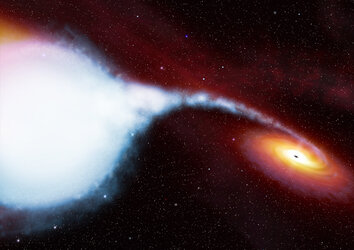
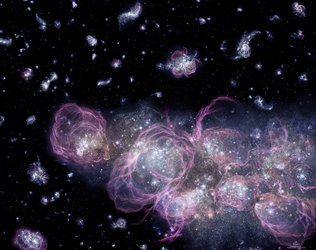
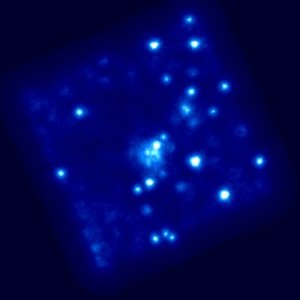
XMM-Newton was launched five years ago, on 10 December 1999. It is now detecting more X-ray sources than any previous satellite and is helping to solve many cosmic mysteries of the violent Universe, from what happens in and around black holes to the formation of galaxies in the early Universe.
It was designed and built to return data for at least a decade, and is the biggest science satellite ever built in Europe. Its telescope mirrors are the most sensitive ever developed in the world, and with its sensitive detectors, it sees much more than any previous X-ray satellite.
XMM-Newton’s high-technology design uses over 170 wafer-thin cylindrical mirrors spread over three telescopes. Its orbit takes it almost a third of the way to the Moon, so that astronomers can enjoy long, uninterrupted views of celestial objects.
XMM-Newton has recently returned new data about the content of the currently popular model of the Universe (70% dark energy, 25% dark matter and 5% normal matter). XMM-Newton has found puzzling differences between today’s clusters of galaxies and those in the Universe around seven thousand million years ago.
Some scientists interpret this to mean that the ‘dark energy’ which most astronomers now believe dominates the Universe simply does not exist. XMM-Newton has given astronomers a new insight into the Universe and a new mystery to puzzle over. These results are being confirmed by other X-ray observations and, if these return the same answer, we might have to rethink our understanding of the Universe.