

Integral overview
Objective
Tracking violent events across the Universe, Integral is ESA's International Gamma-Ray Astrophysics Laboratory. It is studying explosions, radiation, formation of elements, black holes and other exotic objects.
For more in-depth scientific and technical details of our Space Science Programme and missions, follow this link.
Mission
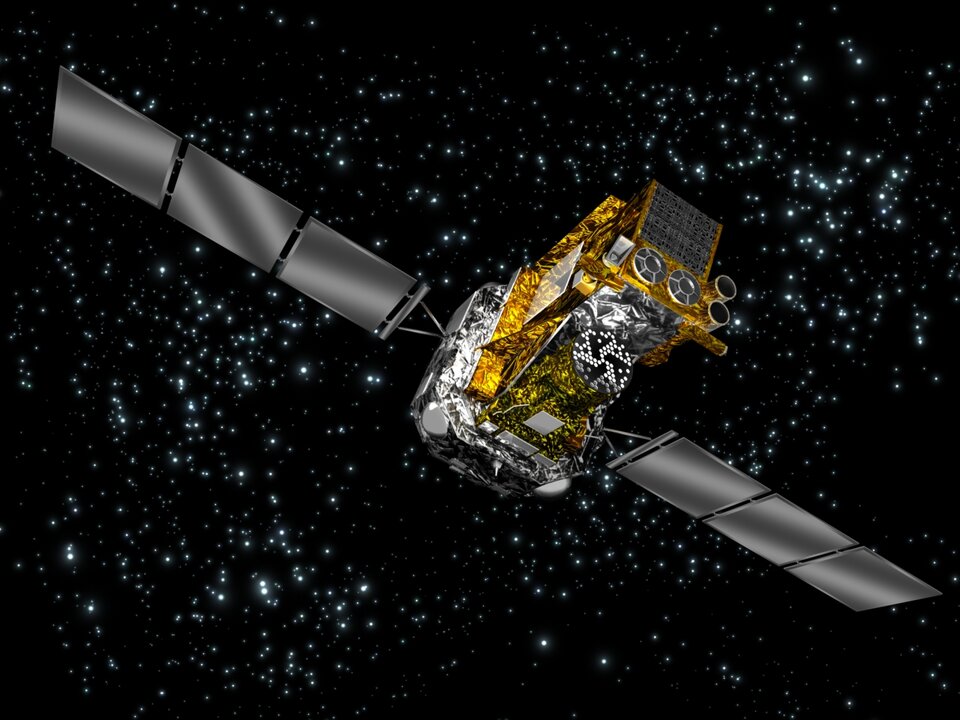
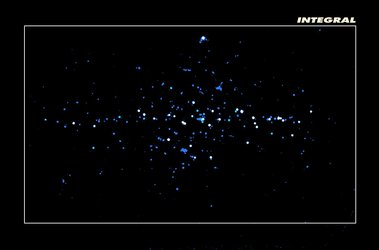
Integral is the first space observatory that can simultaneously observe objects in gamma rays, X-rays and visible light. Its principal targets are violent explosions known as gamma-ray bursts, powerful phenomena such as supernova explosions, and regions in the Universe thought to contain black holes.
Gamma rays are even more powerful and penetrating than the X-rays used in medical examinations. Fortunately, Earth's atmosphere acts as a shield to protect us from this dangerous cosmic radiation. This means that gamma rays from space can only be detected above Earth’s atmosphere. Integral is the most advanced gamma-ray observatory ever launched. It can detect radiation from events far away and from the processes that shape the Universe.
What’s special?
Most of the elements in our bodies and in everything around us come from dying stars! However, how can new elements be formed when a star dies? To answer this question precisely, more basic research has to be done. Integral will help to find out more about this element-making process.
It sounds paradoxical: the events that made the Universe habitable were catastrophic. Violent stellar explosions provided the energy that was needed to form the elements from which planets and living things could be built. Gamma rays from these supernova explosions and from newly formed radioactive elements will be registered by Integral.
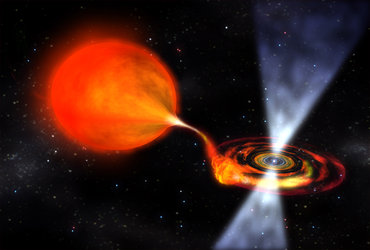
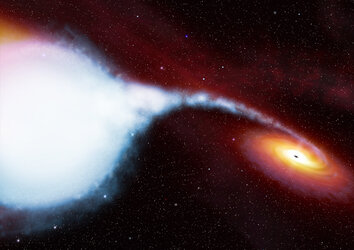
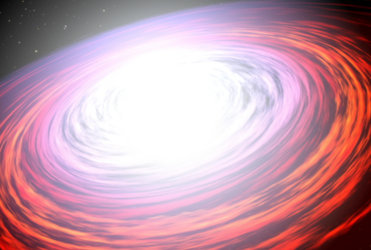
Intense sources of gamma rays lie in the centre of our own galaxy, the Milky Way, caused by an enormous black hole, almost 3 million times more massive than our Sun. Results from Integral may help understanding the nature of this giant and enigmatic object. Gamma rays also appear after a supernova explosion when matter squirms in the intense gravity of the collapsed and very dense star remnant. Studying such compact objects as neutron stars or black holes is the second and very important task of Integral.
Besides stellar black holes, much bigger specimens of these extremely dense objects may exist. Most astronomers believe that in the heart of our galaxy, as in the centre of other galaxies, there are giant black holes. Integral will not only find evidence of these exotic objects, but allow detailed studies of their physical properties.
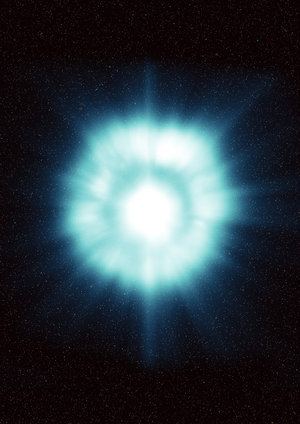
Even stranger than the energetic radiation coming from the centre of distant galaxies are the flashes of extremely powerful radiation that suddenly appear somewhere in the gamma sky and disappear again after a short time. Observations in different wavelengths confirm that these bursts are the biggest explosions in the Universe. However, what is exploding out there? Integral will help to solve this cosmic mystery.
Spacecraft
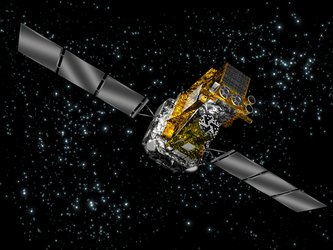
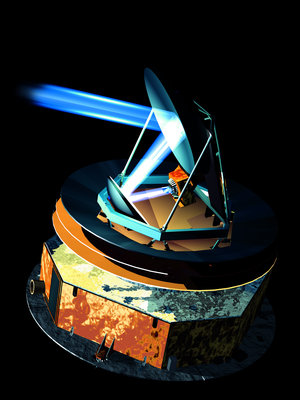
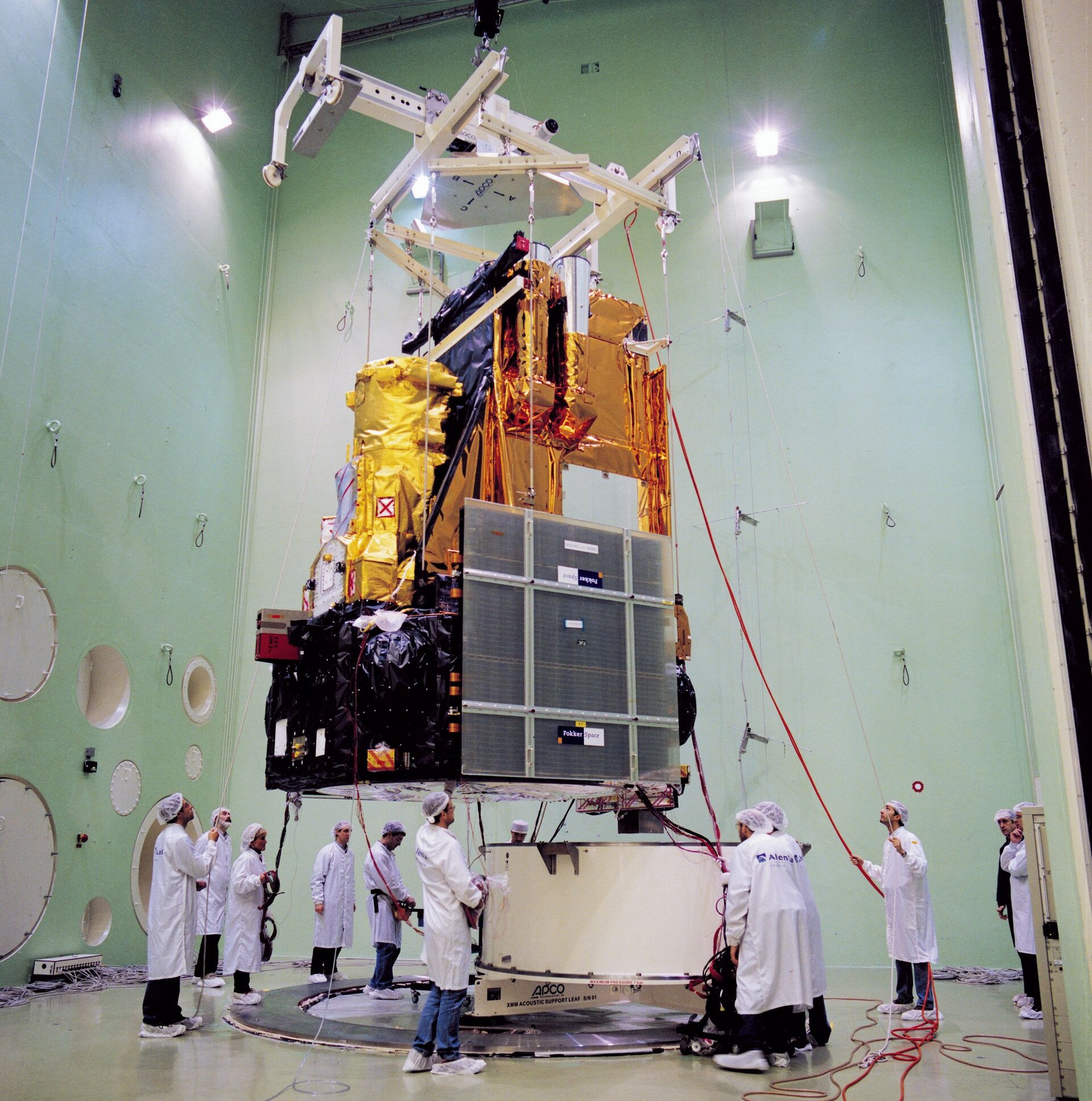
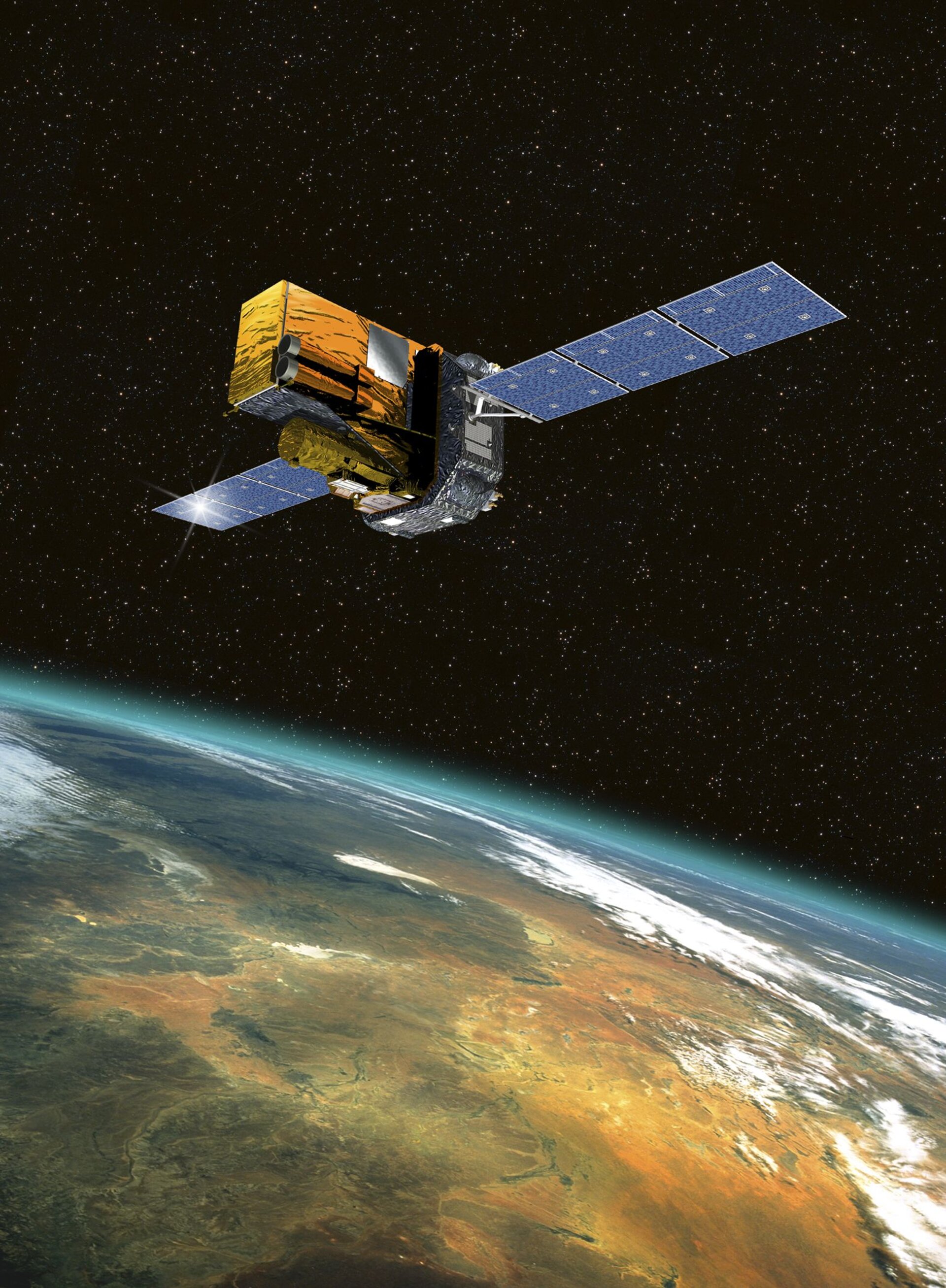
Standing 5 metres high and more than 4 tonnes in weight, the Integral spacecraft is impressive. The satellite has two main parts. The service module is the lower part of the satellite and contains all spacecraft subsystems, required to support the mission. The payload module is mounted on the service module and carries the scientific instruments.
To limit the costs of the mission, the service module is a rebuild of the one developed for XMM-Newton, ESA's X-ray observatory. It is a closed structure made of composite material, a combination of aluminium and carbon fibre. It houses the satellite systems, including solar power generation, power conditioning and control, data handling, telecommunications and thermal, attitude and orbit control.
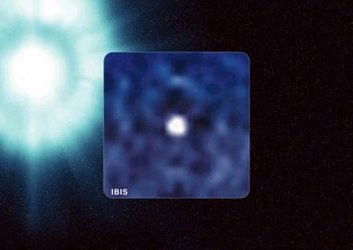
The four scientific instruments of Integral's payload module weigh 2 tonnes, making this payload the heaviest ever placed in orbit by ESA. This is due to detectors' large area needed to capture sparse and penetrating gamma rays and to the need to shield the detectors from background radiation in order to make them sensitive. There are two main instruments detecting gamma rays. An imager will give the sharpest gamma-ray images so far. A spectrometer will gauge gamma-ray energies very precisely. Two other instruments, an X-ray monitor and an optical camera, will help to identify the gamma-ray sources.
Journey
Integral circles Earth in a highly elliptical orbit once every three days. It spends most of its time at an altitude higher than 60 000 kilometres - well outside Earth's radiation belts - to avoid the background radiation effects which would interfere with the measurement of gamma rays.
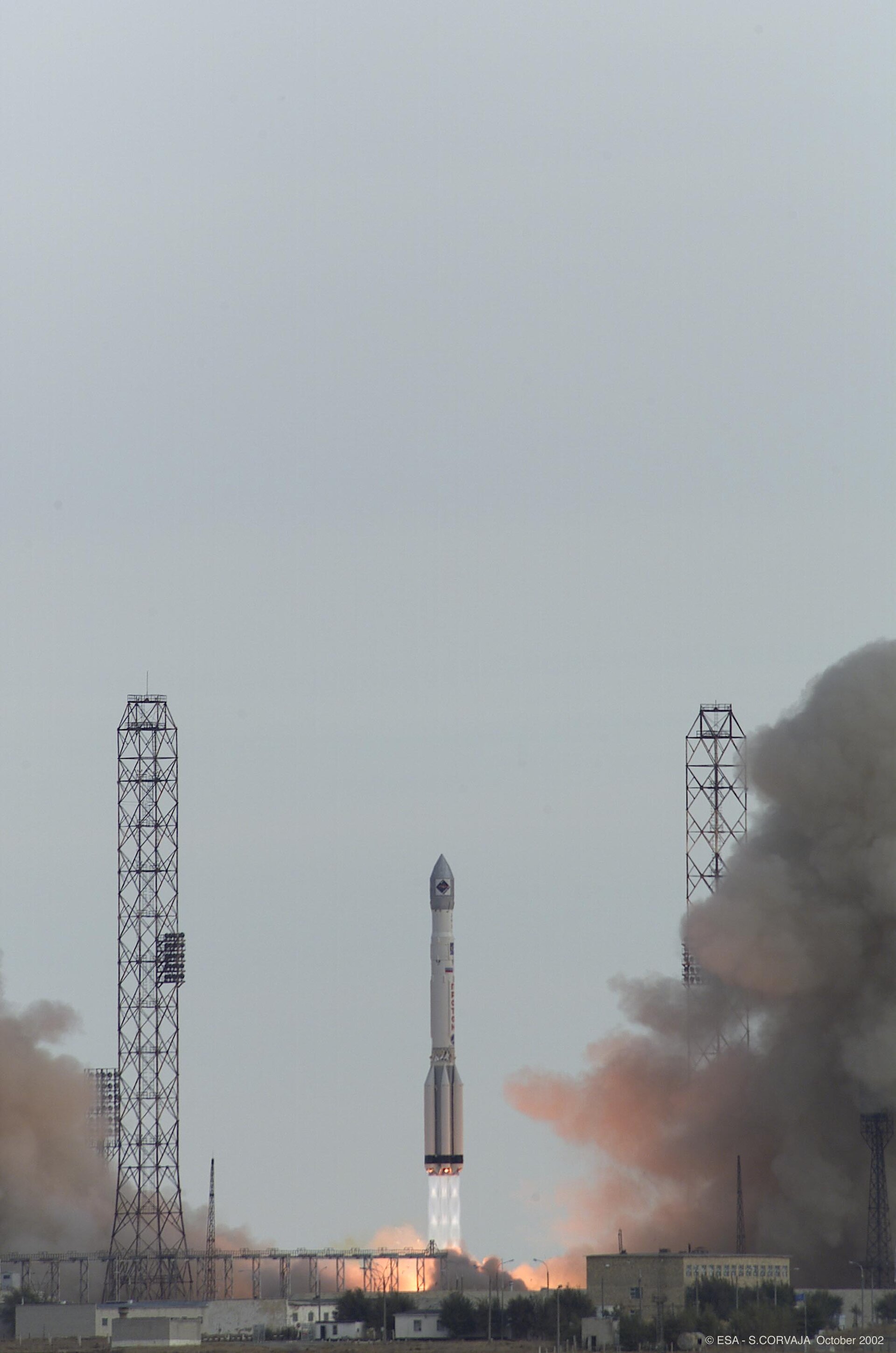
Integral was launched by a Proton rocket, Russia's largest operational launch vehicle, on 17 October 2002 from the Baikonur Cosmodrome in Kazakhstan. A powerful launcher was absolutely essential to put the heavy spacecraft into an unusually high Earth orbit which is crucial for the scientific success of the mission.
The Proton used three booster stages to place the spacecraft into a low ‘parking’ orbit. The Proton upper stage put the satellite into a highly eccentric 'transfer' orbit. Then Integral's own propulsion system brought the spacecraft to its operational 72-hour orbit.
Its lowest point is 9000 kilometres (growing to 13 000 km after 5 years) and its highest point is 153 000 kilometres. In addition to the orbit shape, the inclination (the angle compared with Earth's equator) also changes drastically during the 5 years.
The high and eccentric orbit guarantees long periods of uninterrupted observation with nearly constant background and away from trapped radiation in Earth's proton and electron belts. In this way, scientists can use more than 80% of the time spent in the orbit for scientific observations above an altitude of 60 000 kilometres.
The orbital period of 72 hours is a multiple of 24 hours which guarantees an optimal coverage pattern from the ground stations. This coverage is continuous for Integral's orbit for all revolutions and allows repetitive working shifts on the ground.
History
Integral was selected by the ESA in June 1993 as the next ESA medium-size scientific mission (M2) of its Horizon 2000 programme. The mission was conceived as an observatory led by ESA with contributions from Russia (Proton launcher) and NASA (Deep Space Network ground station).
Partnerships
Integral is a truly international mission with the participation of all Member States of ESA plus United States, Russia, the Czech Republic and Poland.
ESA appointed Alenia Aerospazio, from Italy, as industrial prime contractor, responsible for the design, integration and testing of the satellite. On board, four instruments from teams led by scientists in Italy, France, Germany, Denmark and Spain will gather and analyse the gamma rays from space.