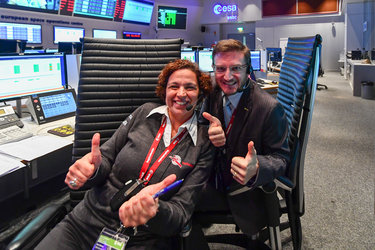
Hear from Laurène Delsupexhe
Laurène Delsupexhe discovered a passion for space during her engineering studies, pursued that passion and is now contributing to cutting-edge propulsion projects at the European Space Agency. In this interview, Laurène reflects on her path to ESA, the highlights of her JP experience and how the programme has accelerated both her technical growth and her international network.

What was your educational and professional background before joining the JP Programme?
My academic background includes a French diplôme d’ingénieur, equivalent to an MSc in Aeronautical Engineering, and a Master in Space Transportation Systems. Indeed, while finishing my first degree, I fell in love with the space industry and decided that in order to pursue a career in that field, a specialised degree would be useful – and I have no regrets! Apart from internships at ESA-ESRIN in Italy and Arianespace, my first job was as a consultant for ArianeGroup in Les Mureaux, France, working mostly on writing codes to automise CFD simulations. After this, I worked as a technical assistant for CNES in the Propulsion service at Daumesnil in Paris. I then moved to Italy for a Systems Engineer position working for VEGA-E for Avio. However, that position didn’t last very long as I received an offer to join ESA as a JP in Chemical Propulsion Engineering!
Can you describe your role as a Junior Professional at ESA and the main projects you worked on?
From the start of my JP assignment I was shadowing a colleague on his tasks, which were mainly divided into two categories: mission support and research activities. In the first case, we provide technical support to the company selected to develop (in my case) the propulsion system for a specific mission and make sure it meets all the mission requirements. In the second case, ESA provides contracts to companies, start-ups or institutions to develop a technical component through one of its research programmes, such as the General Support Technology Programme (GSTP) or Technology Development Element (TDE). We support the company that obtained the contract and help them develop that specific component. It can be anything: right now, I’m working on the development of a cooling channel, an innovative method to gauge the fluid inside a tank and the design of a de-orbiting propulsion system.

What was the most exciting or rewarding part of your work during the programme?
It’s hard to limit it to only one, there were so many! I helped with a test campaign in the ESA Propulsion Lab a year and half ago to characterise a pressure regulator that will be used in one of the missions I am supporting. I also loved my placement with the Lift Me Off company because it allowed me to do a bit of testing at the Westcott facilities, a former British RAF base. The cherry on top for me was a two-month placement at ESA's European Astronaut Centre working for Samantha Cristoforetti on the LEO Cargo Return Service: as someone passionate about human space exploration, I was in heaven!
How did being part of the JP Programme help you grow professionally and personally?
Professionally, I find that I have particularly grown my technical skills: our team has a great atmosphere and there is always someone who will know the answer to your question. We have experts in chemical compatibility, tanks, engine development, modelling, cryogenics: that diversity allowed me to become a better engineer.
Personally, being part of the JP Programme allowed me to enter ESA with 29 other people about my age from all around Europe: this made for some easy social interactions that were most welcome.
What kind of mobility, training and development opportunities did you take advantage of during the programme?
Part of the JP Programme includes a placement, either with industry or in another ESA department. I chose the first, with a company I had already worked with when I first joined ESA, Lift Me Off. The company is based in Reading, UK. I really enjoyed my time with them: it was a small team with whom I got on well, I was able to work a little bit in their lab and even participate in a test campaign at the Westcott facility close by. I would recommend future JPs to do their placement with industry: it’s a fantastic opportunity to develop your technical skills quickly and it’s a great way to build bridges with them. For example, I am now Technical Officer on an activity led by Lift Me Off and it makes the communications that much easier.
After coming back from the placement, I pushed my luck and asked my line manager for a second, smaller one: I am very interested in human space exploration so I really wanted to spend some time at the European Astronaut Centre in Cologne, Germany. This is how I ended up working on the LEO Cargo Return Service (LCRS) project for Samantha Cristoforetti. It was an incredible experience: in addition to my work on LCRS, I did a course inside the Columbus lab replica, toured the LUNA facility, saw the spacesuits that astronauts train in, did a shift with EUROCOM with the experts responsible for all European voice communications with astronauts on the ISS, and met plenty of astronauts.

What was it like working with experts in your field and being part of an international team at ESA?
It was extremely enriching: each of my colleagues has their own expertise and everyone was very welcoming. I grew a lot as an engineer thanks to that. I love working in such an international team and general environment.
What has been your most memorable experience at ESA so far?
Working for the first (and only) European woman to become ISS commander, Samantha Cristoforetti, was most definitely a pretty memorable experience, dare I say out-of-this-world.
How do you feel the programme prepared you for the next steps in your career at ESA?
Shadowing my colleague allowed me to deep dive directly into what my future work would look like. Being “teamed up” like this really made all the difference for me, and it is unique to the JP Programme.
What advice would you give to someone considering applying for the JP Programme?
Do it! Even if you think you’re not the perfect fit, give it a shot: show in your cover letter how your past experiences could be beneficial in that position, prepare solid recommendation letters and if you get an interview, prepare for technical questions.
If you had to describe the ESA Junior Professional experience in three words, what would they be and why?
Demanding, rewarding and fun! Demanding because the workload is not negligeable: we support a very large number of missions and activities, so it’s easy to get lost in all of them. Rewarding because when a milestone happens, or an activity reaches its goals, it feels like you’ve done your part to help advance this mission or that technology. Fun, because my duty station ESTEC, in the Netherlands, is an incredible work environment: from its people from all shapes of life to its facilities to its clubs, it’s a pretty fantastic place to work in. Come join us!
The Junior Professional Programme
The ESA Junior Professional Programme offers a unique opportunity to launch your career at the heart of Europe’s space activities, working alongside leading experts, contributing to real missions and building a strong international network. Whether your passion lies in engineering, science or beyond, ESA provides a dynamic environment where you can grow, learn and make a tangible impact.