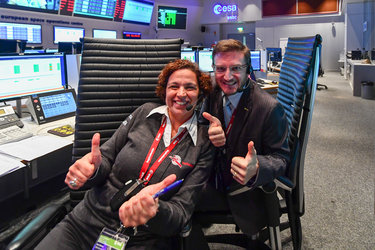
Hear from Romain Esteve
Bringing together expertise in environmental economics and experience in the space sector, Romain Esteve joined the European Space Agency in 2022 through the Junior Professional (JP) Programme. After completing an internship at ESA focused on the economics of space debris then gaining further experience in space strategy and market analysis, he returned to the agency to contribute to Earth observation activities from a programmatic perspective. Here he tells us about his experience of the JP Programme and how it prepared him for his current role at ESA.
As a programme coordinator for Third Party Missions, Romain operates at the intersection of industry, policy and public services, helping connect commercial Earth observation data providers with European users. In this interview, he shares how the JP Programme enabled him to expand his technical knowledge, engage in high-level strategic discussions and play a role in shaping a fast-growing segment of the space economy.
What was your educational and professional background before joining the JP Programme?
I graduated with a master in environmental economics, with a background in mathematics and statistics. For the end of my studies, I landed an internship at ESA in the Clean Space Division, where I wrote a thesis on the economics of space debris in which I applied environmental economics theory to the problem of space pollution.
Following this, I worked for a few years as a consultant in space economics and strategy at London Economics (the company, not the university) where I spent my time working on space programmes and market assessments.
Can you describe your role as a Junior Professional at ESA and the main projects you worked on?
Within the Directorate of Earth Observation Programmes, I am programme coordinator for ESA Third Party Missions (Copernicus Contributing Missions and Earthnet Third Party Missions). I manage commercial Earth observation missions and constellations and supply the data to European public services for operations and technology development. In particular, I work closely with thermal infrared data providers, supporting them in maturing their offer for the Copernicus services.

What was the most exciting or rewarding part of your work during the programme?
Being exposed to strategic discussions between ESA and the European Commission and being in very close collaboration with industry players who are developing Earth observation constellations. Being the bridge between supply and demand is the perfect playground for an economist.
How did being part of the JP Programme help you grow professionally and personally?
Professionally, as I came with little technical background, I learned and am still learning so much. I have developed an understanding of thermal infrared technology and now feel more comfortable with the different types of applications that are possible with this technology. This helps me find new opportunities for suppliers and users and through this I feel part of the development of a strategic segment of the Earth observation industry.
Personally, I gained a lot of confidence through being given a lot of responsibilities and being exposed to a number of strategic and programmatic discussions at ESA, the European Commission and industry level.
What kind of mobility, training and development opportunities did you take advantage of during the programme?
I spent two months at the European Satellite Centre (SatCen) in Madrid. I was working closely with them as part of my daily job as they are a strategic Copernicus service. Spending time on site there helped me make important connections with the people I used to meet online. Nothing can beat the human connection. It also helped me grasp the importance of civil security applications in Europe and how critical the role of SatCen is for public safety.
I’ve also attended a number of trainings and by far my favourite was “Winning hearts and minds”, a course about giving effective presentations which is more an acting class than a traditional training. It pushes you out of your comfort zone, which is very much needed at ESA.

What was it like working with experts in your field and being part of an international team at ESA?
Everything I learned about thermal Earth observation data is thanks to the amazing scientists and engineers in my division and at ESRIN. I’m lucky to work with a lot of interesting, passionate and patient people. Beyond this, there are incredibly diverse specialisms at ESA and you can learn a lot with simple chats at the coffee corner – just be curious.
The international aspect is very important too. We are working in a supra-national organisation; therefore we need to adapt to the cultural differences. Europe is a big village but there are some elements that make us different in our behaviour and approaches to interpersonal relationships. I think this greatly helps on the personal development side too.
What has been your most memorable experience at ESA so far?
Funnily enough, I think it was the day I met my manager. It was at the Living Planet Symposium, and the evening before he invited me to a “team” drink reception. It was at the rooftop bar of a fancy hotel with a bunch of people who introduced themselves one after the other. Their accents did not quite fit European standards and when I asked they all said they were working at NASA! So my first day at work was spent with NASA.
How do you feel the programme prepared you for the next steps in your career at ESA?
The programme allows for mobility, which I think is extremely important in early careers. Then I think it’s up to you to take advantage of what the programme and the agency have to offer. Personally, I was exposed very early on to programmatic discussions and in the front lines of ESA/European Commission collaboration. It is very specific to my position but without the programme I would not have had this chance, so the JP Programme is the enabler.
What advice would you give to someone considering applying for the JP Programme?
I think this programme will have a profound impact on your career. And if you are convinced you want to work at ESA, don’t even think about not applying.
If you had to describe the ESA Junior Professional experience in three words, what would they be?
Enriching, stimulating, auspicious
The Junior Professional Programme
The ESA Junior Professional Programme offers a unique opportunity to launch your career at the heart of Europe’s space activities, working alongside leading experts, contributing to missions and building a strong international network. Whether your passion lies in engineering, science or beyond, ESA provides a dynamic environment where you can grow, learn and make a tangible impact.