Sentinel-1D preparations underway in Kourou
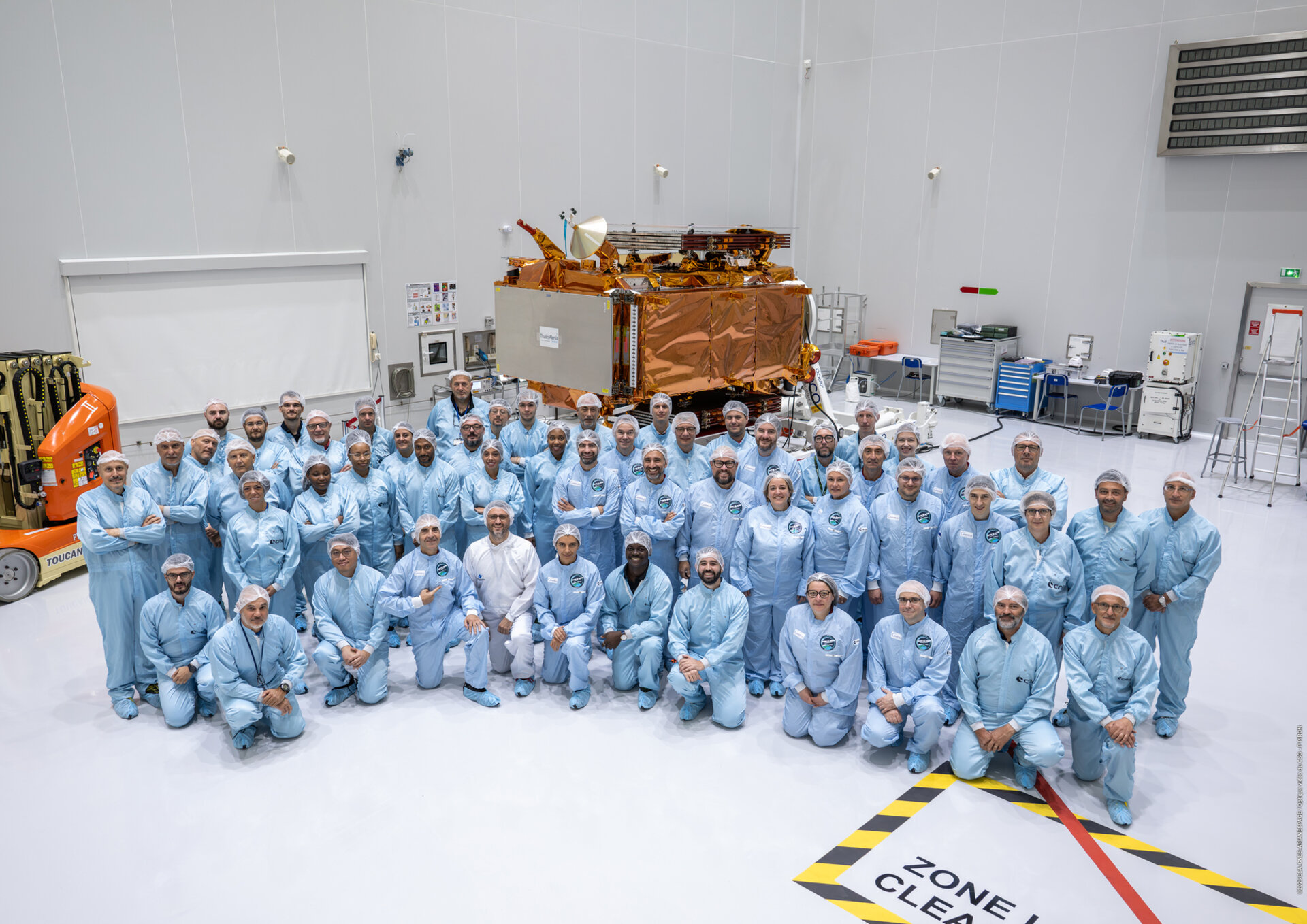
The Copernicus Sentinel-1 mission is about to get its fourth satellite. Copernicus Sentinel-1D has now undergone the checks and functional tests prior to its integration with Ariane 6, ready for launch on Tuesday, 4 November 2025.
When it joins its sibling Sentinel-1C, which was placed in orbit in December 2024, Sentinel-1D will significantly enhance the capabilities of the Copernicus Earth observation programme.
Why two satellites are better than one
The launch of Copernicus Sentinel-1D will provide a much-needed replacement to Sentinel-1A, which has been in orbit for 11 years now, well beyond its planned lifetime.
Sentinel-1C has been fully commissioned and currently operates with Sentinel-1A to deliver radar images of Earth’s surface, performing in all weathers, day-and-night. This service is vital for disaster response teams, environmental agencies, maritime authorities, climate scientists – and other users who depend on frequent updates of critical data.
Having two satellites in operation at any one time is essential for providing timely data and can mean a significant difference between a late warning and a critical early warning. The arrival of Sentinel-1D will enhance the Sentinel-1 mission’s performance in several ways:

- Better revisit time and coverage: With two satellites in the same orbit 180° apart, the revisit rate over any location on Earth improves. This means more frequent imaging, faster change detection, better monitoring.
- Enhanced features working in synergy: Both satellites have a C-band Synthetic Aperture Radar (SAR) instrument on board, which allows it to capture high-resolution imagery of Earth’s surface. They are also equipped with an Automatic Identification System (AIS) instrument to improve detection and tracking of ships. When both are operational, more frequent AIS observations are possible.
- Streamlined operations and cost savings: Because Sentinel-1C has just gone through commissioning, lessons learned can be applied to Sentinel-1D, reducing time and risk.
- GNSS compatibility: There are other improved onboard capabilities for Sentinel-1. For example, while Sentinel-1A and -1B were compatible only with the Global Positioning System (GPS), Sentinel-1C and -1D are compatible with the whole Global Navigation Satellite System (GNSS), including Galileo.
Testing confirms Sentinel-1D is ready

Functional checks have been performed on the spacecraft to confirm the spacecraft is in working order after being transported to Kourou.
These tests started with a pressurisation and leak check before the spacecraft was switched on. Afterwards several tests were performed to assess the spacecraft's health status and the correct functionality of all sub-systems. The AIS antenna assemblies, which were transported to the launch site in separate containers, have also been integrated onto the spacecraft and the final connectivity test to ensure their correct electrical connection concluded the spacecraft functional testing.
The spacecraft is now ready for the next steps, including spacecraft finalisation before fuelling.