Follow the Galileo launch (L14) campaign
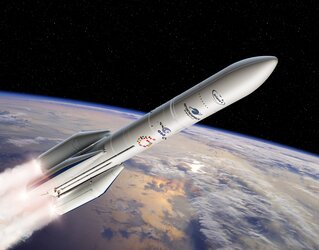
On 17 December, two Galileo satellites will be launched on Ariane 6 from Europe’s Spaceport in French Guiana in the 14th operational launch of the Galileo programme. These satellites will improve the precision, availability and robustness of the Galileo system by adding spares to guarantee the system can always provide a navigation signal for users worldwide. This will be Galileo’s first launch on Ariane 6 and the fifth launch of Europe’s heavy-lift launcher.
The two Galileo satellites, called SAT 33 and SAT 34, arrived in French Guiana on 6 November 2025. This article chronicles their journey by plane, by truck, and eventually by rocket as they join Europe’s independent satellite navigation constellation at 23 222 km above Earth.
The European Space Agency (ESA) is responsible for carrying out the Galileo launch with Arianespace on behalf of the European Commission. The Galileo satellites were manufactured by OHB, under contract with ESA. Once in orbit, the EU Agency for the Space Programme (EUSPA) will bring the satellites into service and oversee their operation.
This article was last updated on 17 December 2025.
6 November: arrival in Kourou

After crossing the Atlantic, Galileo satellites 33 and 34 safely arrived in Kourou in preparation for their launch on Ariane 6, marking the official start of the launch campaign.
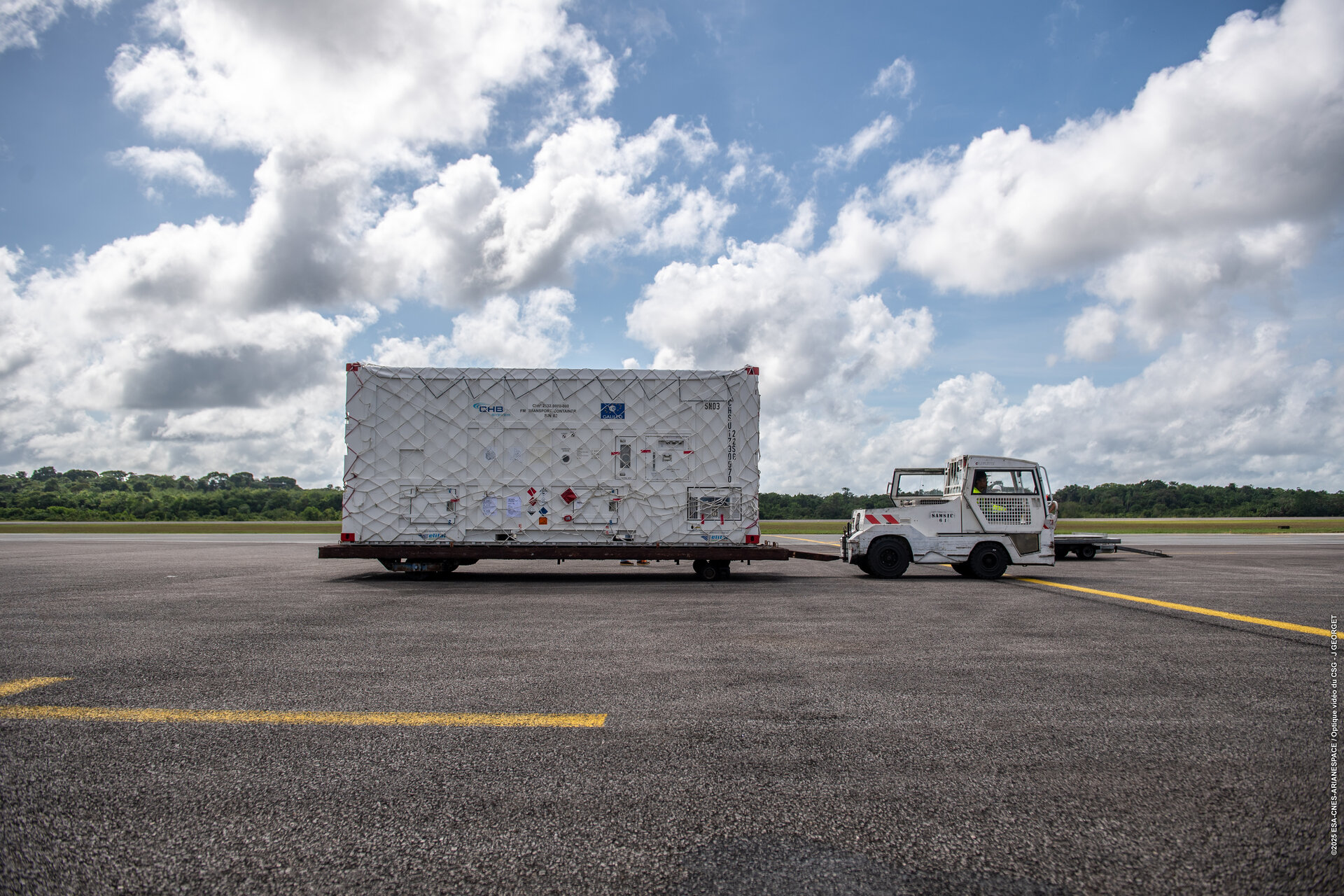
Their journey began on 4 November when they left the OHB premises in Bremen, Germany where they had been in storage. After travelling by road to Luxembourg, the satellites boarded a plane for their 9.5 hour flight to French Guiana. After the long flight, the satellites were carefully unloaded from the plane and transported by truck to Europe’s Spaceport in French Guiana.
8-19 November: ‘fit check’ and functional tests

After their safe arrival in Kourou, Galileo satellites 33 and 34 were taken out of their containers.
Before their launch on Ariane 6, the satellites have to go through a 'fit check'. This is the point in the launch campaign where the teams attach the satellites to the launcher adapter that will hold them during their flight into orbit, verifying the correct mating of the electrical and mechanical connections.
Along with the fit check, the satellites must also undergo functional testing. These tests ensure that all the satellite subsystems are working properly prior to launch. The final software on the satellites is also verified. Once the tests are complete, the satellites are switched off, not to be switched on again until they reach orbit.
27 November: satellite fuelling

Having passed their fit check and functional tests with flying colours, the two Galileo satellites made their way to fuelling facility to be loaded with propellant.
Before adding fuel, the satellites underwent pressure testing to ensure they wouldn't leak any fuel. Only then is it safe to begin adding fuel.
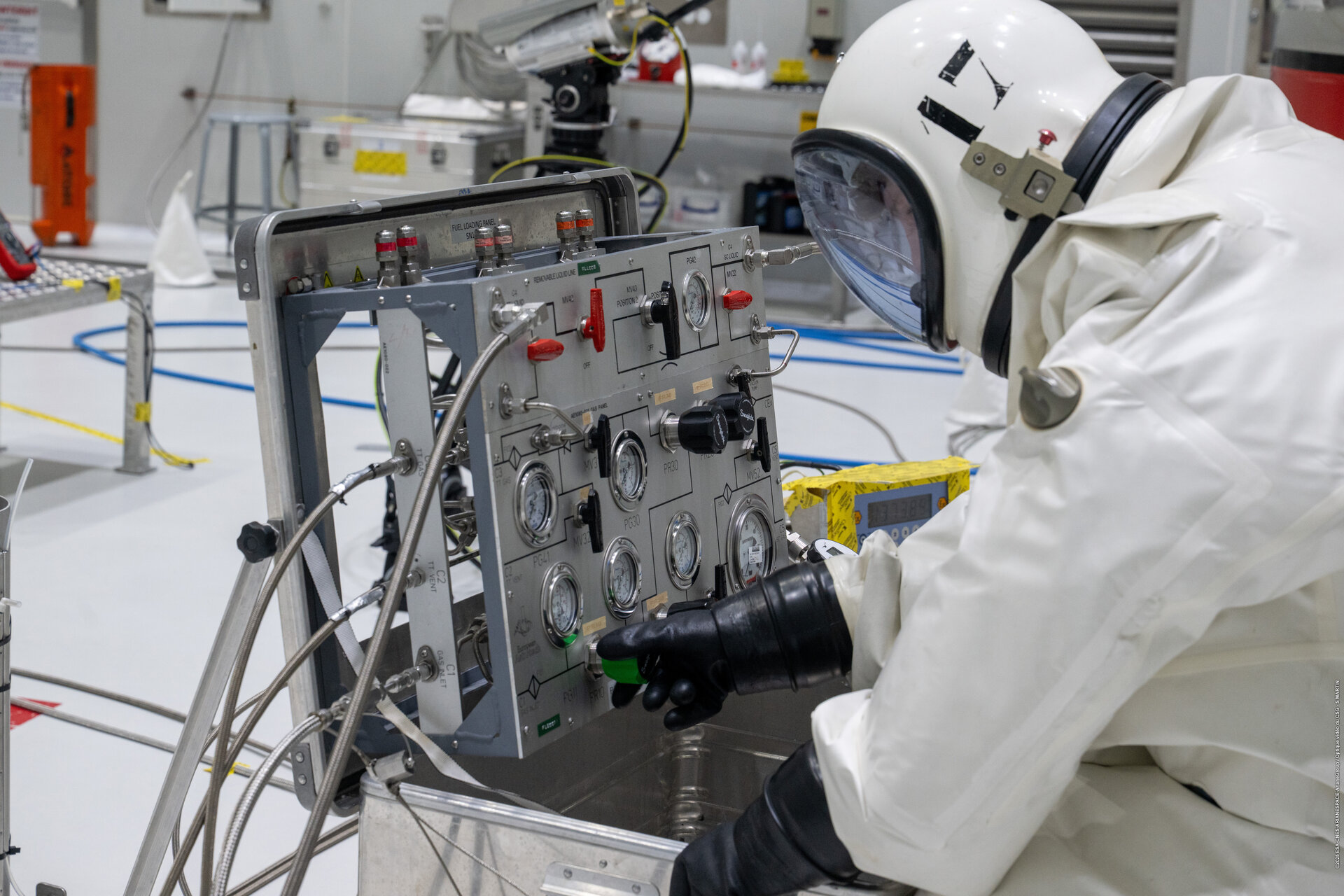
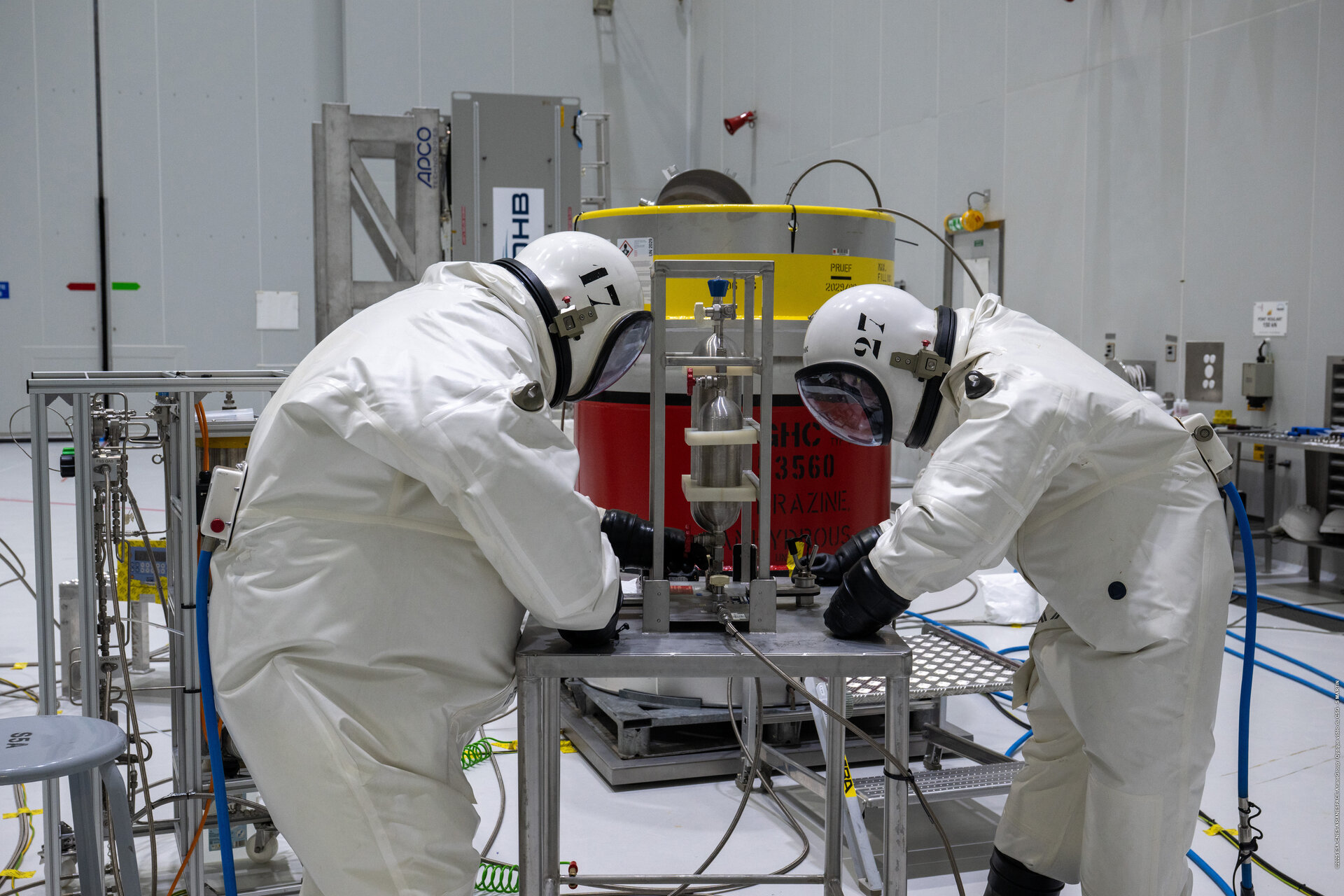
The satellites are fuelled in a special facility, separate from other parts of the spaceport. To get there, they were once again packed into their transport containers.
Fuelling involves hydrazine, a propellant that is both toxic and explosive. For this reason, only a handful of specialists remain inside the cleanroom during the process, fully protected by their astronaut-like SCAPE suits (Self-Contained Atmospheric Protection Ensemble).
Once in orbit, 23 222 km above Earth, this fuel will propel the satellites to their final position and keep them precisely aligned.
A launch is a meticulous process where every step is planned well in advance. Fuelling must be completed early before the next major step: the satellites’ integration on the launcher.
2 December: satellite integration

The two Galileo satellites have been integrated on the newly developed Ariane 6 dispenser at Europe’s Spaceport in French Guiana. From this point onward, they will travel as one unit through the final steps of launch preparation.
This ‘dual launch’ configuration will be maintained during the entire launch phase until the separation of the satellites in medium Earth orbit, 23 222 km above Earth.
Once enclosed within the protective fairing and integrated with the upper stage, the satellites will be ready for liftoff, bringing us closer to strengthening the Galileo constellation and delivering reliable navigation services to billions of users worldwide.
5 December: satellites transferred from fuelling facility

Galileo SAT 33 and SAT 34 have been mounted on their dispenser and transferred from the fuelling facility to the building where they will be enclosed inside the fairing.
This journey of a few kilometres took place in a special vehicle under the cover of night to avoid the harsh daytime temperatures of French Guiana. This brings us ever closer to the Galileo launch, scheduled for 17 December 2025.
Soon, the upper part of the rocket, including the two satellites will be transferred to the Ariane 6 launch pad where it will be integrated on top of the launch vehicle with the help of the mobile gantry.
9 December: encapsulation in Ariane 6 fairing

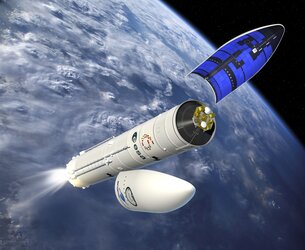
At Europe’s Spaceport in French Guiana, the two Galileo satellites have been placed inside the protective ‘nose cone’ of Ariane 6, known as the fairing. This marks the last time the satellites will see daylight before launch on 17 December. The next time they see the Sun, they will be in space.
The fairing plays a crucial role as it:
- shields the satellites from the elements and maintains a stable temperature and humidity.
- provides the aerodynamic shape Ariane 6 needs to pierce through Earth’s atmosphere as it thunders toward space.
Once the fairing separates during launch, the satellites will begin their journey to medium Earth orbit, 23 222 km above Earth, ready to deliver precise navigation services to billions of users worldwide.
17 December: launch from Europe's Spaceport

And yet it moves! On 17 December at 02:02 local time (05:02 GMT/06:02 CET), the two Galileo satellites launched from Europe’s Spaceport in French Guiana aboard an Ariane 6 rocket. This marked the 14th launch for Europe’s Galileo constellation, reinforcing Europe’s satellite navigation capabilities, resilience and autonomy.
A little over four hours after liftoff, the satellites separated from the launcher. At 10:51 CET, the launch was declared successful, after acquisition of signal, and the confirmation that both satellites are healthy with their solar arrays deployed.




About Galileo
Galileo is currently the world’s most precise satellite navigation system, serving over five billion smartphone users around the globe since entering Open Service in 2016. All smartphones sold in the European Single Market are now guaranteed Galileo-enabled. In addition, Galileo is making a difference across the fields of rail, maritime, agriculture, financial timing services and rescue operations.
A flagship programme of the EU, Galileo is managed and funded by the European Commission. Since its inception, ESA leads the design, development and qualification of the space and ground systems, as well as procuring launches. ESA is also entrusted with research and development activities for the future of Galileo within the EU programme Horizon Europe. The EU Agency for the Space Programme (EUSPA) acts as the service provider, overseeing the market and application needs and closing the loop with users.
For more info about Galileo: https://www.usegalileo.eu/EN/
About Ariane 6
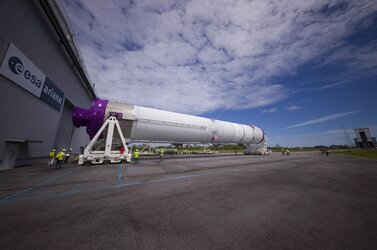
Ariane 6 is Europe’s heavy launcher and a key element of ESA’s efforts to ensure autonomous access to space for Europe’s citizens. Its modular and versatile design allows it to launch all types of missions, from low-Earth orbit to deep space. Standing over 60 metres tall, Ariane 6 can weigh almost 900 tonnes when launched with a full payload.
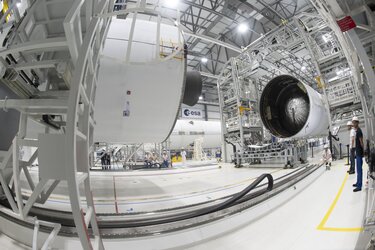
Ariane 6 has three stages each working in order to escape Earth’s gravity and take satellites to orbit: two or four boosters, and a core and upper stage. For this launch, the rocket will be in its two-booster configuration.
The core stage and the boosters are responsible for the first phase of flight. The core stage is powered by the Vulcain 2.1 engine (fuelled by liquid oxygen and hydrogen), with the main thrust at liftoff provided by the P120C boosters.
The upper stage is powered by the reignitable Vinci engine fuelled by cryogenic liquid oxygen and hydrogen. The upper stage will fire two times to reach the required orbit for this mission.
After separation of the Galileo satellites, the Ariane 6 upper stage will move to a stable graveyard orbit far away from operational satellites.