


DORIS joins ESA’s Genesis mission
The second Genesis Science Workshop, held on 3 and 4 April in Matera, Italy, brought together the ESA Genesis team, industry experts and scientists from the international community to discuss the mission’s progress, including the latest satellite design evolutions, and prepare for the most extensive science exploitation possible. ESA and the French Space Agency CNES signed a contract during the event, confirming that the fourth geodetic technique, DORIS, will join the mission.
Genesis is an ESA Navigation mission that will combine and synchronise the four space geodetic (Earth-measuring) techniques in one satellite to contribute to a highly improved reference frame of Earth. A year into preparation, the mission has confirmed that DORIS will join the other three geodetic techniques, completing the suite of payloads on board.
Sara Gidlund, Head of Genesis: “With DORIS on board, Genesis now is confirmed to carry all four satellite-based geodetic techniques on a single well calibrated satellite platform, making it a truly unique mission for the world.”
DORIS (Doppler Orbitography and Radiopositioning Integrated by Satellite) is a tracking system that measures frequency shifts in radio signals from ground beacons to determine precise satellite positioning. This shift, known as the Doppler Effect, is caused by the satellite’s movement relative to the signal source.
Developed and operated by the French national space agency CNES, DORIS has a long flight history. However, this will be the first time the instrument operates in medium Earth orbit (at 6000 km) rather than its traditional low Earth orbit. This shift requires adjusting both space and ground segments.
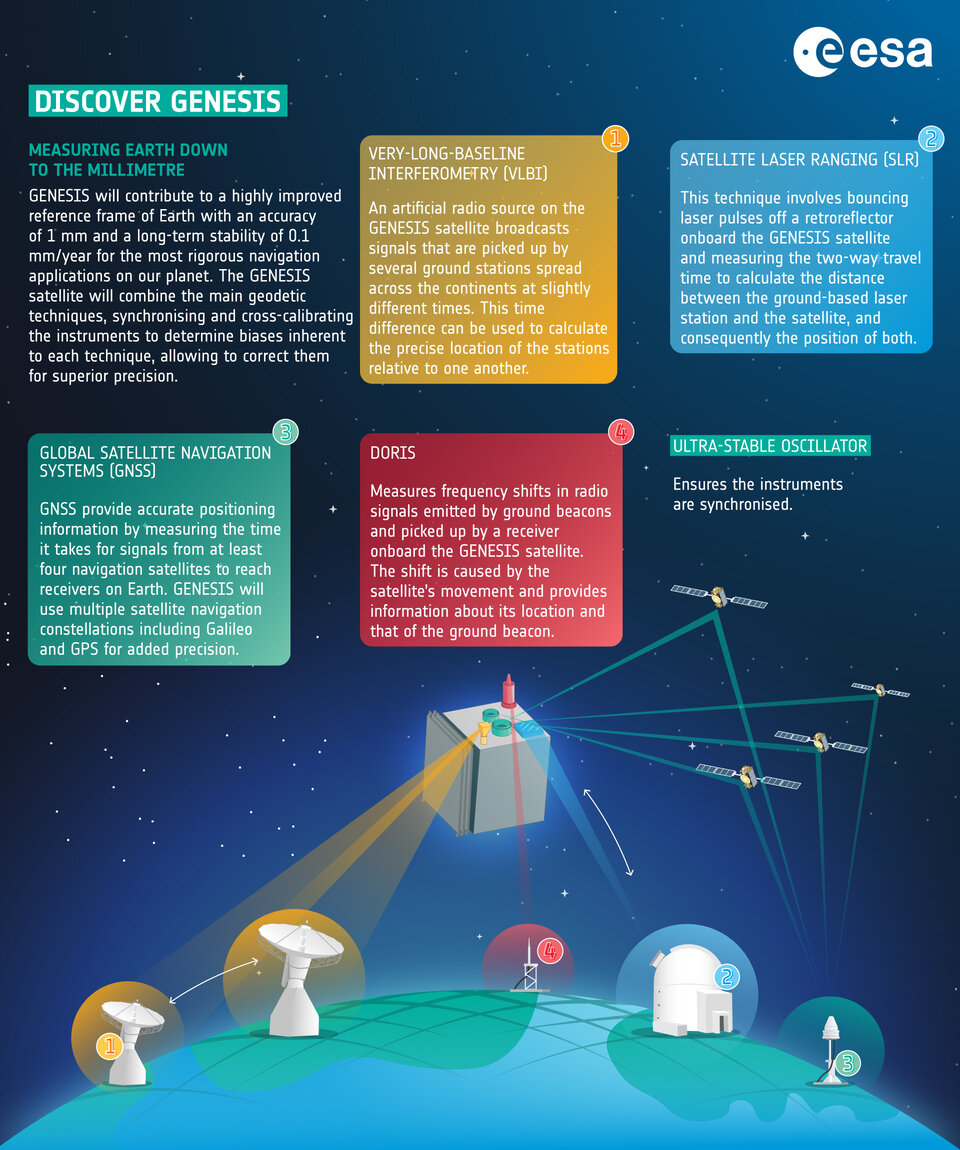
DORIS’s well-distributed network of ground stations will strengthen the ties between the other techniques: Global Navigation Satellite Systems (GNSS), Very Long Baseline Interferometry (VLBI) and Satellite Laser Ranging (SLR).
Felix Perosanz, CNES Solid-Earth Programme: “The international scientific community has high expectations for this space mission. CNES is happy and proud to make DORIS on board Genesis a reality today.”
Second Genesis Science Workshop

The goal of the Genesis Science Workshop is to gather the ESA Genesis team, scientists working on the generation of the International Terrestrial Reference Frame (ITRF), experts on the different geodetic techniques and international geodetic services, as well as representatives from industry, to exchange on project development and set the scientific exploitation preparation objectives for 2025 and beyond.

The annual meeting aims to facilitate the collaboration between stakeholders and address key mission-related topics. This year’s event organised in cooperation with the Italian Space Agency (ASI) in Matera, Italy, featured an update from the Genesis Science Exploitation Team and from each of its working groups, which sparked fruitful discussions on the various topics. The event was concluded with a visit to the ASI Space Geodesy Centre of Matera.
Evolutions of the satellite design towards the Preliminary Design Review
As part of a usual mission development process, the Genesis satellite design is evolving to accommodate more detailed constraints, including antennas field of view, launcher envelope requirements, solar panel efficiency, satellite attitude and power consumption.
At the Genesis Science Workshop, attendees were presented with the latest design concept. The most notable change is the solar panel configuration, now on the sides of the satellite instead of in a roof configuration, to optimise power generation.
Further refinements, such as the solar array design and antenna placement will still change as platform configuration analyses continue to ensure optimal performance. The preliminary design will be confirmed at the Preliminary Design Review at the end of 2025 and the final design will be frozen during the Critical Design Review, scheduled for 2026.

About GENESIS
Genesis is a mission of the FutureNAV programme, an optional ESA Navigation programme with support from Italy, Belgium, Germany, France, Switzerland, Hungary and the UK. Genesis was approved at ESA’s Ministerial Council in 2022, as one of two FutureNAV programme missions.
The goal of Genesis is to significantly contribute to improving the accuracy and stability of the International Terrestrial Reference Frame (ITRF). The ITRF serves as a reference for all space- and ground-based observations for navigation and Earth sciences. Improving the ITRF would impact high accuracy navigation applications with benefits in aviation, autonomous vehicle driving and traffic management, for example. In Earth sciences it would help refine models used for climate and environmental monitoring and much more. Additionally, by contributing to the improvement and consistency of the Earth reference frame, Genesis addresses the United Nations General Assembly resolution calling for a 'global geodetic reference frame for sustainable development.'
Genesis's extreme accuracy is achieved by co-locating the four geodetic (Earth-measuring) techniques (satellite navigation, very-long-baseline interferometry, satellite laser ranging and DORIS) onboard one well calibrated satellite that acts as a flying observatory. The instruments will be synchronized by an ultra-stable oscillator (USO).
For more information, visit www.esa.int/Genesis