

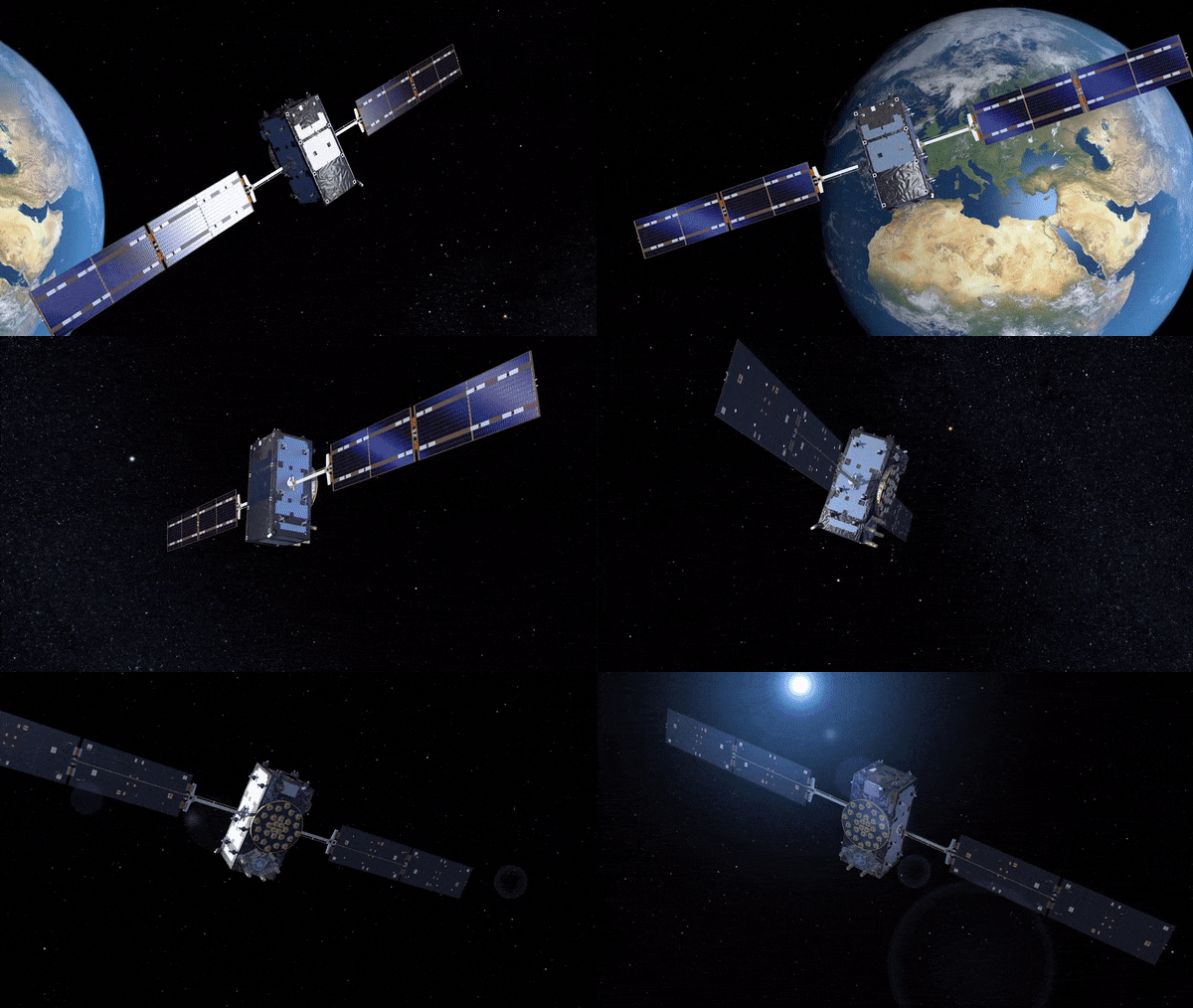
Two new Galileo satellites enter service
Two new satellites have now officially joined Europe’s Galileo satellite navigation constellation, strengthening its capabilities, resilience and autonomy. Four Galileo First Generation satellites remain to be launched, with the next pair planned for the end of the year.
The addition of SAT 33 and SAT 34 to the Galileo constellation reinforces the world’s most advanced global navigation satellite system, ensuring enhanced system redundancy and continuous data provision to billions of users worldwide.
Over the past months, mission operators at the Galileo Control Centre in Germany (GCC-D) have been busy preparing the latest two Galileo satellites for operational service.

Launched on 17 December, the mission benefitted from the most precise orbital injection ever achieved for Galileo, a near-perfect insertion that confirmed the high performance of Ariane 6. Galileo is the only programme to have flown satellites of the same mass to the same orbit with four launchers, using Soyuz, Ariane 5, Falcon 9 and now Ariane 6.
Satellite separation took place about four hours after launch, followed by signal acquisition and solar array deployment, marking the beginning of the critical launch and early operations phase (LEOP). During this phase, GCC-D teams, under the responsibility of the EU Agency for the Space Programme (EUSPA), commissioned the satellites’ essential subsystems, manoeuvred them to point towards the Earth and started an orbital drift towards their target constellation slots.
About seven days after launch, the LEOP was completed and the satellites declared fit for life into space. The commissioning phase was ready to begin.
Final orbit and full commissioning

Early this year, the satellites transmitted their first ‘signal-in-space’, the first broadcast of the navigation payload, to the Galileo in-orbit testing station, located at ESA-ESEC, in Redu, Belgium.
This step opened the payload in-orbit testing phase, which ensures that the new satellites will contribute positively to the global performance of the Galileo service. While the GCC-D led satellite operations, ESA designed the test cases and payload configurations executed throughout the test campaign.
In the meantime, teams configured and validated the navigation payload, atomic clocks, transponders and security functions. In parallel, operators manoeuvred the satellites to their precise orbital slots at 23 222 km.
In May 2026, the EU Space Programme Security Accreditation Board authorised the entry into service of SAT 33. This was followed by that of SAT 34 on 23 July 2026, marking the full deployment of the L14 satellites within the Galileo constellation.

About Galileo

Galileo is the world’s most precise satellite navigation system, serving over five billion smartphone users around the globe since entering Open Service in 2016. All smartphones sold in the European Single Market are now guaranteed Galileo-enabled. In addition, Galileo is making a difference across the fields of rail, maritime, agriculture, financial timing services and rescue operations.
A flagship programme of the EU, Galileo is managed and funded by the European Commission. Since its inception, ESA leads the design, development and qualification of the space and ground systems, as well as procuring launches. ESA is also entrusted with research and development activities for the future of Galileo within the EU programme Horizon Europe.
The EU Agency for the Space Programme (EUSPA) acts as the service provider, overseeing the market and application needs and closing the loop with users.