

Spacecraft Testing Workshop open for applications
ESA Academy is organising the five-day Spacecraft Testing Workshop. The workshop will take place from 31 August to 4 September 2026 at ESA Academy’s Training and Learning Facility in ESA’s European Space Security and Education Centre (ESEC), Belgium.
The experience

Immerse yourself in the intricacies of spacecraft testing with this workshop, a remarkable opportunity tailored for university students with backgrounds in engineering and science. Led by ESA experts, this workshop offers insight into the meticulous processes that ensure satellites operate reliably in space.
Throughout the workshop, selected students will attend lectures delivered by ESA engineers covering a broad range of topics including product assurance, systems engineering, and key environmental testing methods applied to spacecraft.
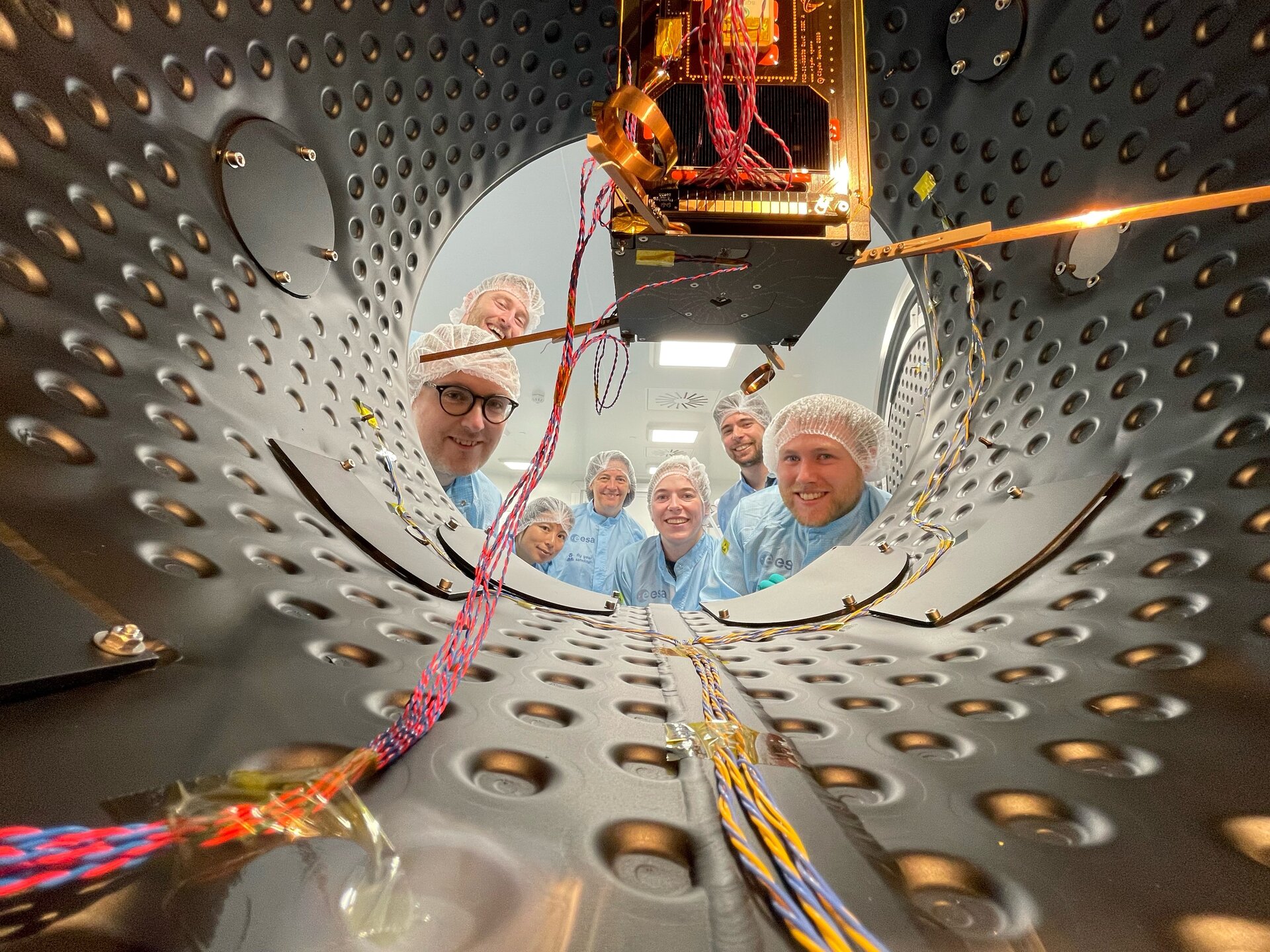
The highlights of the workshop are the hands-on activities. Participants will have the opportunity to apply their newly acquired theoretical knowledge in real-world scenarios. At the CubeSat Support Facility, students will conduct genuine hardware environmental tests using a specially designed educational test unit facilitated by the ESA Education Office.

During the group project phase, students will collaborate in teams to orchestrate a comprehensive environmental test campaign, encompassing vibration testing, thermal vacuum testing, or electromagnetic compatibility testing. From defining test requirements to assembling and testing hardware, participants will become familiar with industry-standard approaches used for spacecraft verification and validation.
At the end of the workshop, each group will present their results to a panel of ESA experts, bringing participants closer to their future careers in the space industry.
This edition of the workshop will also include 15 participants from Africa, selected as part of the broader African Union–European Union strategic partnership. The African Space Agency (AfSA) and the European Space Agency (ESA) are jointly supporting initiatives aimed at strengthening collaboration in space activities.
This cooperation contributes to the Africa-EU Space Partnership Programme (AESPP), which supports both upstream (technology and satellite manufacturing) and downstream (applications and data services) sectors. The programme includes interconnected components focusing on industrial cooperation and private sector development, academic and research collaboration, and policy dialogue and institutional capacity-building.
The programme is guided by three specific objectives:
- Enhance the African institutional and innovation space cooperation framework, including gender-sensitive outreach on the benefits of space
- Enhance the capacity to produce and deliver space-based services and applications, data, and information for early warning systems related to hazardous weather or climate events
- Strengthen the African space private sector ecosystem and industrial cooperation.
Students will be introduced to the following topics:
| Day 1 |
Space Systems Engineering Space Project Testing Assembly Integration & Testing Product Assurance: Every Failure is a Lesson! Assembly and Functional Testing |
| Day 2 |
Mechanical Environment & Vibration Testing Thermal Environment & Thermal Vacuum Testing Verification Planning Antenna Testing Assembly and Test Procedure Preparation |
| Day 3 |
Cleanliness and Contamination Control Electromagnetic Compatibility Testing Assembly and Test Procedure Preparation Assembly / Setup |
| Day 4 |
Test Campaign Execution (Thermal Vacuum / Vibration / EMC) In-Orbit Testing Data Collection and Initial Analysis Test Campaign Preparation & Consolidation |
| Day 5 |
Data Consolidation & Final Presentation Preparation To Radiation Testing… & Beyond! Group Project: Test Reporting and Discussion Inspirational Lecture |
Who can apply?
To participate, students must fulfil the following eligibility criteria at the time of application:
- Enrolled as a university student for the year 2025-2026 or 2026-2027 in a Bachelor (i.e., BSc or equivalent), Master (i.e., MSc or equivalent), or a Doctoral (i.e., Ph.D. or equivalent) degree programme with a background in engineering or science.
- Aged minimum 18 years old. ESA Academy and relevant partners will only appraise applications from students who have no or limited professional experience in relevant scientific or other space-related topics.
- Citizen of an ESA Member States, Canada*, or Associate Members.
*Canadian students enrolled in a Canadian post-secondary institution may apply for additional support from the Canadian Space Agency through this Announcement of Opportunity. This additional support is to cover costs that are not already covered by ESA for selected Canadian post-secondary students.
ESA is committed to achieving diversity and creating an inclusive professional environment. To this end, we welcome proposals and applications from all eligible candidates irrespective of gender, sexual orientation, ethnicity, beliefs, age, disability or other characteristics. The ESA Academy strongly encourages inclusiveness within its programmes and within participating teams, which contributes to the enrichment of our programme.
Whenever possible, we seek to accommodate individuals with disabilities by providing the necessary support, either digitally or at the location of the training. In case of any questions or specific needs, please reach out to academy.training@esa.int to get assistance or advice during the application process.
Attendance to the entire 5-day training course on-site at ESEC is mandatory. Accommodation, meals, as well as up to 350 EUR for travelling to Belgium will be covered by ESA Education.
To enhance the learning experience, students will actively engage in a group project work throughout the week to apply their newly acquired knowledge. Upon successful completion, participants will be awarded a certificate of participation and a course transcript, enabling them to request ECTS credit(s) from their respective universities.
How to apply?
- Access the call for applications in platform https://learn.esa.int/
- Press on the “Apply Now” button
- Upload a motivation letter (PDF, maximum 1 page, no images).
- Upload a CV (Europass format, PDF, no images, maximum 2 pages).
- Upload a formal recommendation letter (PDF, maximum 1 page, including signature, no images) from a university professor or an academic supervisor from your current university (if not possible to receive the recommendation letter from your reference, please ask them to send a recommendation email to academy.training@esa.int before the application deadline).
- Upload a copy of your Transcript of Grades from the two previous semesters, or, if not available, the previous academic year (PDF).
All answers and documents should be in English (except Transcript of Grades if not available). The deadline for applications to participate in the Spacecraft Testing Workshop 2026 is 15 May 2026, 23:55 CEST.
For more information, please contact: academy.training@esa.int
Before you apply
Accommodation
- Participants will stay at Mercure Hotel in Han-sur-Lesse.
- The hotel is provided and paid for by ESA.
- Students will be assigned shared rooms with participants of the same gender.
Arrival and Departure
Arrival:
- Participants must arrive at Rochefort-Jemelle train station on Sunday, 30 August 2026.
Departure:
- Either Friday, 4 September 2026 from Rochefort-Jemelle train station after the workshop ends at 19:00 CEST, or
- Saturday, 5 September 2026 from Rochefort-Jemelle train station before 11:00 CEST.
Important:
- Selected students are required to attend the entire workshop from start to finish.
Transportation During the Workshop
A bus service will be provided and paid for participants by ESA:
- Morning: Hotel → ESA ESEC-Galaxia
- Evening: ESA ESEC-Galaxia → Hotel