


A Mars-velous decade: Celebrating ten years of TGO
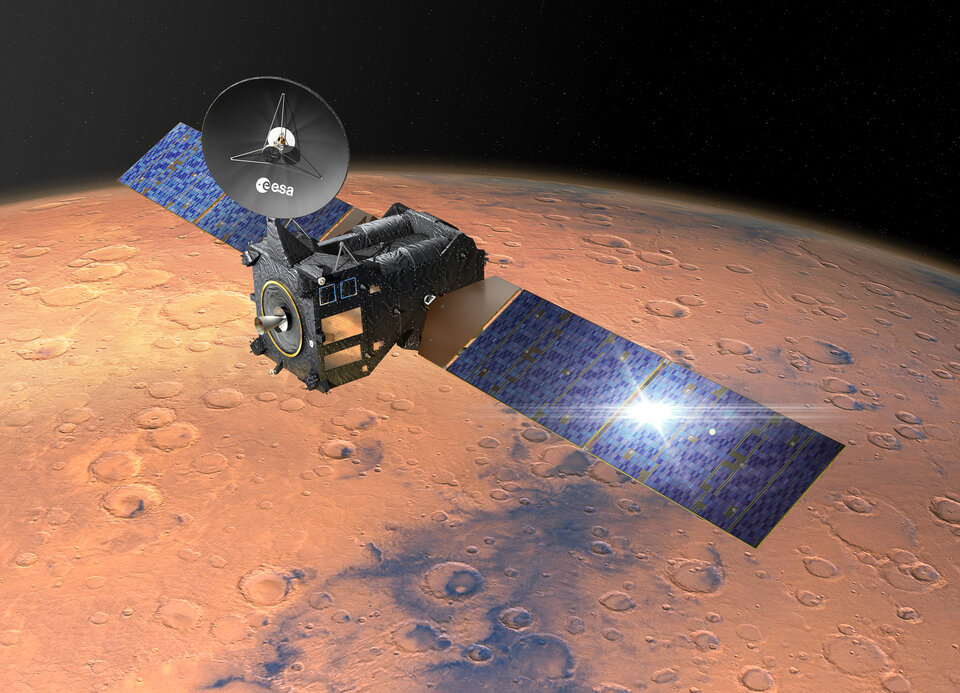
Ten years after arriving at Mars, ESA’s ExoMars Trace Gas Orbiter (TGO) has grown far beyond its original ambitions. From revealing the martian atmosphere to becoming a vital communications link with the surface, the mission’s story is also one of adaptability, resilience and the people behind it.
On 19 October 2016 at 15:24 UTC, ESA’s ExoMars Trace Gas Orbiter (TGO) arrived at Mars. As its engine fired to slow the spacecraft for capture by the planet’s gravity, teams at ESA’s European Space Operations Centre (ESOC) in Darmstadt watched for confirmation that the manoeuvre had succeeded.
At the same time, the Schiaparelli Entry, Descent and Landing Demonstrator Module entered the atmosphere, returning valuable engineering data. A software-related problem caused its descent engines to turn off prematurely, resulting in the loss of Schiaparelli. However, the data it returned provided important lessons that have since been applied to the Rosalind Franklin mission.
TGO was designed to explore trace gases, low-abundance constituents of Mars’s atmosphere, and provide a communications link between Mars and Earth for future surface missions. What followed has been a decade of outstanding science and expanding capabilities.
Ten years later, past and present ExoMars team members are gathering at ESOC to celebrate TGO’s journey of discovery and operations.

The day we arrived
“You feel much lighter.”
That is how Silvia Sangiorgi, head of Mars exploration missions operations unit, remembers the day of arrival.
After an intense three-day campaign of preparations, TGO turned into position for Mars Orbit Insertion (MOI). As the engines fired at 13:05 UTC, the Flight Control Team monitored the spacecraft while also following the signal TGO relayed from Schiaparelli’s descent through the martian atmosphere.
“Looking back, it’s incredible to think about what we were actually doing!” Silvia recalls.
TGO then disappeared behind Mars, cutting communications while it completed its burn. When it emerged, telemetry returned and flight dynamics confirmed its successful capture into Mars orbit.
But there was little time to savour the moment. “When you're flying a mission like this, there's barely time to celebrate one achievement before the next challenge comes along.” Next came almost a year of aerobraking, patience, precision operations and teamwork.
For Silvia, the experience captures an enduring lesson: space operations are rarely black and white. Spacecraft constraints and mission priorities require teams to combine expertise, adapt and find the best way forward. Perhaps that is why “resilience” stands out to her as a defining word for TGO and ExoMars.


Access the video
A decade of discovery
From around 400 km above Mars, TGO examines the atmosphere with extraordinary sensitivity.
As TGO project scientist Colin Wilson puts it, TGO was designed to be “more sensitive to trace gases than any other mission, probably in a generation.”
That sensitivity has helped tackle some of Mars’ biggest mysteries, including the methane dilemma. Despite previous reports of methane detection, TGO has not caught a whiff of this potential biosignature gas, a discrepancy that continues to drive research.
TGO also made the first detection of hydrogen chloride in the martian atmosphere, revealing insights into atmospheric processes and possible geological activity. It has also measured water loss to help trace the history of water on Mars and better understand its habitability.

Its imaging system has mapped more than 10% of Mars’ surface in four colours, supporting science and landing-site studies for the ExoMars Rosalind Franklin rover.
TGO has also monitored radiation, and mapped subsurface water ice, providing data important for future human exploration.
New science continues to emerge.
Fresh from celebrating another Mars New Year, Colin sees TGO’s longevity as a reminder of what a mission built to last can achieve. “A decade after arrival, we’re delivering more than originally envisaged,” he beams.
A mission that keeps evolving

TGO has also been a remarkably capable communications and operations workhorse at Mars.
Built to relay instructions and data to and from Rosalind Franklin, TGO has steadily developed capabilities extending beyond that original role.
“We have shaped the operational concept over time based on experience,” says spacecraft operations manager Peter Schmitz. During solar conjunctions, for example, TGO can now store surface data while regular Earth communications are paused, sending it home afterwards. “We learn by experience. And we are adapting to the needs every day.”
New flight software uploaded in 2024 limits gyroscope use, helping to preserve them for Rosalind Franklin’s arrival.
Other capabilities are finding entirely new uses. Radio equipment designed for communications with the martian surface is now being used with Mars Express for atmospheric radio science. “We have basically one more payload on TGO than when we launched,” Peter smiles.
Behind that evolution is the team itself. For Peter, a decade of operations has reinforced one key lesson: “You trust your folks.” Behind every signal, observation and piece of Mars data reaching Earth stands a team with the expertise and judgement to keep the mission moving forward.
Once the newcomer to an established martian fleet, TGO has become one of its most dependable members, continually adapting while preparing for its next chapter.
A legacy to build on
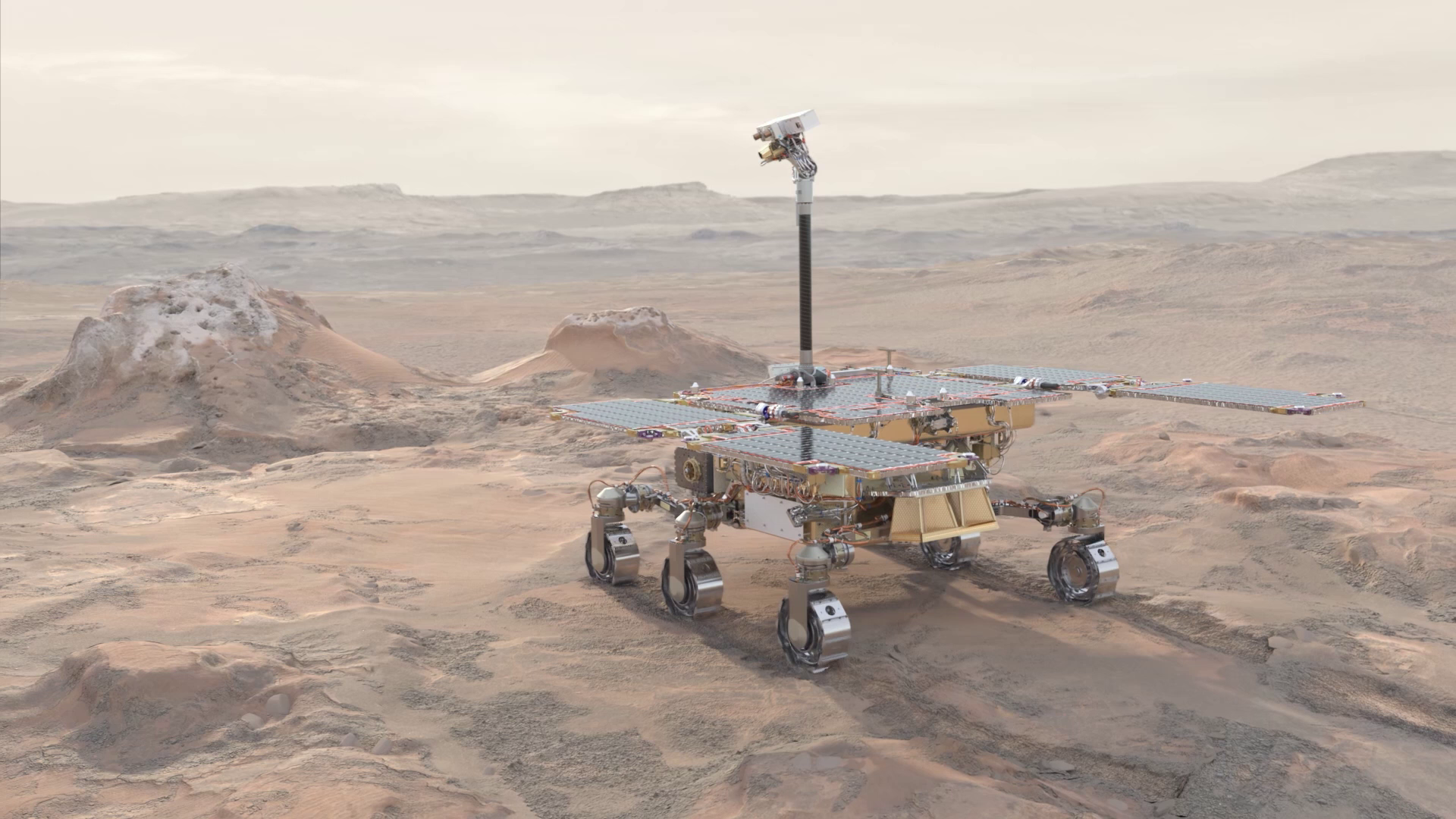
For Jorge Vago, ExoMars project scientist, ten years of TGO have demonstrated the importance of accumulated expertise. Across ExoMars, European teams have built knowledge spanning atmospheric science, spacecraft design and Mars entry, descent and landing.
“Passing that experience to new generations will be an important part of preparing for future Mars missions,” he says.
That experience is matched by TGO’s own capabilities. “TGO as a platform is amazingly powerful,” Jorge adds, pointing to its longevity and evolution as foundations for future European planetary missions.
ExoMars has also shown how a shared vision, sustained through scientific, technological and industrial partnerships, can grow into a major European exploration programme. “This is what happened to ExoMars. It really can be done!”
For Jorge, the opportunity now is to build on that experience while preserving the ambition that makes exploration compelling. “This is how you go to places nobody has gone and do things nobody has done,” he says with a smile. “And that is the feeling of discovery we want to convey.”
Access the video