Europe’s launchers
As the USA and the Soviet Union first launched satellites into orbit in the late 1950s, Europe's space programme also began to take shape. Today, still, at the heart of Europe’s space ambitions, is the need to access space: reliably, affordably and autonomously.
The idea of creating an independent space organisation in Europe dates back to the early 1960s when six European countries – Belgium, France, Germany, Italy, the Netherlands and the United Kingdom, associated with Australia – formed ELDO (the European Launcher Development Organisation) to develop and build a satellite launcher called ‘Europa’.
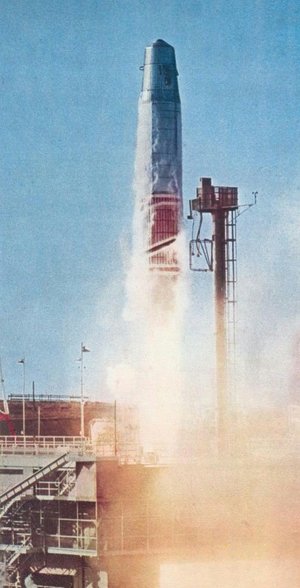
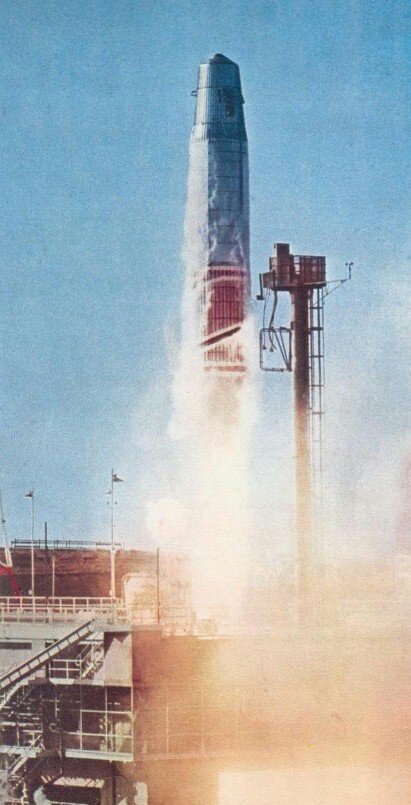
The first Europa flight took place on 5 June 1964, involving a Europa-1 first stage (F1), a repurposed British Blue Streak missile, from Woomera, Australia, signalling the start of Europe's cooperative venture into space. The eleventh and final test flight with the improved Europa-2 was launched from French Guiana in 1971.
In 1975, a Convention was endorsed at political level to set up the European Space Agency (ESA), effectively incorporating ELDO together with ESRO (the European Space Research Organisation), and broadening the scope of the agency’s remit.
Ariane 1-5

Work started on the Ariane 1 rocket, with its first liftoff on Christmas Eve, 1979. An early Christmas present for the thousands of workers throughout Europe and at Europe’s Spaceport in French Guiana who were involved in its development and production. As the size of the satellites grew Ariane 1 began to give way to the more powerful Ariane 2 and Ariane 3 launchers.
In 1988 Ariane 4 took over, which achieved 113 successful launches including the last liftoff in 2003. Ariane 4 proved ideal for launching communications and Earth observation satellites as well as those for scientific research.

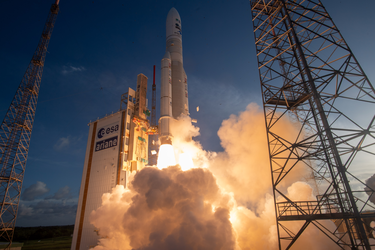
Ariane 5 made its first successful launch in 1997 and became a reference point for reliability, precision and power in the first decades of the 21st century.
Ariane evolved to meet the needs of the worldwide commercial launch service market and for many years remained Europe’s only launcher to guarantee Europe’s access to space for its institutional missions.
Vega

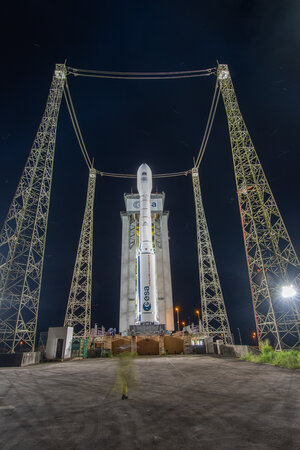
Vega joined the family of rockets at Europe’s Spaceport in French Guiana in 2012, delivering satellites and spacecraft to equatorial and Sun-synchronous orbits. In total Vega flew 22 missions with 20 successful flights sending more than 100 satellites into space from 22 countries.
Soyuz in French Guiana
From 2011 the Soyuz rocket was also launched from Europe’s Spaceport in French Guiana, a collaborative effort with Russia. A medium-class launcher, its performance complemented the ESA launchers Ariane and Vega and increased the competitiveness and flexibility of the exploitation of Ariane launchers in the commercial market.
The final launch of Soyuz launcher from French Guiana occurred in February 2022, after which the launcher was withdrawn from service as a result of Russia’s war against the Ukraine.
Ariane 6 and Vega-C

At the ESA Council meeting at Ministerial level in December 2014 in Luxembourg, ESA Member States decided to begin development of the Ariane 6 and Vega-C rockets.
To maximise commonalities of technologies, the P120C and later P160C solid-propellent rocket motor was developed to be used on both Ariane 6 and Vega-C.
Vega-C, the more powerful version of Vega with a larger fairing debuted in 2022.
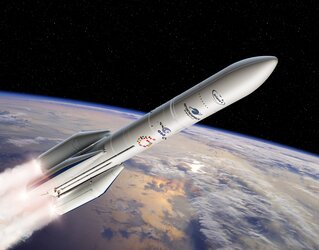
Ariane 6 first flew in 2024, offering the versatility of both a medium and heavy-class launcher, depending on its configuration using two or four solid motor boosters.
A full complement

Europe benefits from the Ariane and Vega family of launchers with the capability and flexibility to cover all European institutional and most commercial launch service needs, providing space benefits to Europe’s citizens.
The efforts of Member States in developing and sustaining Ariane and Vega have established a competitive European space industry that assures European independence and strengthens European industry.
Challenge the future

For over four decades, ESA has been providing Europe with autonomous access to space through the Ariane and Vega launcher families, which will continue to evolve.
The European Space Agency sustains European autonomy in accessing and using space through contributing to the services available at Europe’s Spaceport in French Guiana and maintaining industrial competitiveness and reliability of ESA-developed launchers, while preparing their future evolution and fostering technical innovation through its ‘Boost!’ Future Launcher Preparatory Programme and the European Launcher Challenge.
Based on decisions at the ESA Council held in Seville, Spain, in 2023, the European Launcher Challenge was initiated and subsequently funded by Member States at the ESA council at Ministerial level in 2025. It’s aim is to expand the European launch services on offer, further increase launch cadence, lower the cost of access to space, providing a wider range and diversity based on competition. It’s vision sees ESA switching role from being a developer of launchers to becoming a customer of commercial launch services.