Vega programme
The Vega programme had its origins back in the 1990s, when studies in several European countries investigated the possibility of complementing the performance range offered by the Ariane family of launchers with a capability for smaller payloads.
The objective of the Vega programme written in the ESA Council Resolution adopted on 20 June 2000:
“completing, in the medium term, the range of launch services offered by the addition of a European manufactured small and medium launcher, complementary to Ariane, consistent with diversified users needs and relying on common elements, such as stage, subsystems, technologies, production facilities and operational infrastructure, thereby increasing the European launcher industry’s competitiveness”.
Background
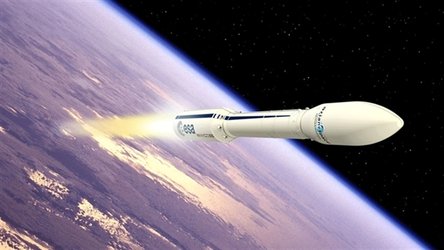
Vega was a smaller launcher for placing 300 kg to 2000 kg satellites, economically, into the polar and low-Earth orbits used for many scientific and Earth observation missions.
The ASI Italian space agency and Italian industry developed concepts and began pre-development work based on their established knowhow in solid propulsion.
Vega officially became an ESA programme in June 1998, when the Agency Europeanised the national ASI small launcher programme – in the meantime called Vega, named after the second brightest star in the northern hemisphere.
A flexible mission
The programme's main objective was to provide Europe with a safe, reliable and competitive capacity to carry science and Earth observation satellites into orbit, while perfectly complementing the heavy Ariane 5 and medium Soyuz rockets launched from Europe’s Spaceport in French Guiana at the time.
Vega was designed to cope with a wide range of missions and payload configurations in order to respond to different market opportunities and provide great flexibility. Unlike most small launchers at the time, Vega could place multiple payloads into orbit. In particular, it offered configurations able to handle payloads ranging from a single satellite up to one main satellite plus six microsatellites.
Vega was compatible with payload masses ranging from 300 kg to 2500 kg, depending on the type and altitude of the orbit required by the customers. The benchmark was for 1500 kg into a 700 km-altitude polar orbit.
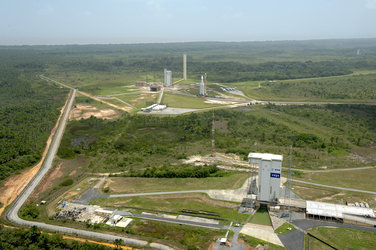
The Vega ground segment provided the operational infrastructure for the launcher system. The European spaceport in Kourou, French Guiana was the launch base for Vega and the launch site ELA 1 – the original Ariane launch zone – was chosen as the Vega launch site.
Scope of the Vega ground segment
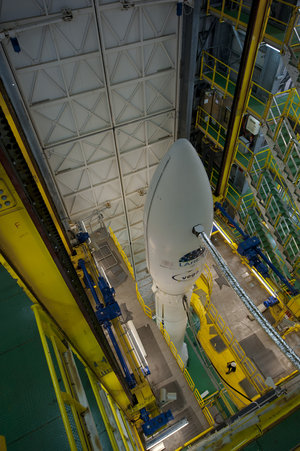
The Vega ground segment consisted of all existing, modified or new construction, facilities, equipment, services and software necessary both in Kourou and worldwide needed for the proper control of the flight and to support the integration, processing, check-out, launch, telemetry, tracking, control and post flight analysis of the launch system. It included:
- the integration infrastructures (including office buildings) and verification facilities for the launch vehicle after delivery of the stages in French Guiana.
- facilities for the preparation of the payload and the upper composite, including the connection means with their ground control bench,
- campaign preparation support for the launcher up to liftoff (e.g. control bench for check out, meteorological previsions, safeguard analysis, etc.),
- the launch pad
- the Vega flight check services (telemetry, safeguard, positioning, etc.),
- means for post flight analyses in French Guiana and Europe.
The facilities required for the P80 first stage at the Bâtiment d’Integration des Propluseur (BIP) and the Banc d’Essais des Propluseurs (BEAP) were not within the scope of the Vega activity as they were part of the P80 development, with the exception of common facilities like Fardier and the sliding pallet.
Guidelines and constraints for the Vega programme
Industrial contractors covered the production of the ground segment under five dedicated procurements:
- mechanical infrastructure (02.189.01)
- civil infrastructures (02.189.02)
- fluids process and general means (02.189.03)
- operational computing system and operational software, 'the control centre' (02.189.04)
- services control command
ESA had the overall management responsibility for all parts of the Vega programme, and, in particular, for ensuring the necessary technical and programmatic coherence between the development of the launch vehicle and the ground segment. Contracts were placed by the Agency according to its rules and procedures.