How we predict eclipses
Once a portent of doom, eclipses have become wildly anticipated cultural and scientific events. People flock from all over the world for a brief glimpse of a solar eclipse. Scientists can predict when an eclipse will occur by tracking the positions of the Sun, the Moon and Earth.
What happens during an eclipse?
An eclipse occurs when the Sun, the Moon, and Earth are positioned in a straight line.
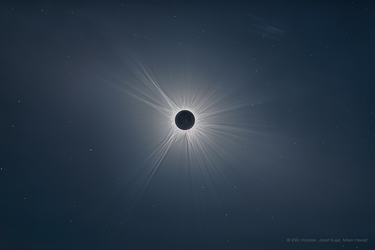
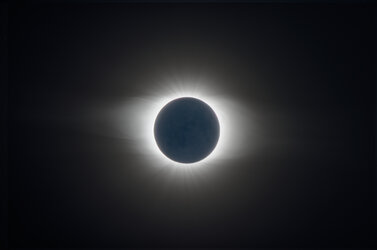
During a solar eclipse, the Moon lies between Earth and the Sun, blocking the sunlight and plunging parts of Earth into temporary darkness. Locations on Earth within the full shadow (umbra) experience a total solar eclipse, where the Sun is entirely covered by the Moon. Viewers in the partial shadow (penumbra) witness a partial solar eclipse, as the Moon only blocks part of the Sun from this angle.
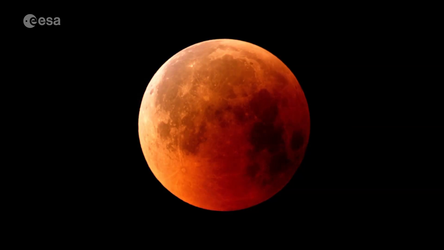
During a lunar eclipse, Earth is between the Sun and the Moon. Earth casts a shadow on the Moon, but it does not become completely dark. Instead, the Moon turns red. This happens because Earth’s atmosphere bends and filters sunlight, scattering blue light and letting red light reach the Moon’s surface.

Predicting an eclipse
If an eclipse is caused by the Moon or Earth passing in front of the Sun, then why don’t we see an eclipse twice a month during every full and new moon?
The Moon’s orbit around Earth is not in the same plane as Earth’s orbit around the Sun, called the ecliptic plane. The Moon’s orbit is tilted at an angle of 5° to the ecliptic. This means that as the Moon travels around Earth, it does not always pass in front of the Sun.
Twice a year, the Moon’s orbit is aligned such that it crosses the Sun-Earth line in the ecliptic during the full and new moon. The crossing points are called lunar nodes. This is when an eclipse can occur.
Astronomers can therefore predict the timing of an eclipse by tracking and predicting the positions of the Moon, the Sun and Earth.

There is a period of 35 days around each lunar node during which an eclipse can occur, called the ‘eclipse season’. The timing can be explained mathematically by considering the angle of the Moon’s orbit, and the diameter of the Sun and the Moon as they appear in the sky.
Usually, one solar and one lunar eclipse take place in each eclipse season. Since each season lasts slightly longer than a full orbit of the Moon around Earth (27.3 days) some seasons have a third eclipse.
During a new moon, the Moon crosses the ecliptic between the Sun and Earth, creating a total, annular or partial solar eclipse. During a full moon, the Moon crosses the ecliptic behind Earth, creating a total or partial lunar eclipse.
Every year, eclipse seasons start two to three weeks earlier than the year before. This is because the Moon’s orbit around Earth is slowly rotating (precession).
As a result, the time between two lunar nodes is 173.3 days and an ‘eclipse year’ lasts 346.6 days. This is shorter than a 365.25-day ‘solar year’.
Even without precise calculations, the time of the next eclipse can be estimated by counting 173 days from the day of the current eclipse. What cannot be counted on is the cloudless sky needed to observe it.