• → European Space Agency

      • Space for Europe
      • Space News
      • Space in Images
      • Space in Videos
    • About Us

      • Welcome to ESA
      • DG's News and Views
      • For Member State Delegations
      • Business with ESA
      • ESA Exhibitions
      • ESA Publications
      • Careers at ESA
    • Our Activities

      • Space News
      • Observing the Earth
      • Human Spaceflight
      • Launchers
      • Navigation
      • Space Science
      • Space Engineering
      • Operations
      • Technology
      • Telecommunications & Integrated Applications
    • For Public

    • For Media

    • For Educators

    • For Kids

    • ESA

    • Mars500

    • Human Spaceflight and Exploration

    • Background
    • Study overview
    • The isolation facility
    • Science
    • Scientific protocols
    • ESA and isolation studies
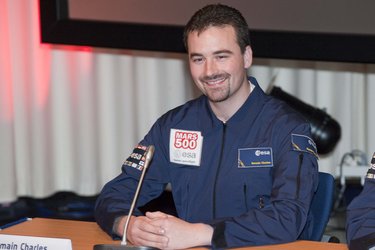
    • European 520-day isolation crew
    • Romain Charles
    • Diego Urbina
    • European 105-day crew
    • Cyrille Fournier
    • Oliver Knickel
    • Downloads
    • Mars500 on ESA-TV
    • Mars500 photo gallery
    • Information Kit, English (pdf)
    • Information Kit, Russian (pdf)
    • Follow us
    • ESA on Youtube
    • Question and answers with Mars500 crew
    • Mars500 Diego

    ESA > Our Activities > Human Spaceflight > Mars500

    Mars500 quick facts

    Mars500 is an international study into interplanetary spaceflights and is conducting in 2010-11 the first full duration simulation of a manned flight to Mars.

    Timeline

    • November 2007: a 14-day simulation (tested the facilities and operational procedures)
    • 31 March 2009: four Russian and two European crewmembers started a 105-day isolation study
    • 14 July 2009: end of the 105-day study

    • 23 March 2010: European candidates for the 520-day crew announced
    • 18 May 2010: the whole 520-day crew announced
    • 3 June 2010: start of the 520-day isolation study

    • 3 Jun 2010: Beginning of experiment - hatch closed, lift off
    • 15 Jun 2010: Undocking from orbital assembly laboratory
    • 23 Jun 2010: Transfer to heliocentric orbit towards Mars
    • 24 Dec 2010: Shifting to spiral orbit towards Mars
    • 1 Feb 2011: Entering circular orbit around Mars
    • 1 Feb 2011: Mars Lander hatch opening
    • 8 Feb 2011: Completion of loading, Lander hatch closure
    • 12 Feb 2011: Undocking, landing on Mars
    • 14, 18 and 22 Feb 2011: Egresses on Martian surface
    • 23 Feb 2011: Ascent, beginning of quarantine
    • 24 Feb 2011: Docking with interplanetary craft
    • 26 Feb 2011: End of quarantine
    • 27 Feb 2011: Habitation module hatch opening
    • 27 Feb 2011: Crew transfer to Habitation module
    • 28 Feb 2011: Lander loading with trash ends
    • 1 Mar 2011: Hatch closure, Lander undocking
    • 2 Mar 2011: Entering into spiral orbit away from Mars
    • 7 Apr 2011: Transfer to heliocentric orbit towards Earth
    • 15 Sep 2011: End of communications delay, switchover to voice communications
    • 13 Oct 2011: Shifting to spiral orbit towards Earth
    • 4 Nov 2011: End of 520-day study, crew landing on Earth

    (Note: all actions have been simulated.)

    The facility:

    • four hermetically sealed interconnected habitat modules
    • one external module, 'martian surface'
    • total volume of the habitat modules is 550 m3.

    During the mission:

    • the crew is hermetically isolated
    • ‘surface operations’ after 250 days the crew will be divided in half, three will move to the martian surface simulator and three will remain in the ‘spacecraft’
    • crew live and work like astronauts on ISS
    • maintenance, scientific experiments and daily exercise.
    • a seven-day week, with two days off, except when special and emergency situations are simulated.
    • crew monitored and their psychological, medical and physical signs recorded
    • limited consumables
    • connection disrupted and with a realistic delays
    • communications delay varies from 8 to 736 sec with maximum delay on flight day 351

    Mars500 is being conducted by Russia’s Institute of Biomedical Problems (IBMP), with extensive participation by ESA as part of its European Programme for Life and Physical Sciences (ELIPS) to prepare for future human missions to the Moon and Mars.

    Last update: 1 November 2011

    Rate this

    Views

    Share

    • Currently 0 out of 5 Stars.
    • 1
    • 2
    • 3
    • 4
    • 5
    Rating: 0/5 (0 votes cast)

    Thank you for rating!

    You have already rated this page, you can only rate it once!

    Your rating has been changed, thanks for rating!

    77
    facebook
    twitter
    reddit
    google plus
    digg
    tumbler
    digg
    blogger
    myspace
    • Mars500 logo
      Mars500 logo
      Mars500
      • End of the Mars500 520-day isolation
        • Mars500 quick facts
          • Mars500 crew
          • Partners
          • Institute of Biomedical Problems (IBMP)
          • Mars500 (IMBP)
          • Mars500 Photos
          • Gallery 1: Before
          • Gallery 2: Towards Mars
          • Gallery 3: Mars
          • Gallery 4: Return trip
          • Mars500 Mission Diary
          • Previous diary entries
          • Diary #11 - 26.1.2011
          • Diary #12 - 2.2.2011
          • Diary #13 - 10.2.2011
          • Diary #14 - 1.3.2011
          • Diary #15 - 3.6.2011
          • Diary #16 - 3.6.2011
          • Diary #17 - 17.8.2011
          • Diary #18 - 13.10.2011
          • Diary #19 - 25.10.2011
          • Mars500 Video Diary
          • Previous diary videos
          • Video #10 - 12.1.2011
          • Video #11 - 14.2.2011
          • Video #12 - 21.3.2011
          • Video #13 - 26.8.2011
          • Video #14 - 1.9.2011
          • Video #15 - 27.10.2011
          • Online video
          • ESA TV: One year inside

    Connect with us

    • RSS
    • Youtube
    • Twitter
    • Flickr
    • Google Buzz
    • Subscribe
    • App Store
    • LATEST ARTICLES
    • · CryoSat hits land
    • · Ariane 5 completes seven launches …
    • · Measuring skull pressure without t…
    • · Malargüe station inauguration
    • · The solar wind is swirly
    • FAQ

    • Jobs at ESA

    • Site Map

    • Contacts

    • Terms and conditions