Science and thoughts of Chilean miners
In this newest diary entry from the Mars500, Romain writes about cognitive experiments, describes how to do EEG measurements and sends his best regards to the 33 miners trapped beneath the ground in Chile.
When you are in isolation you tend to feel closer to all the other people who are living, or who have lived, the same kind of experience. From a former colleague who sailed on submarines to our fellow Mars500 colleagues Oliver Knickel and Cyrille Fournier, I have received a lot of advice to help me cope with the isolation. I really appreciate and understand them now. The main advice that I hear from everybody is “stay busy, be careful with your health and keep a normal day-night schedule”.
This advice I would like to share with all the people who are in isolation. In particular, all our thoughts go to the 33 miners in Chile who are trapped beneath the ground. Their living conditions are really tough and I hope that our message, which Diego kindly translated into Spanish, will reach them.
Now I will come back to our day-to-day life in our modules and for this diary I want to talk about one experiment. As you may know, my background is in the automotive industry and more specifically, quality control. For several years I studied, wrote and validated many work instructions as part of my job.
Coming back to Mars 500, we have roughly 100 experiments to perform during this isolation study and each one of them has instructions. I won’t enter into too much detail because it could become boring but trust me when I say that there are huge differences between all these instructions.
To show you a typical experiment, I will focus on one good example involving Electro-Encephalo-Graphy (EEG): exercise as a countermeasure to psycho-physiological deconditioning during long-term confinement. The scientists behind this were able to transform this complex and unfriendly title into an actually easy and visually attractive experiment.
This experiment involves an EEG and cognitive tests before and after exercise, to see how exercise can help us cope with the psychological problems of isolation.
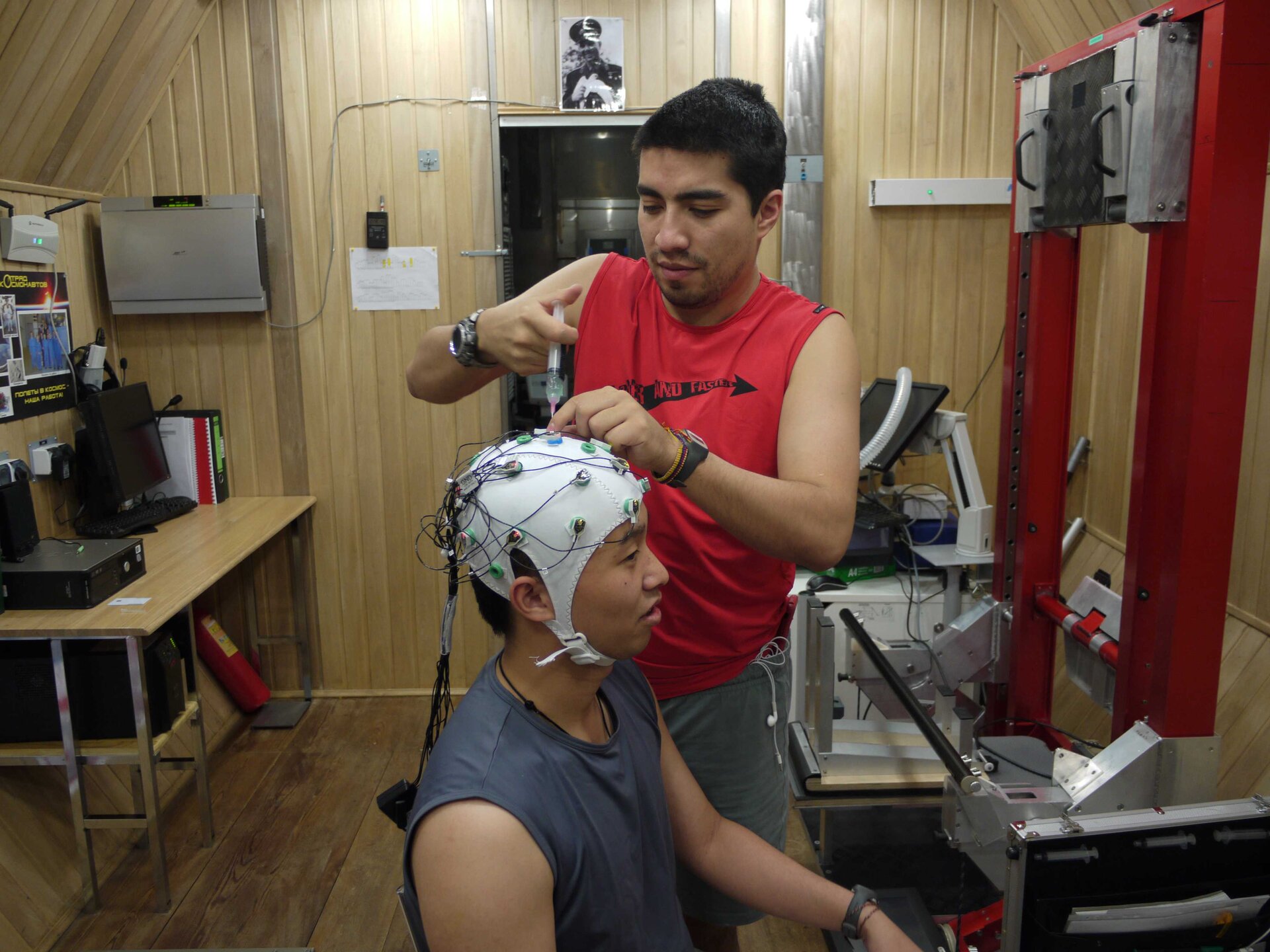
Unless you are a doctor or a nurse, probably you have never performed an EEG. The basic idea of this technique is to record the electrical activity of the subject’s brain. We are the subjects here. To have a good signal, each electrode must be connected to the skull. Don’t be afraid, we connect them with a gel. For all our EEGs, we have to validate that each electrode has good connectivity.

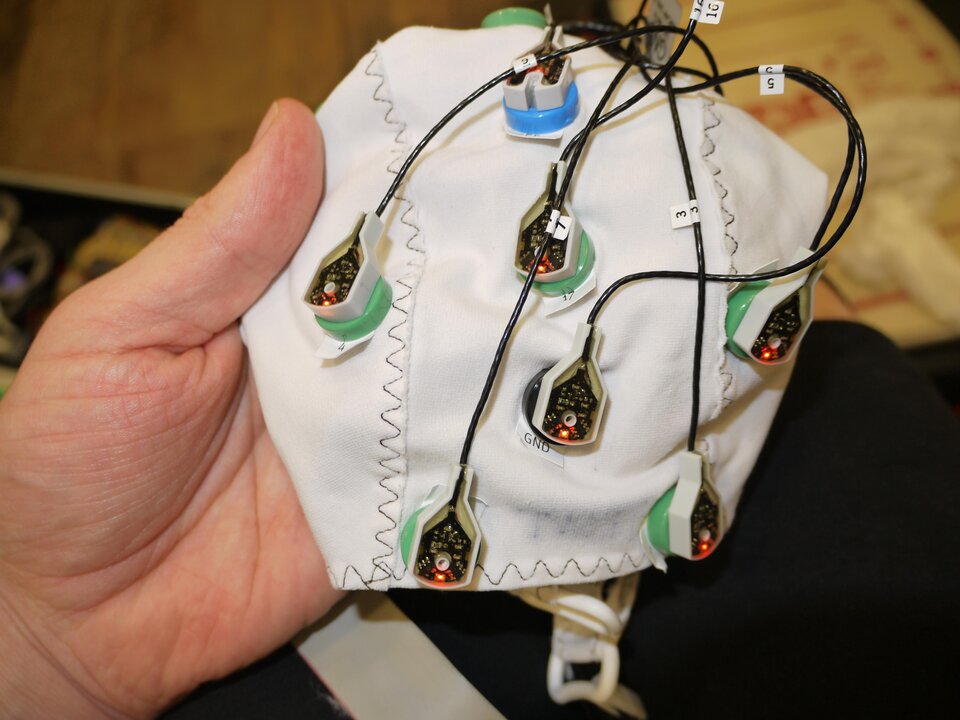
The nice thing about this experiment is that a tiny colored light bulb is on the electrode and it appears red (if the connectivity is not good) or green (if everything is all right). For the setup of the EEG for other experiments we have to refer to a software, which is less efficient. We have also discovered another use for these red and green lights: Xmas lights! Now we just have to find an Xmas tree before December.
The cognitive performance tests are widely used in our 100 experiments. We have to count, to estimate time, to react to visual stimuli or do all these things at once while playing some ’stressful’ games (I mean it, sometimes I think the goal of some of these games is to stress us!).
The clever idea of the scientists for this experiment was to use off-the shelf ’edutainment’ games; just like the ones those of you who like to spend a few minutes everyday playing on your smartphones use. We use an iPod Touch with cognitive tests, three of them. As we can look at the best scores there is a kind of competition between us and each time we try to perform the best we can. The data retrieved by the scientists will then be more consistent and meaningful.

One last point that I want to stress is the storage of this experiment. Generally big boxes are used and we have to spend some minutes looking for a device that is hidden inside. As you can see on the picture, this EEG experiment has everything in one suitcase. When you open it everything is attached and has its own place. Some may recognise a successful ’5S’ in this picture. “There is a place for everything and everything is in its place”.
I hope that you get a better understanding of our experiments through the description of this one. We will continue to give you an insight into some of the many experiments we are executing on behalf of the scientists involved in Mars500.