• → European Space Agency

      • Space for Europe
      • Space News
      • Space in Images
      • Space in Videos
    • About Us

      • Welcome to ESA
      • DG's News and Views
      • For Member State Delegations
      • Business with ESA
      • ESA Exhibitions
      • ESA Publications
      • Careers at ESA
    • Our Activities

      • Space News
      • Observing the Earth
      • Human Spaceflight
      • Launchers
      • Navigation
      • Space Science
      • Space Engineering
      • Operations
      • Technology
      • Telecommunications & Integrated Applications
    • For Public

    • For Media

      • Media
      • ESA TV
      • Videos for professionals
      • Photos
    • For Educators

    • For Kids

    • ESA

    • Space Science

    • Our Universe
    • About Space Science
    • ESA's 'Cosmic Vision'
    • Science missions
    • Mission navigator
    • Target groups
    • For Media
    • For Scientists
    • For Kids
    • Multimedia
    • Science images
    • Science videos
    • Animations
    • Downloads
    • Sounds from space
    • Resources
    • Reference section
    • Services
    • FAQs
    • Glossary
    • Help
    • Portal terms of use
    • Comments
    • Follow us
    • RSS feeds
    • ESA Sci on Twitter
    • ESA Space Science Images on Flickr
    • ESA 3D on Flickr

    ESA > Our Activities > Space Science

    Loading...
    MAXI J1659­–152
    Access the video

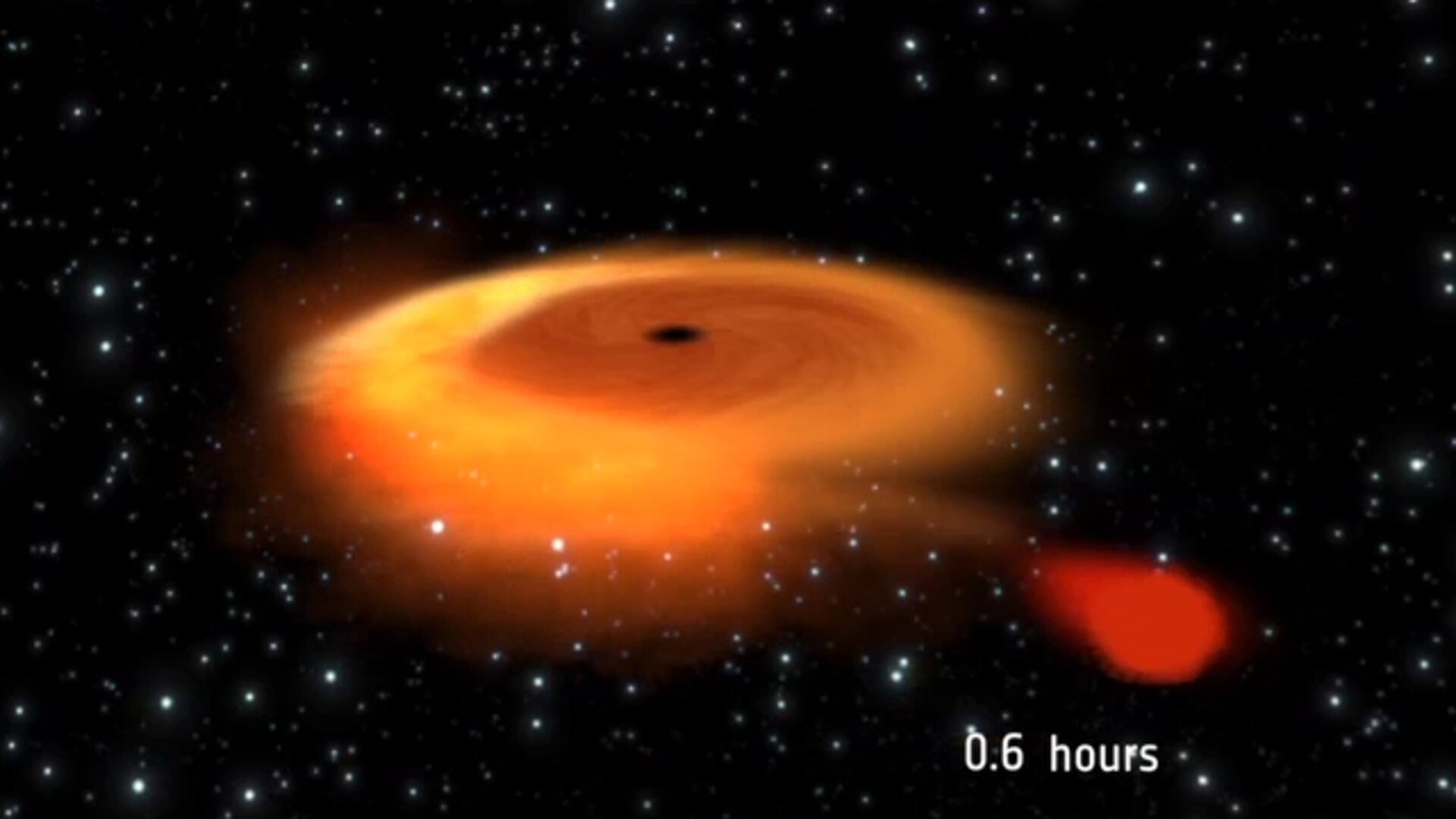
    Black hole-star pair orbiting at dizzying speed

    19 March 2013

    ESA’s XMM-Newton space telescope has helped to identify a star and a black hole that orbit each other at the dizzying rate of once every 2.4 hours, smashing the previous record by nearly an hour.

    The black hole in this compact pairing, known as MAXI J1659-152, is at least three times more massive than the Sun, while its red dwarf companion star has a mass only 20% that of the Sun. The pair is separated by roughly a million kilometres.

    The duo were discovered on 25 September 2010 by NASA’s Swift space telescope and were initially thought to be a gamma-ray burst. Later that day, Japan’s MAXI telescope on the International Space Station found a bright X-ray source at the same place.

    More observations from ground and space telescopes, including XMM-Newton, revealed that the X-rays come from a black hole feeding off material ripped from a tiny companion.

    Several regularly-spaced dips in the emission were seen in an uninterrupted 14.5 hour observation with XMM-Newton, caused by the uneven rim of the black hole’s accretion disc briefly obscuring the X-rays as the system rotates, its disc almost edge-on along XMM-Newton’s line of sight.

    From these dips, an orbital period of just 2.4 hours was measured, setting a new record for black hole X-ray binary systems. The previous record-holder, Swift J1753.5–0127, has a period of 3.2 hours.

    The black hole and the star orbit their common centre of mass. Because the star is the lighter object, it lies further from this point and has to travel around its larger orbit at a breakneck speed of two million kilometres per hour – it is the fastest moving star ever seen in an X-ray binary system. On the other hand, the black hole orbits at ‘only’ 150 000 km/h.

    “The companion star revolves around the common centre of mass at a dizzying rate, almost 20 times faster than Earth orbits the Sun. You really wouldn’t like to be on such a merry-go-round in this Galactic fair!” says lead author Erik Kuulkers of ESA’s European Space Astronomy Centre in Spain.

    His team also saw that they lie high above the Galactic plane, out of the main disc of our spiral Galaxy, an unusual characteristic shared only by two other black-hole binary systems, including Swift J1753.5–0127.

    “These high galactic latitude locations and short orbital periods are signatures of a potential new class of binary system, objects that may have been kicked out of the Galactic plane during the explosive formation of the black hole itself,” says Dr Kuulkers.

    Returning to MAXI J1659−152, the quick response of XMM-Newton was key in being able to measure the remarkably short orbital period of the system.

    “Observations started at tea-time, just five hours after we received the request to begin taking measurements, and continued until breakfast the next day. Without this rapid response it would not have been possible to discover the fastest rotation yet known for any binary system with a black hole,” adds Norbert Schartel, ESA’s XMM-Newton project scientist.


    Notes for Editors

    “MAXI J1659−152: The shortest orbital period black-hole transient in outburst,” by E. Kuulkers et al. is published in Astronomy & Astrophysics, 552, A32 (2013).

    For further information, please contact:

    Markus Bauer 


    ESA Science and Robotic Exploration Communication Officer


    Tel: +31 71 565 6799


    Mob: +31 61 594 3 954


    Email: markus.bauer@esa.int


    Erik Kuulkers
    European Space Astronomy Centre, Madrid, Spain
    Email: Erik.Kuulkers@esa.int

    Norbert Schartel


    XMM-Newton Project Scientist


    Tel: +34 91 8131 184


    Email: Norbert.Schartel@sciops.esa.int
    Rate this

    Views

    Share

    • Currently 4.5 out of 5 Stars.
    • 1
    • 2
    • 3
    • 4
    • 5
    Rating: 4.72/5 (96 votes cast)

    Thank you for rating!

    You have already rated this page, you can only rate it once!

    Your rating has been changed, thanks for rating!

    256538
    Tweet

    Related articles

    Speedy black hole holds galaxy’s history27 February 2013

    Speedy black hole holds galaxy’s history27 February 2013 A rapidly rotating supermassive black hole has been found in the heart of a spiral galaxy by ESA’s XMM-Newton and NASA’s NuSTAR space observatories, opening a new window into how galaxies grow.

    Artist's view of intermediate-mass black hole in its host galaxy

    XMM-Newton discovers a new class of black holes01 July 2009

    Artist's view of intermediate-mass black hole in its host galaxy

    XMM-Newton discovers a new class of black holes01 July 2009 Astronomers using ESA’s XMM-Newton X-ray observatory have discovered a black hole weighing more than 500 solar masses, a missing link between lighter stellar-mass and heavier supermassive black holes, in a distant galaxy. This discovery is the best de...

    Supermassive black hole

    XMM-Newton takes astronomers to a black hole’s edge27 May 2009

    Supermassive black hole

    XMM-Newton takes astronomers to a black hole’s edge27 May 2009 Using new data from ESA’s XMM-Newton spaceborne observatory, astronomers have probed closer than ever to a supermassive black hole lying deep at the core of a distant active galaxy.

    SGR 1627-41

    XMM-Newton measures speedy spin of rare celestial object13 January 2009

    SGR 1627-41

    XMM-Newton measures speedy spin of rare celestial object13 January 2009 XMM-Newton has caught the fading glow of a tiny celestial object, revealing its rotation rate for the first time. The new information confirms this particular object as one of an extremely rare class of stellar zombie – each one the dead heart of a st...

    Artist’s impression of a super-massive black hole

    XMM-Newton uncovers well-tuned super-massive black hole17 September 2008

    Artist’s impression of a super-massive black hole

    XMM-Newton uncovers well-tuned super-massive black hole17 September 2008 XMM-Newton has uncovered a well-tuned periodic signal from a super-massive black hole lodged at the centre of a galaxy, ending a long quest for such an object. The discovery provides scientists with a clearer picture on black hole accretion processes...

    Our galaxy's centre

    Milky Way's giant black hole awoke from slumber 300 years ago15 April 2008

    Our galaxy's centre

    Milky Way's giant black hole awoke from slumber 300 years ago15 April 2008 A team of Japanese astronomers using ESA’s XMM-Newton, along with NASA and Japanese X-ray satellites, has discovered that our galaxy’s central black hole let loose a powerful flare three centuries ago.

    • More about...
      • XMM-Newton overview
      • XMM-Newton image gallery
      • In depth
      • XMM-Newton in-depth
      • Related links
      • NASA Swift
      • MAXI

    Connect with us

    • RSS
    • Youtube
    • Twitter
    • Flickr
    • G+
    • Facebook
    • Livestream
    • Subscribe
    • App Store
    • ESA Science Twitter

    Follow ESA science

    • LATEST ARTICLES
    • · Banking on satellites in Africa
    • · Earth Explorers take centre stage …
    • · The fast winds of Venus are gettin…
    • · ExoMars 2016 set to complete const…
    • · Herschel ends operations as orbiti…
    • FAQ

    • Jobs at ESA

    • Site Map

    • Contacts

    • Terms and conditions