• → European Space Agency

      • Space for Europe
      • Space News
      • Space in Images
      • Space in Videos
    • About Us

      • Welcome to ESA
      • DG's News and Views
      • For Member State Delegations
      • Business with ESA
      • ESA Exhibitions
      • ESA Publications
      • Careers at ESA
    • Our Activities

      • Space News
      • Observing the Earth
      • Human Spaceflight
      • Launchers
      • Navigation
      • Space Science
      • Space Engineering
      • Operations
      • Technology
      • Telecommunications & Integrated Applications
    • For Public

    • For Media

      • Media
      • ESA TV
      • Videos for professionals
      • Photos
    • For Educators

    • For Kids

    • ESA

    • Space Science

    • Our Universe
    • About Space Science
    • ESA's 'Cosmic Vision'
    • Science missions
    • Mission navigator
    • Target groups
    • For Media
    • For Scientists
    • For Kids
    • Multimedia
    • Science images
    • Science videos
    • Animations
    • Downloads
    • Sounds from space
    • Resources
    • Reference section
    • Services
    • FAQs
    • Glossary
    • Help
    • Portal terms of use
    • Comments
    • Follow us
    • RSS feeds
    • ESA Sci on Twitter
    • ESA Space Science Images on Flickr
    • ESA 3D on Flickr

    ESA > Our Activities > Space Science

    Abell 30: a born-again planetary nebula

    Born-again star foreshadows fate of Solar System

    15 November 2012

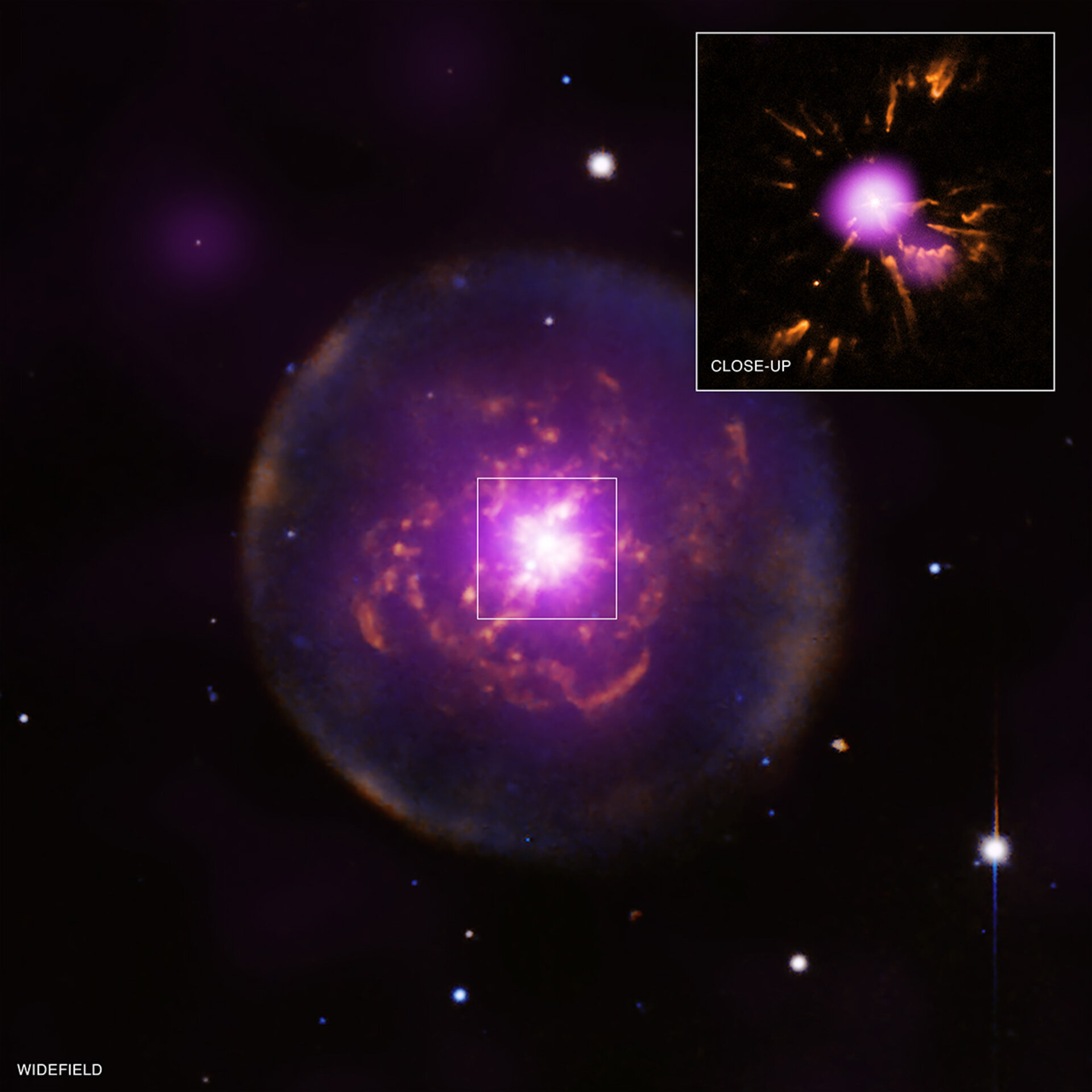
    Astronomers have found evidence for a dying Sun-like star coming briefly back to life after casting its gassy shells out into space, mimicking the possible fate our own Solar System faces in a few billion years.

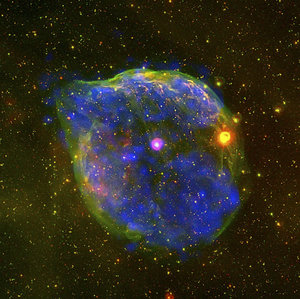
    This new picture of the planetary nebula Abell 30, located 5500 light-years from Earth, is a composite of visible images from the NASA/ESA Hubble Space Telescope and X-ray data from ESA’s XMM-Newton and NASA’s Chandra space telescopes.

    ‘Planetary nebula’ is the name given to the often-concentric shells of stellar material cast into space by dying stars. To astronomers of the 18th century, these objects looked like the colourful ‘blob’ of a planet through their telescopes, and the name stuck.

    Astronomers now know that as a star with less than eight times the mass of the Sun swells into a red giant towards the end of its life, its outer layers are expelled via pulsations and winds.

    Ultraviolet radiation shining out from the stripped-down hot stellar core then lights up the ejected shells, resulting in intricate artworks that can be seen by modern telescopes.

    The star at the heart of Abell 30 experienced its first brush with death
    12 500 years ago – as seen from Earth – when its outer shell was stripped off by a slow and dense stellar wind.

    Optical telescopes see the remnant of this evolutionary stage as a large, near-spherical shell of glowing material expanding out into space.

    Then, about 850 years ago, the star suddenly came back to life, coughing out knots of helium and carbon-rich material in a violent event.

    The star’s outer envelope briefly expanded during this born-again episode, but then very rapidly contracted again witin 20 years.

    This had the knock-on effect of accelerating the wind from the star to its present speed of 4000 kilometres per second – over 14 million kilometres per hour.

    As this fast stellar wind catches up and interacts with the slower wind and clumps of previously ejected material, complex structures are formed, including the delicate comet-like tails seen near the central star in this image.

    The stellar wind bombarding dense clumps of material provides a chilling look at the possible fate of Earth and its fellow planets in our own Solar System in a few billion years’ time.

    When our Sun emits its final gasps of life at the heart of a planetary nebula, its strong stellar wind and harsh radiation will blast and evaporate any planets that may have survived the red giant phase of stellar evolution.

    If any distant civilisation is watching with high-power telescopes at the time, they might see the glowing embers of the planets light up in X-rays as they are engulfed in the stellar wind.
    Notes for Editors

    Rate this

    Views

    Share

    • Currently 4 out of 5 Stars.
    • 1
    • 2
    • 3
    • 4
    • 5
    Rating: 4.2/5 (5 votes cast)

    Thank you for rating!

    You have already rated this page, you can only rate it once!

    Your rating has been changed, thanks for rating!

    731
    Tweet
    • Hubble's Universe
    • More about
      • Hubble overview
        • XMM-Newton overview
          • XMM-Newton factsheet
          • Related articles
            • Fire burn and cauldron bubble
              • Aftermath of a stellar explosion
                • Giant eruption reveals 'dead' star
                  • Dissecting a stellar explosion
                    • X-rays provide a new way to investigate exploding stars
                      • X-ray evidence supports possible new class of supernova
                        • Supernova leaves behind mysterious object
                          • Spirograph Nebula (IC 418)
                            • Stingray Nebula (Henize 1357)
                              • The Hourglass Nebula (MyCn-18)
                              • Related links
                              • Chandra at NASA
                              • Chandra at Harvard
                              • In depth
                              • Hubble in depth
                              • XMM-Newton in-depth
                              • Follow us
                              • ESA Sci on Twitter
                              • ESA on Flickr

    Connect with us

    • RSS
    • Youtube
    • Twitter
    • Flickr
    • G+
    • Facebook
    • Livestream
    • Subscribe
    • App Store
    • ESA Science Twitter

    Follow ESA science

    • LATEST ARTICLES
    • · Rare merger reveals secrets of gal…
    • · Watching for hazards: ESA opens as…
    • · ESA astronaut Timothy Peake set fo…
    • · Space drives e-mobility
    • · Proba-V opens its eyes
    • FAQ

    • Jobs at ESA

    • Site Map

    • Contacts

    • Terms and conditions