• → European Space Agency

      • Space for Europe
      • Space News
      • Space in Images
      • Space in Videos
    • About Us

      • Welcome to ESA
      • DG's News and Views
      • For Member State Delegations
      • Business with ESA
      • ESA Exhibitions
      • ESA Publications
      • Careers at ESA
    • Our Activities

      • Space News
      • Observing the Earth
      • Human Spaceflight
      • Launchers
      • Navigation
      • Space Science
      • Space Engineering
      • Operations
      • Technology
      • Telecommunications & Integrated Applications
    • For Public

    • For Media

      • Media
      • ESA TV
      • Videos for professionals
      • Photos
    • For Educators

    • For Kids

    • ESA

    • Space Science

    • Our Universe
    • About Space Science
    • ESA's 'Cosmic Vision'
    • Science missions
    • Mission navigator
    • Target groups
    • For Media
    • For Scientists
    • For Kids
    • Multimedia
    • Science images
    • Science videos
    • Animations
    • Downloads
    • Sounds from space
    • Resources
    • Reference section
    • Services
    • FAQs
    • Glossary
    • Help
    • Portal terms of use
    • Comments
    • Follow us
    • RSS feeds
    • ESA Sci on Twitter
    • ESA Space Science Images on Flickr
    • ESA 3D on Flickr

    ESA > Our Activities > Space Science

    First light for the Venus Monitoring Camera

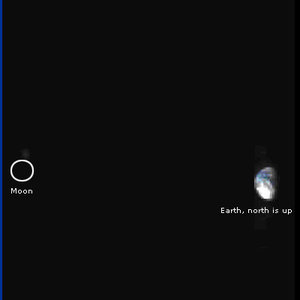
    Venus Express camera image
    First light for Venus Express camera
    30 November 2005

    This image, taken by the Venus Monitoring Camera (VMC) during commissioning of the Venus Express instruments, shows Earth and Moon from 3.5 million kilometres away.

    The exposure time was set to obtain a signal from the Moon in all four channels simultaneously. For this reason Earth is overexposed.

    The value of such images to the scientific teams is that it allows them to test and calibrate their instruments before Venus approach.

    VMC is a wide-angle multi-channel camera that will be able to take images of the planet in the near-infrared, ultraviolet and visible wavelengths. VMC will be able to make global images and will study the cloud dynamics and image the surface. In addition it will assist in the identification of phenomena seen by other instruments.

    The VMC team is led by the Max Planck Institute for Solar System Research (MPS), Katlenburg-Lindau, Germany.
    Rate this

    Views

    Share

    • Currently 0 out of 5 Stars.
    • 1
    • 2
    • 3
    • 4
    • 5
    Rating: 0/5 (0 votes cast)

    Thank you for rating!

    You have already rated this page, you can only rate it once!

    Your rating has been changed, thanks for rating!

    53
    Tweet
    • Looking at Venus
    • ESApod: Venus Express
    • Related articles
      • And now… straight to Venus!
        • Successful Venus Express main engine test
          • First light for the Venus Monitoring Camera
            • Earth-Moon observations from Venus Express
              • Venus Express performs flawlessly, LEOP complete
                • Venus Express mission operations update
                  • Venus Express en route to probe the planet's hidden mysteries
                  • More about...
                  • Status reports
                    • Venus Express factsheet
                    • Related links
                    • Venus ground-based image active archive
                    • The Venus Amateur Observing Project
                    • Venus Express operations
                    • Cebreros station webcam

    Connect with us

    • RSS
    • Youtube
    • Twitter
    • Flickr
    • G+
    • Facebook
    • Livestream
    • Subscribe
    • App Store
    • ESA Science Twitter

    Follow ESA science

    • LATEST ARTICLES
    • · The fast winds of Venus are gettin…
    • · ExoMars 2016 set to complete const…
    • · Herschel ends operations as orbiti…
    • · Europe’s largest spaceship reache…
    • · ATV ready to nose up to Station
    • FAQ

    • Jobs at ESA

    • Site Map

    • Contacts

    • Terms and conditions