• → European Space Agency

      • Space for Europe
      • Space News
      • Space in Images
      • Space in Videos
    • About Us

      • Welcome to ESA
      • DG's News and Views
      • For Member State Delegations
      • Business with ESA
      • ESA Exhibitions
      • ESA Publications
      • Careers at ESA
    • Our Activities

      • Space News
      • Observing the Earth
      • Human Spaceflight
      • Launchers
      • Navigation
      • Space Science
      • Space Engineering
      • Operations
      • Technology
      • Telecommunications & Integrated Applications
    • For Public

    • For Media

    • For Educators

    • For Kids

    • ESA

    • Launch Special

    • Herschel

    • Planck

    • ESA Science

    • About Herschel

      • Herschel at a glance
      • Science objectives
      • Herschel highlights
      • History of infrared astronomy
    • The infrared Universe

      • Why the infrared?
      • More about the infrared
      • The infrared revolution
    • Spacecraft and telescope

      • Vital stats
      • The largest infrared space telescope
      • Instruments
      • Cutting-edge spacecraft
    • The mission

      • Journey
      • Early operations
      • Operating Herschel
    • Meet the team

      • Herschel Project Scientist: An interview with Göran Pilbratt
      • Herschel and Planck Programme Manager: An interview with Thomas Passvogel
    • Multimedia
    • Herschel images
    • Herschel videos

    ESA > Our Activities > Space Science > Herschel

    Inside the dark heart of the Eagle

    Inside the dark heart of the Eagle

    16 December 2009

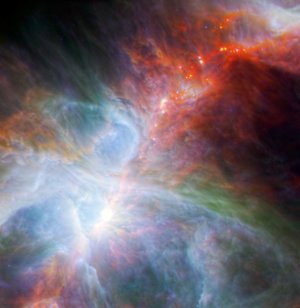
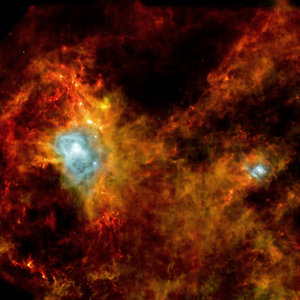
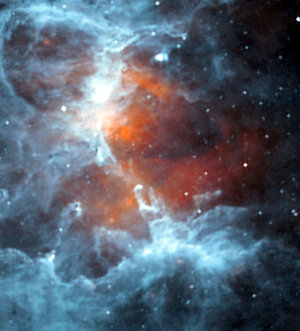
    Herschel has peered inside an unseen stellar nursery and revealed surprising amounts of activity. Some 700 newly-forming stars are estimated to be crowded into filaments of dust stretching through the image. The image is the first new release of ‘OSHI’, ESA’s Online Showcase of Herschel Images.

    This image shows a dark cloud 1000 light-years away in the constellation Aquila, the Eagle. It covers an area 65 light-years across and is so shrouded in dust that no previous infrared satellite has been able to see into it. Now, thanks to Herschel’s superior sensitivity at the longest wavelengths of the infrared, astronomers have their first picture of the interior of this cloud.

    It was taken on 24 October using two of Herschel’s instruments: the Photodetector Array Camera and Spectrometer (PACS) and the Spectral and Photometric Imaging Receiver (SPIRE). The two bright regions are areas where large newborn stars are causing hydrogen gas to shine.


    The new OSHI website that goes live today will become the library of Herschel’s best images. Stunning views of the infrared sky will be made available as the mission progresses. Each will be captioned in a way to make them accessible to media representatives, educators and the public.

    Embedded within the dusty filaments in the Aquila image are 700 condensations of dust and gas that will eventually become stars. Astronomers estimate that about 100 are protostars, celestial objects in the final stages of formation. Each one just needs to ignite nuclear fusion in its core to become a true star. The other 600 objects are insufficiently developed to be considered protostars, but these too will eventually become another generation of stars.

    This cloud is part of Gould’s Belt, a giant ring of stars that circles the night sky – the Solar System just happens to lie near the centre of the belt. The first to notice this unexpected alignment, in the mid-19th century, was England’s John Herschel, the son of William, after whom ESA’s Herschel telescope is named. But it was Boston-born Benjamin Gould who brought the ring to wider attention in 1874.

    Gould’s Belt supplies bright stars to many constellations such as Orion, Scorpius and Crux, and conveniently provides nearby star-forming locations for astronomers to study. Observing these stellar nurseries is a key programme for Herschel, which aims to uncover the demographics of star formation and its origin, or in other words, the quantities of stars that can form and the range of masses that such newborn stars can possess. Apart from this region of Aquila, Herschel will target 14 other star-forming regions as part of the Gould’s Belt Key Programme.

    Notes for editors:

    The scientific rights of these Herschel observations are owned by the consortium of the Gould Belt Key Programme, led by P. André (CEA Saclay). A total of 15 nearby star-forming regions such as Aquila will be studied as part of this Programme.

    Rate this

    Views

    Share

    • Currently 5 out of 5 Stars.
    • 1
    • 2
    • 3
    • 4
    • 5
    Rating: 5/5 (1 votes cast)

    Thank you for rating!

    You have already rated this page, you can only rate it once!

    Your rating has been changed, thanks for rating!

    254
    Tweet
    • Herschel: ESA's giant infrared observatory
    • More on Herschel First Results
    • Herschel overview
      • Notes to editors
        • Other Herschel First Science Stories
        • Online Showcase of Herschel Images OSHI
        • Herschel on YouTube
        • Inside Herschel
        • Herschel mission objectives
        • Related articles
          • Herschel spots comet massacre around nearby star
            • Fledgling stars flicker in the heart of Orion
              • A New View of an Icon
                • Herschel and Planck win the French Grand Prix
                  • Herschel finds a hole in space
                    • Herschel reveals the hidden side of star birth
                      • Herschel takes the temperature of an interstellar cloud
                        • Tracing the Milky Way’s hidden reservoirs of gas
                          • Herschel resolves the cosmic infrared fog
                            • Baby stars in the Rosette cloud
                              • Inside the dark heart of the Eagle
                                • Herschel views deep-space pearls on a cosmic string
                                  • Herschel and Planck pass in-orbit 'exam'
                                    • Herschel images promise bright future
                                      • Herschel’s daring test: a glimpse of things to come
                                        • Herschel cryocover is open
                                        • Read more
                                          • Observations: Seeing in infrared wavelengths
                                            • Why infrared astronomy is a hot topic
                                              • L2, the second Lagrangian Point
                                              • In depth
                                              • This article in depth
                                              • Herschel in depth
                                              • Herschel first science results in depth
                                              • Herschel Science Centre

    Connect with us

    • RSS
    • Youtube
    • Twitter
    • Flickr
    • G+
    • Facebook
    • Livestream
    • Subscribe
    • App Store
    • LATEST ARTICLES
    • · ESA astronaut Timothy Peake set fo…
    • · Space drives e-mobility
    • · Proba-V opens its eyes
    • · First new Galileo satellite arrive…
    • · Next destination: space
    • FAQ

    • Jobs at ESA

    • Site Map

    • Contacts

    • Terms and conditions